Filming in changing window light
You want to check during recording whether bright areas of paper and shadows still show detail. Waveform, histogram and False Color offer different ways to monitor this; the tools available depend on the model.


Start by choosing a monitor that accepts your camera’s actual output signal and is easy to see and mount at your filming position. Exposure tools can help with bright areas of paper, while focus aids such as peaking or magnification make fine fold lines easier to see. A larger or brighter display is most useful when your viewing distance or window light calls for it; manufacturers’ brightness figures don’t tell you how easy a monitor will be to see in your particular setup.
You want to check during recording whether bright areas of paper and shadows still show detail. Waveform, histogram and False Color offer different ways to monitor this; the tools available depend on the model.
You need to check the framing and fold lines while the camera is positioned above or beside your work surface. Viewing distance, screen size and focus aids all affect how clearly you can see the image.
For longer recording sessions, the connections, mounting and power supply need to work with your existing camera setup without getting in the way of your hands and paper.
A good fit if: The monitor will sit close to the camera or table and you want to keep your setup lightweight. Atomos lists the Shinobi GO as having a 5.2-inch display, an HDMI input, and focus and exposure aids.
The trade-off: The smaller screen may be less comfortable to view from further away. According to Atomos, the Shinobi GO has neither a built-in battery nor an HDMI output.
A good fit if: You want to see more of your folding area from a little further away. Portkeys lists the HD7H as having a 7-inch screen, along with peaking, histogram and False Color.
The trade-off: According to Portkeys, the HD7H panel has a resolution of 1280 × 720 pixels, so a larger screen doesn’t necessarily mean more detail.
A good fit if: Window light falls directly on your viewing position and you can’t reposition the monitor more favourably. FEELWORLD and NEEWER offer models with high brightness figures stated by their respective manufacturers.
The trade-off: Manufacturers’ figures aren’t comparative measurements taken in your lighting conditions. Also check power requirements and what’s included, particularly as the NEEWER F700 comes in different battery options.
| Priority | What to check when buying | Who it matters most to |
|---|---|---|
| Exposure in window light | Exposure aids such as waveform or False Color, as well as screen position and power supply. | When the window light changes, I want to assess bright areas of paper and shadows rather than relying on the camera screen alone. Exposure is the top priority for around 36% of consumers. |
| Camera signal compatibility | HDMI connector type, supported resolution and frame rate, and the camera setting for displaying recording information. | Before buying, I want to know whether my specific camera actually outputs a compatible signal. Around 29% of consumers prioritise connection compatibility above all else. |
| Fold lines and framing | Viewing distance, panel resolution and focus aids such as peaking or image magnification. | While folding, I need to see the lines while keeping my hands and the paper in the frame, so the screen size and resolution need to suit the viewing distance. Around 21% of consumers focus on folding details and framing. |
| Power and mounting | Compatible power source, included accessories, mounting points and cable routing. | For longer tabletop shoots, I want to plan the power and mounting so cables don’t get in the way while I’m working with the paper. Around 14% of consumers prioritise their setup and power supply. |
A monitor can accept a 4K signal and still have a lower-resolution panel. Portkeys lists the HD7H panel resolution as 1280 × 720 pixels.
Check separately which input signals the monitor supports and the native resolution of its display.
Specifications for the Viltrox DC-550 Pro II don’t confirm that a differently named DC-550 model has the same connections, features or items included.
Check the specifications against the full model name in the specific listing.
What’s included and how the monitor is powered varies by model and version. According to the manufacturer, the NEEWER F700 is available with or without a battery, while the Atomos Shinobi GO has no built-in battery.
Check which parts are included and whether they’ll work with your camera and tabletop setup.
Depending on what’s included, you may need additional accessories such as a power source, a compatible HDMI cable or a mount.
The Shinobi range includes compact monitors. The Shinobi GO and Shinobi II differ in features, including the control functions available.
The LUT5 and F6 PLUSX are HDMI monitors with different brightness figures stated by the manufacturer.
The F700 is a 7-inch monitor with HDMI loop-through for a larger view of your footage.
The HD7H is an HDMI monitor with a 7-inch screen, suited to a viewing position a little further away.
The DC-550 Pro II is a specific version in the DC-550 range, with exposure aids.
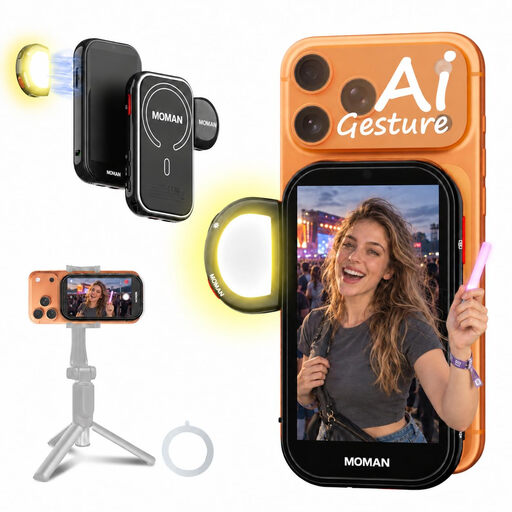
This selection includes a smartphone selfie monitor for filming with a compatible phone. It could suit a folding tutorial if you’d like to use your smartphone to monitor the image.
 No image available
For a folding tutorial filmed alone, the monitor can help you check the image when you’re using a compatible smartphone.
The product description lists wired 4K and wireless screen mirroring. Check which connection method suits your phone and filming setup.
Compatibility is listed for iPhone 7 to 17 and supported Android devices; Google Pixel devices are excluded.
No. Having a compatible HDMI socket alone doesn’t guarantee a connection. Check the output of your specific camera and the resolution and frame rate supported by the monitor. For example, the Sony ILCE-7M4 lets you choose whether recording information appears on the external display; this doesn’t confirm that the feature is available on other cameras.
It depends on the model and version you choose. Atomos states that the Shinobi GO has no built-in battery and lists NP-F or USB-C PD as power options. According to the manufacturer, the NEEWER F700 is available with or without a battery. Check what’s actually included and make sure you have a compatible power source.
No. For a consumer purchase, statutory rights generally apply against the seller; a manufacturer’s guarantee is an additional voluntary service with its own terms. The Verbraucherzentrale states that the statutory guarantee period is generally two years. For purchase contracts entered into from 31 July 2026, it describes a 12-month extension under certain conditions if you choose a repair.
For equipment covered by the EU Electromagnetic Compatibility Directive, EUR-Lex explains that CE marking is required for sale in the EU. Exceptions and any more specific rules should also be taken into account; the general rule doesn’t confirm that a particular product listing complies.