For a soldering demonstration at a small desk, a well-positioned monitor with focus peaking or magnification is a useful starting point if you want to check fine solder joints and framing. Before you buy, check your camera’s live HDMI output in the recording mode you plan to use, along with the cables, mount and power supply. Assist tools don’t guarantee sharp focus or correct exposure.
Who is an external monitor for?
Filming close-ups of soldering
If you want to check small solder joints, the tip of your tool and your framing, look for features such as focus peaking or magnification. FEELWORLD lists peaking for the F5 PROX, while Atomos lists peaking and magnification for the Shinobi II.
Filming with limited desk space
If you don’t want the monitor, mount and cables to get in the way, screen size and mounting options are important factors. Atomos lists a 1/4-inch-20 mount for the Shinobi II; a larger screen will take up more space.
Filming longer demonstrations
If you’ll be recording for a while, match the power source and what’s included to the planned recording time. Atomos specifies external power via NP-F/L-Series batteries or USB-C PD for the Shinobi II; the battery supplied with the FEELWORLD F5 PROX depends on the package you choose.
What should you look for when buying?
First, check that the camera signal is compatible with the monitor and the recording mode you’ve chosen. Then consider the space available, focus tools, exposure monitoring and power supply for your setup.
| What matters |
What to check before buying |
Who should consider it? |
| Focus and framing |
Peaking or magnification on the specific model; monitor position and visibility of the edges of the frame. |
If I want to check small solder joints and the tool tip in shot, checking focus comes first for me. Around 33% of consumers focus primarily on sharpness and framing. |
| Camera connection and desk space |
HDMI output in the planned recording mode, signal format, and suitable cables and mount. |
At a small desk, I want to see the live image without putting cables and the monitor in my work area. Around 27% of consumers prioritise connections and desk space. |
| Power supply and what’s included |
For the exact variant you’re choosing, check whether a battery, power adapter and required cables are included. |
For a longer demonstration, I want to plan the power supply in advance so it suits my setup and recording time. Around 20% of consumers prioritise battery life and what’s included. |
| Exposure and screen visibility |
Check how easy the display is to read where you plan to use it, and whether you need tools such as waveform, histogram or false colour. |
If the lighting at my soldering station changes, I want to be able to read the preview clearly and use exposure guides. Around 20% of consumers prioritise exposure monitoring and screen visibility. |
Avoiding common buying pitfalls
-
Assuming 4K HDMI means a 4K display
A monitor may accept certain 4K HDMI signals even if its panel resolution is different. Atomos lists the Shinobi II’s panel resolution as 1920 × 1080.
Check the panel resolution separately from the supported HDMI formats and the camera mode you plan to use.
-
Assuming a battery or power adapter comes in the standard package
FEELWORLD describes the standard F5 PROX accessories as a version without a battery or power adapter; battery bundles are different.
Check what’s included with the version you’ve chosen against your power source and the cables you need.
Depending on the package, you may need a suitable power source or an extra cable.
-
Choosing based on maximum brightness alone
FEELWORLD specifies a maximum brightness of 3000 nit for the LUT5. An independent review of the Desview R7II says its brightness was reduced for indoor filming; this refers to a different model and different conditions.
Start by considering the lighting and where you’ll position the display. Then weigh brightness against space, focus tools and power supply.
-
Assuming camera control is the same as HDMI image output
Touch focus and other control features on the Atomos Shinobi II require a supported camera model. HDMI image display can also depend on the camera model and recording mode.
Check control features and the live image separately for your camera model and the specific mode you plan to use.
Key brands at a glance
FEELWORLD
The models covered here range from a compact monitor with focus and exposure tools to a model that the manufacturer describes as particularly bright.
- FEELWORLD lists peaking, waveform, histogram and false colour for the F5 PROX; for the LUT5, the manufacturer specifies a maximum brightness of 3000 nit.
- The brightness figure isn’t a comparison test for your own room. The battery supplied with the F5 PROX depends on the package you choose.
Atomos
The Shinobi II is a compact option for monitoring an HDMI image, with additional camera control available if you need it.
- Atomos lists peaking, magnification, waveform and several power options for the Shinobi II.
- Touch focus and camera control require a supported camera model. Atomos says the monitor has no built-in battery.
Portkeys
According to the manufacturer, the LH5P II combines a 5.5-inch HDMI monitor with analysis tools and camera control that depends on the camera model.
- Portkeys lists peaking, waveform, false colour and a maximum brightness of 2000 nit for the LH5P II.
- Camera control is limited to supported cameras; the brightness figure alone doesn’t tell you whether the model is right for your room.
NEEWER
The F500 PRO package covered here is a bundle option with several ways to power it.
- NEEWER lists an NP-F750 battery and exposure displays for this specific package.
- Details of what’s included and the specifications for this bundle don’t necessarily apply to other F500 variants.
Desview
The R7II may suit you if a larger screen for viewing at a distance matters more than an especially compact setup.
- An independent review from 2023 describes the R7II as a 7-inch monitor.
- The review also says its brightness was reduced indoors; it doesn’t confirm that every mount is suitable.
Related products at Joybuy
The products below are larger portable displays that could work as a separate screen in a camera setup. Before buying, check that your camera output, signal format, connection and mount are all compatible. The product names alone don’t confirm compatibility with your camera.
 No image available
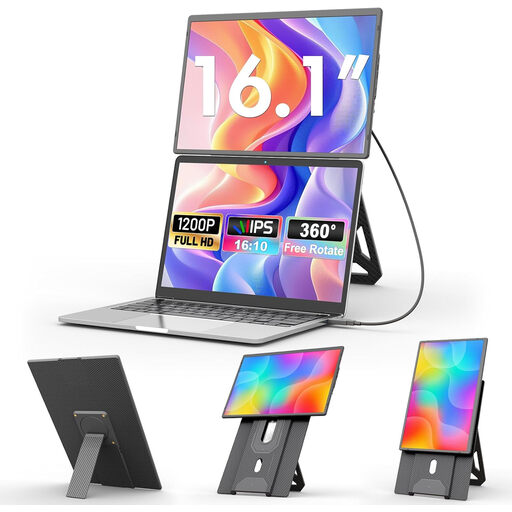
KEFEYA 16-inch FHD 1200P Portable Monitor
This 16-inch display is a larger option if you’d like more screen space and have enough room on your desk.
The product title lists a 16-inch display, FHD 1200P and a 360° rotating magnetic stand.
View at Joybuy
 No image available
Portable Monitor PM14R, 14-inch
At 14 inches, this portable display is a more compact alternative to the 16-inch models in this selection. Still, check that it will fit comfortably on your desk.
The product title lists FHD 1920 × 1200, IPS, USB-C and Mini-HDMI.
View at Joybuy
 No image available
Blackview TABLE 9, 16-inch
This portable 16-inch display may suit you if you’re planning for a larger screen and have the extra desk space available.
The product title lists a 16:10 aspect ratio, an extendable and rotating magnetic stand, and support for 100 W reverse charging.
View at Joybuy
Frequently asked questions
Will my camera definitely display an image on the external monitor while recording video?
It depends on the camera model and recording mode. Sony describes differences for certain models depending on file format, proxy recording and HDMI info display; these examples don’t automatically apply to other cameras. Test the mode you plan to use and check that the output signal matches the monitor input.
Will I need an extra battery for a longer recording?
It depends on the monitor and the version you choose. Atomos says the Shinobi II has no built-in battery and lists NP-F/L-Series batteries or USB-C PD as power options. For the F5 PROX, FEELWORLD offers a standard accessories package without a battery as well as battery bundles.
Is a 4K HDMI input the same as a 4K screen?
No. Supported HDMI signal formats and the resolution of the monitor panel are different specifications. Atomos lists the Shinobi II’s panel resolution as 1920 × 1080, so check both separately and take your camera’s output into account.
Do I definitely need an especially bright monitor for filming at a desk?
Not necessarily. What matters is whether you can read the image clearly where you plan to position the monitor, with your lighting setup. FEELWORLD specifies a maximum brightness of 3000 nit for the LUT5; that figure alone doesn’t prove it will give you better focus control or that you need this level of brightness indoors.
Will a monitor’s camera controls work with every camera?
No. Additional control features may depend on supported camera models and the connection. Atomos lists the camera models supported for touch focus on the Shinobi II. Check compatibility with your exact camera separately from basic HDMI image output.


