Who can benefit from a remote shutter release?

Photographers working from a fixed tripod position

If you photograph tableware in one spot and stay beside the camera, a compatible remote shutter release lets you press the shutter without touching the camera body. Nikon describes this option for the MC-DC2 on certain DSLR cameras with the right accessory connection.

Photographers who change their set-up

If you rearrange tableware and props between shots, a supported remote can let you release the shutter from beside your set-up. The available functions depend on the camera and remote model.

Photographers with a camera that supports an app

If you’d like to make use of what you already have, check whether you can control your camera remotely using your smartphone. Canon lists Camera Connect as an option for many Canon cameras.

What should you look for when buying?

What you need What to check before buying Who is this important for?
Compatibility with your camera Check the full camera model, compatible connection or supported remote, and any adapters required. If I’m looking for an accessory for my current camera, exact compatibility is essential. Around 36% of consumers prioritise compatibility with their camera.
Releasing the shutter from a fixed set-up Check that a compatible cable reaches where you’ll be operating it and can be routed safely around a small table. I want to release the shutter from a fixed tripod position without touching the camera when I press the button. Around 29% of consumers prioritise this.
Freedom to move while arranging your set-up Check that your specific Bluetooth remote is supported, how to pair it and which controls you’ll need. If I rearrange tableware regularly, I want to be able to release the shutter from where I’m standing beside the set-up. Around 21% of consumers say this is especially important to them.
Avoiding an extra purchase Check your camera’s manual to see whether it can already be controlled remotely using an app, and what functions are available. I want to check the remote control options for my existing camera before buying another accessory. Around 14% of consumers consider this their top priority.

Common buying mistakes

  • Choosing a remote based only on the camera brand

    A remote made by a particular brand won’t necessarily work with every camera from that brand. Fujifilm explicitly specifies an adapter for certain cameras used with the RR-100.

    Before buying, check your camera’s full model name against the compatibility list and confirm which connection it requires.

    Brands to consider

    Canon

    The BR-E1 is a Bluetooth option for specifically supported Canon cameras. Camera Connect may be an app-based alternative for many Canon cameras.

    • Canon lists shutter release, AF start and a Bluetooth range of up to 5 metres for the BR-E1.
    • This information applies to the BR-E1, not other models. Check whether Camera Connect supports your camera, too.

    Nikon

    The MC-DC2 is a cable release for certain DSLR cameras, while the ML-L7 is a Bluetooth option for supported Nikon cameras.

    • Nikon describes the MC-DC2 as letting you release the shutter without touching the camera, and lists shutter and video buttons among the ML-L7’s controls.
    • Neither model is compatible with every Nikon camera just because it’s made by Nikon. The connection or support must match your camera model.

    Sony

    The RMT-P1BT may suit cameras that support this Bluetooth remote.

    • Sony lists features including a status indicator and controls for the shutter and video.
    • Check the specific features and remote support for your camera model.

    Fujifilm

    The RR-100 is a cable option for specific X and GFX cameras listed as compatible.

    • Fujifilm’s compatibility list names specific camera models for the RR-100.
    • Some of the listed models also require a third-party 2.5 mm to 3.5 mm adapter.

    JJC

    The MA-R is a cable release option whose compatibility depends on the camera model.

    • JJC describes the MA-R as having a two-stage shutter button and requiring no battery of its own.
    • The compatibility list applies to the MA-R. It does not automatically cover the MA series or every camera from the brands listed.

Joybuy products

This product is designed for taking photos at the table with a smartphone. Its inclusion doesn’t replace checking compatibility with a camera.
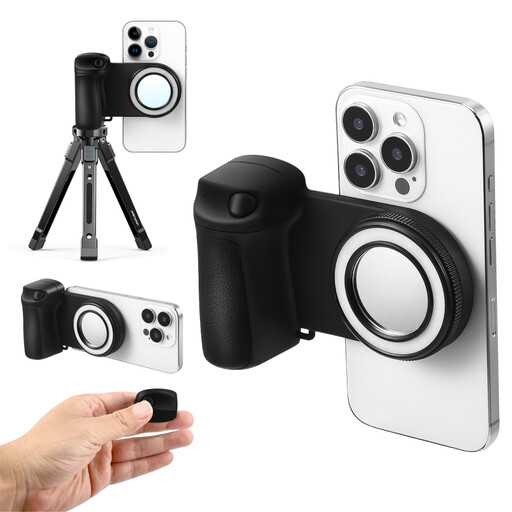
Magnetic smartphone grip with detachable remote shutter release and fill light, black

Magnetic smartphone grip with detachable remote shutter release and fill light, black

Designed for use with a smartphone. Don’t choose it as a camera remote shutter release without checking compatibility separately.

With 1/4-inch tripod thread.

View at Joybuy

Frequently asked questions

Is a remote shutter release all you need for sharp photos of tableware?

No. A remote shutter release can stop you touching the camera when you take a photo, but it won’t automatically fix other possible causes of blurry images. For a fixed set-up, Nikon describes touch-free shutter release using the MC-DC2 with compatible cameras.

How do I set up a cable release?

First, check that the cable release matches your exact camera model, then connect it to the designated socket. If you’re using a Fujifilm RR-100, check the adapter information for your model before routing the cable around the table.

Do I always need to buy an accessory for remote control?

Not necessarily: Canon describes Camera Connect as a remote control option for many Canon cameras. Check whether the app is available for your model and offers the functions you need.

What should I check about batteries and adapters?

Before ordering, check whether any required battery or adapter is included, and what terms apply with the specific seller. Canon describes the BR-E1 as battery-powered, while Fujifilm says that some RR-100 combinations require an additional third-party adapter.

Where should I take an old electronic remote shutter release in Germany?

According to the German Federal Ministry for the Environment’s guidance on the Electrical and Electronic Equipment Act (ElektroG), old electrical equipment must not be put in household waste. Take it to an authorised collection or take-back point instead. Removable used batteries should be collected separately.