For steady close-ups on a tripod, you don’t necessarily need a separate remote shutter release. First, check whether your camera has a self-timer or a supported camera app; Canon UK lists Camera Connect for a wide range of cameras. If you do need an extra accessory, a cable release is better suited to a fixed setup, while Bluetooth is more convenient if you often change position. Either way, check that it’s compatible with your exact camera model. Infrared is only an option if both your camera and shooting position are suitable.
Who can benefit from a remote shutter release?
Close-up photographers using a tripod
If you’re photographing carved ornaments up close, a compatible cable release or a remote function already supported by your camera can help you avoid touching the camera when taking a shot. Nikon UK lists half-press and full-press functions for the MC-DC3, among others.
Photographers who often change their setup
If you regularly change the subject or angle by the window, wireless control may be more convenient than a cable. The key is whether your camera supports the remote in question, as Sony UK and Nikon UK both point out.
Casual photographers
If you only take photos occasionally, check your camera’s self-timer or an app supported by the camera manufacturer before buying a separate accessory. Canon UK describes how Camera Connect can remotely control a wide range of cameras.
What to look for in a remote shutter release
Self-timer or camera app
Best when: Your camera already offers the remote control you need and you don’t require an extra device.
Things to consider: An app requires a supported camera model and a compatible smartphone. Available features may vary by model.
Cable release
Best when: Your tripod setup stays in one place and the cable connector is compatible with your camera.
Things to consider: The cable limits where you can operate the camera. The manufacturer says certain Fujifilm RR-100 combinations also need an adapter.
Bluetooth remote control
Best when: You want to move around freely while rearranging ornaments and your camera supports the specific remote.
Things to consider: Check pairing and power requirements too. Manufacturers’ range figures only apply to the models specified.
Infrared remote control
Best when: Your camera is explicitly compatible with the infrared remote in question and you can operate it from a suitable position.
Things to consider: Canon’s stated range of up to 5 metres for the RC-6 applies to that model and isn’t a general range guarantee.
| Criterion |
What to check before buying |
Who is it especially important to? |
| Compatibility |
Check your exact camera model and, where relevant, firmware version against the compatibility list. Check the connector and whether any adapters are needed. |
When I’m looking for a release for my specific camera, I check the model and connector first. Around 36% of consumers put compatibility first. |
| Taking a shot without touching the camera |
Check whether the self-timer or app will do, and whether a cable release offers the features you want, such as a half-press or lock function. |
For close-ups on a tripod, I don’t want to touch the camera body when taking a shot. Around 29% of consumers prioritise minimising camera shake. |
| Freedom of movement |
Confirm that the remote is supported by your specific model. Only rely on range figures for the combinations they apply to. |
When I often change the subject and angle by the window, I don’t want to be tied to a cable. For around 21% of consumers, wireless freedom of movement is a priority. |
| Need for extra accessories |
Check the camera’s existing features and whether you may need an adapter or batteries. |
For just a few shots, I first check whether the self-timer or a supported app will do. Around 14% of consumers want to avoid buying extra accessories. |
Buying and compatibility pitfalls
-
Assuming “for Canon” or “for Nikon” means it’s compatible with your model
Manufacturers list specific camera models. The brand alone doesn’t confirm that the connector or remote will work with your camera.
Compare the full camera model name with the compatibility list, and check the firmware, connector and adapter if needed. For certain models, Fujifilm says the RR-100 also requires a 2.5-to-3.5 mm adapter.
-
Treating Bluetooth, infrared and app control as the same thing
Each control method has different requirements. Canon has separate compatibility lists for the BR-E1 and RC-6, while Sony says you should check whether your specific camera model supports Bluetooth.
Before buying, check which type of remote control your camera explicitly supports.
-
Buying a separate release before checking the features you already have
A self-timer or app may already do the job, as long as your camera supports the feature.
First, try the features already available on your camera with your window setup.
Key camera brands: a guide
Canon
Canon offers the BR-E1 Bluetooth remote and RC-6 infrared remote, each for a range of specified camera models.
- Canon UK lists model-specific ranges of up to 5 metres for both models.
- The compatibility lists differ, so check your exact camera model.
Nikon
Nikon describes the MC-DC3 cable release and ML-L7 Bluetooth remote control for supported cameras.
- According to Nikon, the MC-DC3 offers half-press and full-press functions, as well as a lock; the ML-L7 has buttons for the shutter and video recording, among other functions.
- A remote’s features don’t mean it will work with every Nikon model.
Sony
Sony describes the RMT-P1BT Bluetooth remote control for compatible cameras with a suitable built-in receiver.
- Sony says no additional receiver is needed for this type of control.
- Sony specifically recommends checking whether your camera model supports Bluetooth remote control.
Fujifilm
Fujifilm lists the RR-100 cable release for specific X and GFX camera models.
- The published model list can help you check compatibility with your camera.
- Fujifilm says some of the listed cameras also require a 2.5-to-3.5 mm adapter.
Panasonic
Panasonic describes the DMW-RS2E cable release, which has a shutter button and video start/stop control.
- These features let you control photo and video recording via a cable.
- For cameras marked as compatible, Panasonic specifies a firmware requirement. Check the details for your camera model.
Joybuy products for camera setups and remote control
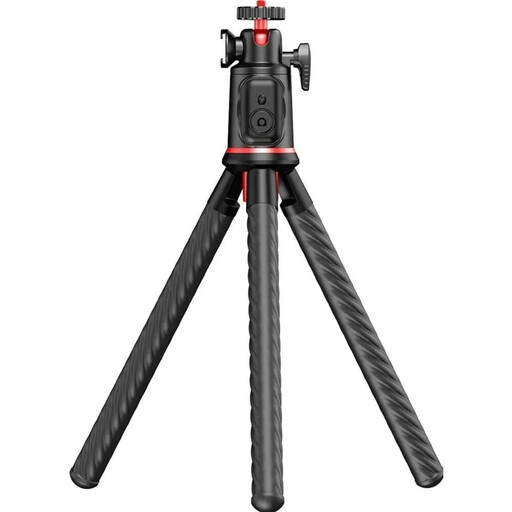
This selection pairs a Bluetooth remote for controlling a camera or smartphone with a mini tripod that you can position flexibly. Before buying, check that the remote works with your specific camera model.
 No image available
Rollei Easy Creator MonkeyPod Flexible Mini Tripod Selfie Stick with 360° Ball Head and Bluetooth Remote Control
An option if you want to combine a remote control with a flexible camera setup. Check that the remote is compatible with your camera.
Flexible mini tripod with selfie stick function, 360° ball head and Bluetooth remote control.
Maximum load: 2 kg. Do not exceed this limit, and make sure the tripod is secure before letting go.
The remote contains a button cell battery; keep it out of reach of young children.
Joybuy
Frequently asked questions about camera remote shutter releases
Do I really need to buy a remote shutter release for photographing ornaments by a window?
Not necessarily. First, check your camera’s self-timer and, if you’d like to use an app, whether it supports your model. Canon UK describes Camera Connect as a way to control a wide range of Canon cameras remotely.
How do I connect and set up a cable release?
Use the connector designed for your camera model. Nikon describes half-press and full-press functions for the MC-DC3, while Fujifilm says certain RR-100-compatible cameras also require an adapter.
What should I know about batteries?
For a battery-powered model, check the battery type and what’s included. According to the German Environment Agency, used batteries should be taken to collection boxes in shops or municipal collection points, not put in household waste.
What are my rights when shopping online in Germany?
For a typical online purchase from a trader, you generally have a 14-day right to cancel, although exceptions apply. This is separate from your statutory rights if goods are faulty or not as described. The European Union’s Your Europe website provides information about the right to cancel, and the Council of the European Union explains your rights when goods are faulty.


