Which camera options suit different needs?

For close-up detail photography

If you want to show tiny handmade textures in close-up, compare a compact camera’s close-up mode with the magnification ratio of a specific compatible macro lens. Make sure you also allow room for lighting and a stable setup. OM SYSTEM describes macro photography modes for the TG-7, while Nikon recommends using a tripod for macro photography.

For photographing entire window decorations

If you mainly want to photograph the whole decoration in the window and try different compositions, a kit with a standard zoom could be a good starting point. It won’t necessarily replace a lens designed for highly magnified details. Canon Germany, Nikon Germany and Sony Germany describe their respective kits with standard zoom lenses.

For sellers taking product photos regularly

If you’re photographing several of your own pieces with similar compositions, a fixed setup and checked white balance can help keep your photos consistent. Canon Germany explains white balance, while Nikon recommends a tripod for macro photography.

What should you look for when buying a camera?

The key question is whether you mainly want to capture the whole decoration or small surface details. OM SYSTEM lists macro photography modes for the TG-7, including a microscope mode. Nikon Germany and Sony Germany each state a maximum magnification of 1:1 for separately sold macro lenses.

What you need What to check before buying Who is this important to?
Fine surface details Check the maximum magnification ratio or dedicated close-up mode, as well as the working distance and space for lighting. If I want to show fine fibres or small decorations in close-up, the close-up capabilities of the specific camera-and-lens combination are crucial. Around 33% of consumers put magnifying details first.
Wide shots by the window Check the focal length range of the included lens and whether you have enough room by the window to get the composition you want. If I want to photograph the entire hanging decoration and its surroundings, being able to choose the right composition matters more than maximum macro magnification. Around 27% of consumers prioritise the wide shot.
Window light and colours Check whether there’s room for side lighting or an additional light, and adjust the white balance and camera position. If I’m taking photos in changing or difficult window light, I want to be able to control the colours and the front of the decoration. Around 20% of consumers focus on light and colour control.
Sharpness across multiple planes Check whether the specific model only takes focus-bracketed shots or combines multiple shots in-camera. Make sure the camera is stable. If decorations protrude by different amounts, I want as many of the important layers as possible to appear sharp. Around 20% of consumers prioritise sharpness throughout the image.

Common camera-buying pitfalls

  • Assuming a standard zoom in a kit is a fully fledged 1:1 macro lens

    A standard zoom isn’t automatically a 1:1 macro lens. The stated 1:1 magnification figures apply to separate Nikon and Sony macro lenses, not the kit zooms covered here.

    Compare the maximum magnification ratio of the exact lens included with the size you want your details to appear in the image.

    For highly magnified details, you may also need a compatible macro lens.

  • Assuming a short minimum focusing distance leaves plenty of room for lighting

    A stated minimum focusing distance doesn’t automatically tell you how much space there is between the lens and your subject. This can make it harder to position your lighting when shooting very close up.

    At the actual shooting distance, check whether there’s still enough room to light the subject without casting too many shadows.

    Depending on your setup, you may need to reposition the light.

  • Confusing focus bracketing with a finished focus-stacked image

    Focus bracketing takes photos with different focus points. Focus stacking combines several images into one with a wider area in focus. The exact feature varies by model.

    Read the feature description for the model you’re considering and check whether the images are combined in-camera or afterwards.

    If the images aren’t combined in-camera, you may need to do some extra editing.

  • Assuming what’s included and what’s covered by the warranty from the camera name

    The kit name doesn’t necessarily list every accessory included. For the Z50II kit reviewed, Nikon specifically states that the charger isn’t included. A voluntary warranty should also be distinguished from your statutory rights.

    Before buying, check what’s included and the warranty terms for the exact version.

    You may need to buy any missing accessories separately.

Camera brands to consider

OM SYSTEM

The TG-7 is a compact camera with a fixed lens and macro photography modes for close-ups without changing lenses.

  • OM SYSTEM lists a microscope mode, Focus Stacking and Focus Bracketing for the TG-7.
  • The manufacturer lists a 12 MP sensor. Check whether the framing works for the whole window decoration and whether there’s room for lighting when shooting very close up.

Canon

The EOS R50 kit reviewed pairs an APS-C body with an RF-S 18–45mm standard zoom.

  • Canon lists 24.2 MP, a vari-angle screen and focus bracketing combined in-camera for the EOS R50.
  • These specifications don’t prove that the kit zoom offers 1:1 magnification or that it performs better in backlit conditions. If you need high magnification, check a suitable lens separately.

Nikon

The Z50II kit reviewed includes a 16–50mm VR standard zoom; the NIKKOR Z MC 50mm f/2.8 is a separate macro lens option.

  • Nikon states that the NIKKOR Z MC 50mm f/2.8 has a 1:1 magnification ratio.
  • According to Nikon Germany, the charger isn’t included with the Z50II standard kit reviewed. The macro lens is separate from, and not the same as, the kit zoom.

Sony

The α6400 kit ILCE6400AKB.CEC reviewed includes a 16–50mm II power zoom; the E-mount APS-C macro SEL30M35 is a separate lens option.

  • Sony states that the SEL30M35 offers 1x maximum magnification.
  • The stated minimum focusing distance of 0.095 m doesn’t confirm the clear distance between the front of the lens and the subject. Check the lighting at the actual shooting location.

Related products at Joybuy

A selection of Joybuy cameras for photographing window decorations.
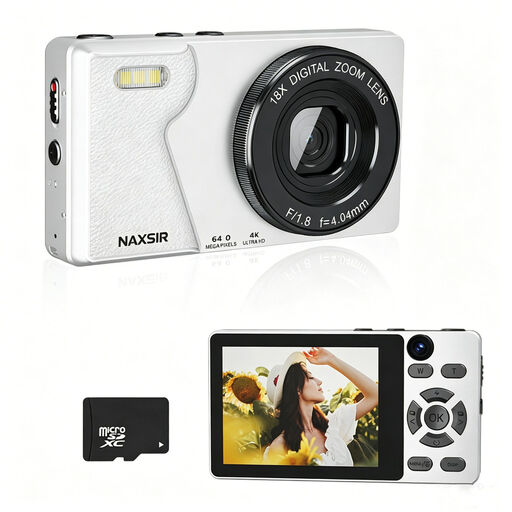
NAXSIR 4K Ultra HD digital camera

NAXSIR 4K Ultra HD digital camera, 64 MP, 18x digital zoom

The product title describes it as a digital camera; it doesn’t specify a particular macro magnification.

The title lists 64 MP photo resolution, autofocus, 4K video and 18x digital zoom.

The product title states that a 32 GB memory card is included.

View at Joybuy

Frequently asked questions

Do I need a camera with interchangeable lenses for tiny details?

No. According to OM SYSTEM, the TG-7 has its own macro photography modes, including a microscope mode. If you need a specific magnification ratio such as 1:1, check a compatible lens and camera combination. Nikon and Sony state this figure for the macro lenses mentioned here.

How do I get started photographing a hanging decoration in a window?

Keep the camera and composition as steady as possible, and check the exposure and colours when the light changes. Canon Germany describes window light as an option for product photography, while Nikon recommends using a tripod for macro photography. These are photography tips, not a requirement to buy a particular model.

What extra costs and rights should I consider when buying online?

Check whether a macro lens, tripod, lighting and, if needed, a charger are actually included. According to Nikon, the Nikon Z50II kit reviewed doesn’t include a charger. For applicable consumer purchases made at a distance, you generally have a 14-day right to cancel, although exceptions apply. Your Europe, European Union, also distinguishes this right from your statutory rights if goods are faulty and from any additional voluntary guarantees.

Can I post photos of my window decoration online if people are identifiable in the window or reflections?

The decoration itself doesn’t answer the question of identifiable people in the image. The State Commissioner for Data Protection and Freedom of Information of Rhineland-Palatinate notes that taking and using photos of people generally requires their consent or another applicable legal basis. Consider each photo and its publication separately, and check for reflections and views through the window beforehand.