
Lieferung heute & morgen

Qualitätsgarantie

Willkommens-Angebote freischalten: KOSTENLOSE Lieferung | Bis zu 80 % RABATT | Kostenlose 30-Tage-JoyPlus-Testphase
App herunterladen
The right meal can be the perfect end to a strenuous day of hiking or a relaxing evening of camping. An unreliable or unsuitable camping stove, on the other hand, can quickly lead to frustration. Many outdoor enthusiasts invest in gear that looks good on paper but proves impractical in the field. Before you make a decision, it's crucial to understand the most common pitfalls that often lead to unnecessary expenses.
To find the right portable stove for your needs, you should examine three core technical aspects. These are the primary determinants of your mobile kitchen's functionality and reliability.
The most common type is the gas stove. It's easy to use, clean, and the flame is highly adjustable. The crucial factor here is the gas canister's connection system. In Europe, the EN 417 screw thread has become the standard for most trekking and hiking stoves. These screw-on canisters are widely available and can be easily detached from the stove for transport. Cheaper piercing-cartridge systems are less flexible, as the canister cannot be removed after being punctured until it is completely empty.
A stove's power is measured in watts and determines how quickly it can bring a litre of water to a boil. For solo hikers who mainly heat water for dehydrated meals or a hot drink, a lightweight stove with moderate power (approx. 1000–2000 watts) is often the most efficient choice. For groups or more elaborate meals, models with higher power and a larger, more stable pot support are better suited. Pay attention to the total weight and pack size. A good camping cook set integrates the burner, canister, and pot into a single compact, nesting unit.
The material of the stove and pot affects both weight and durability. Aluminium is lightweight and conducts heat well, while stainless steel is more robust but also heavier. A critical feature for efficiency is the wind protection. Some systems, often referred to as gas canister stoves with a heat exchanger, have an integrated windshield and fins on the pot's base to optimise heat transfer. This significantly reduces fuel consumption and ensures reliable performance in adverse conditions.
Instead of making a one-size-fits-all recommendation, we have matched models to specific use cases.
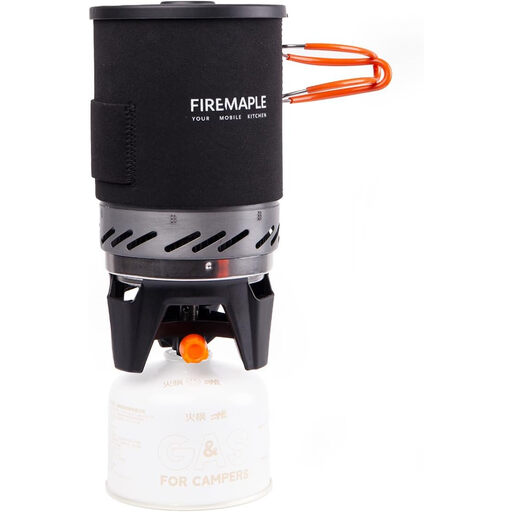
Why it's a great fit: This integrated system is designed for solo travellers who prioritise minimal pack size and maximum fuel efficiency. All components can be stowed inside the 1-litre pot, lightening the load in your backpack.
The heat exchanger technology directly counters the problem of wind susceptibility and boosts efficiency. As a complete system, it bypasses compatibility issues between the burner and pot.
Integrated wind protection via heat exchanger; all components nest inside the pot; compatible with standard screw-on canisters.
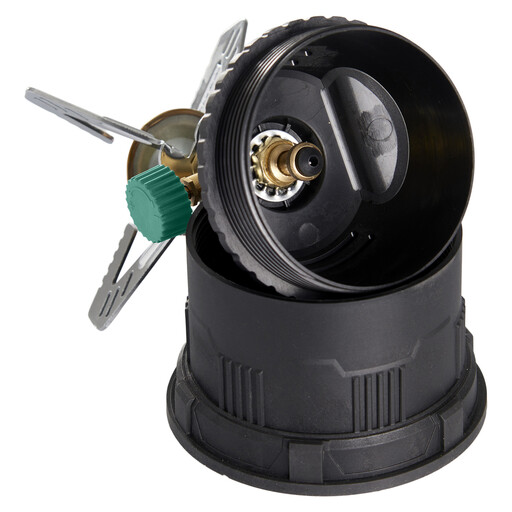
Why it's a great fit: A straightforward and affordable solution for anyone needing a reliable stove for car camping, fishing trips, or park picnics where weight is not a primary concern.
This model avoids the mistake of investing in oversized technology. It provides a solid 1.22 kW of power for simple meals without being unnecessarily complex or heavy.
Simple operation with stepless flame control; low net weight of 0.495 kg; long burn time of up to 4 hours per canister.
We've compiled a complete, up-to-date list of products that fully meet these strict selection criteria and rigorous safety standards.
The burn time of a gas canister depends on several factors: the stove's power consumption (specified in grams per hour), the chosen flame setting, the ambient temperature, and wind. As a rough guideline, a standard 230g screw-on canister can burn for about 60 to 90 minutes on a medium flame. For a solo hiker, this is often enough for 3-5 days if primarily heating water.
Stoves with an integrated system of a burner and pot that includes a heat exchanger are the most efficient in windy conditions. They protect the flame and direct heat straight to the pot's base. For conventional screw-on stoves, a separate, foldable aluminium windshield is an essential accessory to reduce fuel consumption and shorten cooking times. For safety reasons, a gas stove must never be operated inside a closed tent (risk of suffocation from carbon monoxide).
In principle, yes, as long as the pot sits stably on the stove's pot supports. However, for optimal efficiency and fast boiling, pots made from materials with high thermal conductivity like aluminium, or specialised camping pots with a heat exchanger on the bottom, are preferable. Standard household stainless steel pots are often heavier and transfer heat more slowly, leading to longer cooking times and higher gas consumption.