
Lieferung heute & morgen

Qualitätsgarantie

Willkommens-Angebote freischalten: KOSTENLOSE Lieferung | Bis zu 80 % RABATT | Kostenlose 30-Tage-JoyPlus-Testphase
App herunterladen
A camping tent needs to suit its actual use. A compact 2-person tent for a hiking trip has different requirements to a spacious family tent for several nights on a campsite. However, eye-catching marketing claims often lead to the wrong purchase: a quick pitch says little about pack size and stability, a high hydrostatic head doesn't replace carefully taped seams, and the stated capacity doesn't always account for luggage or living space.
Our selection is therefore based on verifiable specifications such as tent dimensions, weight, hydrostatic head, material, ventilation and pitch type.
A tent for "2 to 5 people" may be designed for five sleeping spots, but then offers barely any room for bags or clothing. For families and longer stays, separate sleeping and living areas are often more practical. Alongside capacity, pay attention to the internal dimensions and floor area.
Water resistance is often given as the hydrostatic head. This describes the pressure a material can withstand under standardised conditions. Actual use also depends on seam sealing, groundsheet material, guy lines, slope and pitch. A tent with PU2000 mm may be suitable for many camping conditions, but it is not automatically designed for persistent heavy rain or extreme weather.
A pop-up tent can be unfolded quickly, but when taking it down it must be folded in a specific order. Large pole constructions also require more storage space than a classic trekking tent. So check not only the pitch time, but also pack size, transport weight and folding technique.
For a waterproof tent, several components are relevant:
With a 3-season tent, you should follow the manufacturer's instructions. Such models are typically intended for spring, summer and autumn, not for heavy snow loads or extreme winter conditions.
For hikers and backpackers, a few hundred grams are noticeable. An ultralight trekking tent should therefore be as light as possible and have a small pack size. The Mobi Garden YADEEN UL2 20D is listed with a product weight of approximately 1.18 kg and a pack size of 48 × 11 × 11 cm. A classic 2-person tent with more material or a larger interior can be significantly heavier.
For car camping, picnics or family trips, weight is less critical. Here, larger interiors, a porch or a sun canopy can increase practical usefulness.
Mesh panels, opposite doors and windows support air exchange and help reduce condensation. With a camping tent with UV protection, the specific value should be stated. The Mobi Garden Automatic Pop-Up Camping Tent 155 is listed with UPF50+ protection, stated to block at least 99.9% of UV radiation. However, UV protection does not replace personal sun protection and should be complemented by choosing a suitable pitch location.
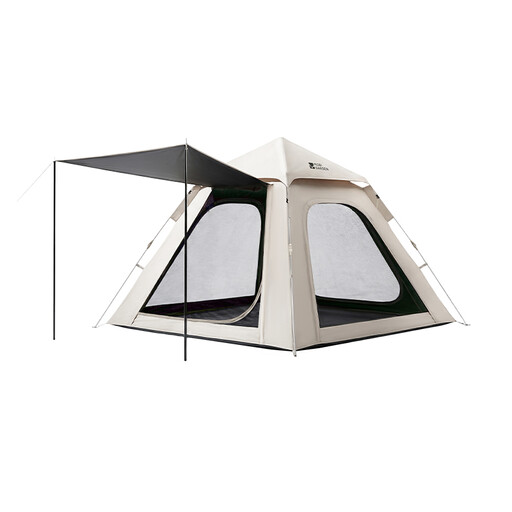
Why this product fits the profile: The stated 3-second pop-up structure is aimed at beginners and users looking for a tent for camping and picnics without traditional poles.
The product specifications list both the pack size of 77 × 15 × 15 cm and the hydrostatic head of PU2000 mm. This makes it easier to assess transport and weather protection before purchase.
240 × 240 × 155 cm internal dimensions, five-sided ventilation and stated UPF50+ sun protection.
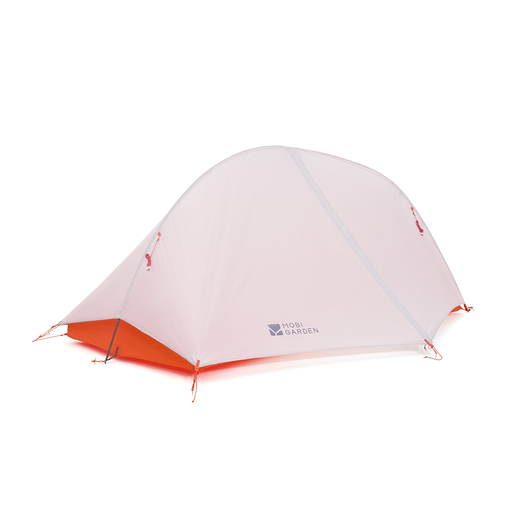
Why this product fits the profile: This model is designed for lightweight trekking, long hikes and trips with limited rucksack volume.
The low weight is complemented by specific dimensions and material details: 20D ripstop nylon, aluminium poles and PU2000 mm hydrostatic head.
Approximately 1.18 kg weight, compact carry bag, two entrances and mesh inner tent for ventilation.
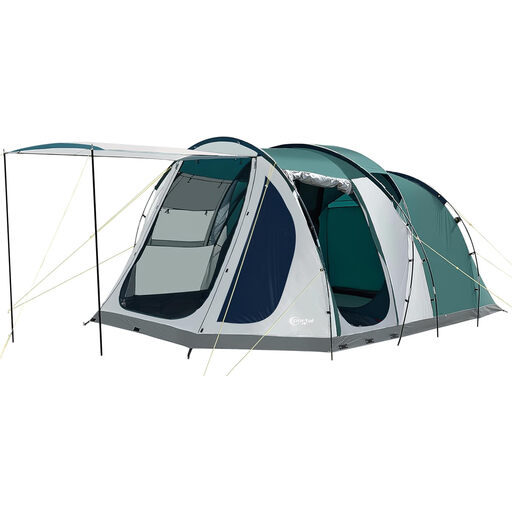
Why this product fits the profile: This tunnel tent is aimed at families and groups who need a separate living area for car camping.
The specifications clearly separate the sleeping area and living space: 7.05 m² bedroom and 5.8 m² living area. Weight and pitch time are also stated.
430 × 320 × 200 cm, stated hydrostatic head of 3000 mm, sewn-in groundsheet and multiple ventilation openings.

Why this product fits the profile: This spacious tipi tent is designed for families and groups who prefer standing height and plenty of room to move when spending time outdoors.
The large construction is complemented by specific requirements: 14 pegs and 10 guy lines are intended for pitching. The tent must be stored completely dry.
450 × 390 × 300 cm, stated hydrostatic head of 3000 mm, UV30 treatment and space for up to six people.
We have put together a complete, regularly updated list of products that fully meet these strict selection criteria and the safety regulations in force in the EU.
First, choose a level, wind-sheltered spot and remove any sharp stones or branches. Lay the tent out completely, assemble the poles according to the instructions, then secure the corners, flysheet and guy lines. The pegs should be driven into the ground at an angle away from the tent. In strong wind, additional guying is advisable.
The lifespan depends on the material, UV exposure, frequency of use and care. Allow the tent to dry completely after every use before storing it. Clean it with water and a soft cloth, and avoid machine washing, harsh cleaning agents and unnecessary pulling on the fabric. Lightweight nylon materials also require particularly careful handling on sharp ground.
Aside from the purchase price, ongoing costs are usually minimal. Relevant expenses include transport, replacement pegs, repair materials and possibly a new groundsheet. With frequent use, proper care and dry storage can help extend its service life. Open flames, cooking and smoking inside the tent should be avoided for safety reasons.