What should you look for when buying?
First, consider how noisy and busy your listening spot is. Then check the recording, audio source, fit and cable against the way you actually practise.
| What matters |
What to check when buying |
Who will find this useful? |
| Background noise and sound leakage |
Try a quiet passage with closed-back headphones and check the fit of the ear pads; make sure sound doesn’t leak out within earshot of others. |
If conversations drown out quiet passages, I want to hear them without continually turning up the volume. Around 33% of consumers say isolation is their main concern. |
| Following notes and phrasing |
Listen to the same familiar solo passage repeatedly at a moderate volume and check whether you can still make out note attacks and transitions. |
When I’m learning a solo by ear, I want to follow the sequences of notes and phrasing in my recording. Around 27% of consumers put this listening goal first. |
| Connecting to your audio source |
Check the plug type, whether you need an adapter, the cable route and the usable volume headroom on your own device. |
When I practise with a smartphone, player or laptop, I need a connection that works with my device. Around 20% of consumers say this is their main concern. |
| Comfort, portability and wear |
Check the fit with your guitar and, if relevant, glasses, as well as the cable route; make sure the specific model folds and has suitable replacement ear pads available. |
When I practise for longer and have little luggage with me, I look for a comfortable fit and consider how easy the headphones are to pack. Around 20% of consumers prioritise comfort, pack size or replaceable parts. |
Joybuy products for mobile monitoring
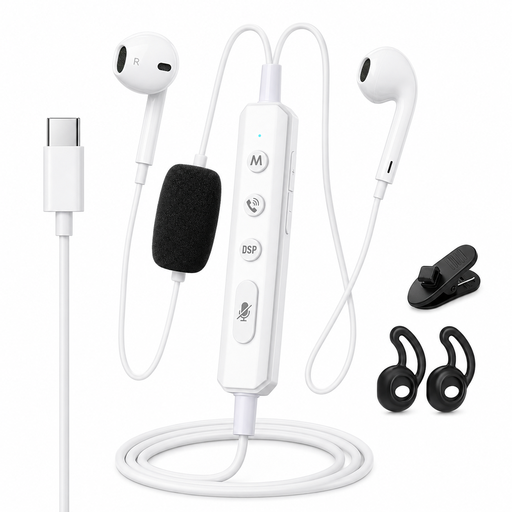
This selection includes wired headphones with a Type-C connection and a sound card for real-time monitoring.
 No image available
VoxorAI KM08 White, wired headphones with sound card for real-time monitoring
This model is worth considering for repeated listening if your audio source has a compatible Type-C connection and you want to use the monitoring function.
The product description lists Type-C compatibility, a 1.2 m cable and support for smartphones, tablets and computers. Check the connection and usable volume on your own audio source.
Joybuy
Frequently asked questions
Do I need to choose closed-back headphones to pick out a solo?
No. If there’s distracting campsite noise or other people sitting nearby, a well-fitting pair of closed-back headphones is an obvious place to start. In a quiet spot, open-back headphones may also work.
Can I connect the headphones directly to my existing device?
Compare your device’s headphone output with the plug and, if necessary, adapter for the specific model. Whether the combination gives you a suitable level for your recording depends not only on impedance, but also on sensitivity, output and recording level.
How can I practise a difficult passage without simply turning up the volume?
First, find as quiet a place to listen as possible, then check the fit and isolation. Listen to short passages repeatedly at a moderate volume and match them on your guitar; ear training relies on focused listening and practice. High sound levels can damage your hearing.
What should I check for transport and care?
For the specific model, check whether it folds, how the cable sits while you play and whether suitable replacement ear pads are available. For example, the detachable cable on the DT 770 PRO X isn’t compatible with the 80-ohm DT 770 PRO.
Are quiet hours the same at every campsite in Germany?
Quiet hours may be governed by state, local authority and site rules; the Federal Ministry for the Environment refers to these different levels of regulation. Check the rules for the specific campsite. Headphones won’t make an unamplified guitar silent.


