Which option is right for you?

Photographers with a fixed candle set-up

If you’re taking close-ups with your camera on a tripod and want to avoid touching it when you take the shot, start by checking the self-timer and the features available for your model. Canon UK lists Camera Connect as a possible remote-control option for many supported Canon cameras. A wired release must be compatible with your camera’s connector.

Styling candles on set

If you move candles and props around between shots, a compatible Bluetooth remote can let you take photos without a cable. Sony describes the RMT-P1BT as suitable for supported cameras with a built-in Bluetooth receiver. Check that your exact camera model is supported.

Photographers planning a series of shots

If you’re planning to use specific intervals or long exposures, compare the features you need with your camera’s settings. Nikon lists interval shooting and long-exposure support for the MC-36a; the connector must also be compatible with your camera.

What to consider when choosing

Self-timer or camera app

Best if: your subject stays still and you don’t need to take the shot remotely at a precise moment after setting everything up.

Things to consider: An app is only an option if your camera supports it. With the self-timer, you can’t choose the moment to take the shot spontaneously using a remote.

Wired remote shutter release

Best if: you’re working with a fixed tripod set-up and your camera supports the wired release’s connector.

Things to consider: The cable limits where you can operate the camera from. For example, Canon lists an N3 connector and an 80 cm cable for the Canon RS-80N3.

Bluetooth remote

Best if: you want to take photos wirelessly while moving candles and props around, and your camera supports that particular model.

Things to consider: You’ll need to set up the connection, and compatibility depends on both the camera and the remote.

Timer or interval remote

Best if: you’re planning repeated shots or a specific long exposure.

Things to consider: Extra features may be unnecessary for individual candle photos if your camera can already handle the type of shoot you have in mind.

Buying consideration What to check before buying Who should pay particular attention
Camera compatibility Check your full camera model against the manufacturer’s compatibility list. For wired releases, check the connector and whether an adapter is needed. If I want to avoid buying a release that won’t fit my camera, I’ll check the model and connector first; around 36% of consumers put compatibility first.
Taking photos with the camera on a tripod Check whether the self-timer or a supported app will do the job. If not, check the wired connection and make sure the cable can be routed safely. If I don’t want to touch the camera for a close-up, being able to take the shot reliably with my fixed set-up is essential; around 29% of consumers prioritise a shake-free single shot.
Freedom of movement on set Check support for your exact camera model, as well as the connection and how the remote works from where you plan to use it. If I’m moving candles or props around, I want to be able to take photos without a cable; around 21% of consumers prioritise this freedom of movement.
Intervals or long exposures Check that the remote has the specific timing features you need and compare them with your camera’s features. If I’m planning a series of shots at set intervals or a specific long exposure, I need the right features; around 14% of consumers prioritise timing controls.

Common buying mistakes

  • Choosing based only on camera brand

    Even cameras from the same brand can have different connectors and support different remotes. Fujifilm, for example, lists an additional adapter for the RR-100 with certain cameras.

    Before buying, check your full camera model against the manufacturer’s information. For a wired release, check the connector and whether an adapter is needed. For a wireless remote, check that your camera model is explicitly listed as compatible.

  • Choosing a more expensive release to fix artificial-light flicker

    A remote shutter release lets you take a photo without touching the camera. Bands or colour shifts caused by certain artificial light sources are a separate issue.

    Check your lighting and the camera settings available for dealing with it, independently of your choice of remote.

  • Assuming you’ll need timer features for every product photo

    Interval and long-exposure features only matter if your planned shoot actually requires them.

    First check whether your camera already has the feature you need, then choose a compatible release.

A guide to relevant brands

Canon

Canon lists wired and Bluetooth remote shutter releases, as well as Camera Connect as a possible alternative for supported cameras.

  • According to Canon, the RS-80N3 has an N3 connector and an 80 cm cable; the BR-E1 uses Bluetooth.
  • Compatibility depends on the specific EOS model and the remote you choose.

Nikon

Nikon offers camera-specific wired releases for tripod photography, as well as models with additional timing features.

  • Nikon describes the MC-DC2 as a way to operate certain cameras without touching the camera body. The MC-36a offers interval shooting and long-exposure support.
  • You can’t assume the releases are interchangeable just because they’re from the same brand; check your camera’s connector.

Sony

The RMT-P1BT is a Bluetooth remote for supported Sony cameras.

  • According to Sony, it uses the camera’s built-in Bluetooth receiver, so you don’t need a separate receiver.
  • This doesn’t mean it works with every Sony camera model.

Fujifilm

Fujifilm lists the RR-100 as a wired option for specified X and GFX cameras.

  • The manufacturer’s list names the camera models compatible with the release.
  • For some combinations, Fujifilm specifies an additional 2.5 mm to 3.5 mm adapter.

Panasonic

The DMW-RS2E is a wired release for compatible LUMIX set-ups.

  • For certain combinations, Panasonic also lists a start/stop button for video.
  • According to Panasonic, some combinations require a firmware update; check the information for your camera.

Joybuy product selection

This product selection is for hands-free photography with a smartphone at your candle set-up. If you’re using a separate camera, check that the remote is compatible with it.
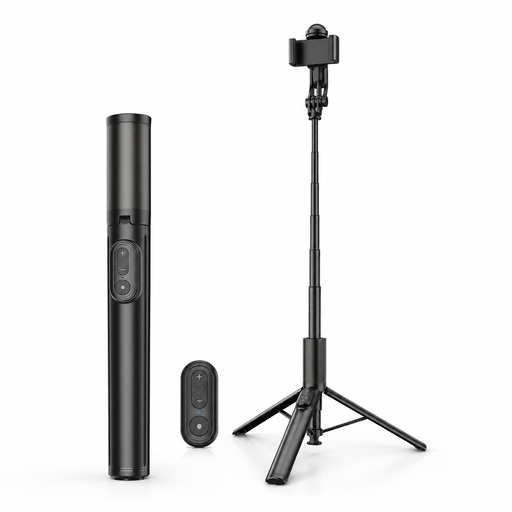
Verbex K60 Black selfie stick with smartphone holder and remote control

Verbex K60 Black Selfie Stick

For taking photos and videos with your smartphone when you want to work hands-free at your candle set-up. The product description lists a Bluetooth remote with a range of around 10 m and compatibility with iOS and Android. The smartphone holder is designed for devices up to 6.0 inches.

Joybuy

Frequently asked questions

Will a remote shutter release remove bands or colour shifts caused by artificial light?

No. A remote shutter release lets you take a photo without touching your camera. Canon Academy describes flicker under certain artificial light sources as a separate issue, so check your lighting and supported camera settings independently.

How do I set up a wired release for my candle set-up?

First, check your camera model and connector against the manufacturer’s information, then test the release before starting your photo series. Position the cable so you won’t catch or pull it while arranging your set. According to the manufacturer, some cameras also require an additional adapter for the Fujifilm RR-100.

How do I set up a Bluetooth remote?

First, check whether your camera supports the exact remote model, then set up the connection by following the instructions. Once connected, test that the shutter and any controls you need work from where you plan to use the remote.

What should I know when buying online if the release doesn’t fit or is faulty?

The Verbraucherzentrale explains that consumers generally have a 14-day right to cancel online purchases, starting from the day they receive the goods. Exceptions may apply, and the specific contract should be checked. If an item is faulty, statutory consumer rights against the seller are separate from any voluntary guarantee.

What should I look for in a wireless remote sold in the German market?

As part of its market surveillance, the Bundesnetzagentur checks factors including CE marking, whether the product can be identified and whether the manufacturer’s details are correct. CE marking is the manufacturer’s declaration of conformity, not an award for photographic quality.