Use the oven you already have if you can rely on being able to use it and your baking dish fits. Buying your own mini oven is mainly worth considering if you want to bake independently and have a suitable place to put it. Measure your dish, including the handles, and compare it with the usable internal dimensions. Also check the appliance’s external dimensions and installation guidance, as the stated capacity in litres alone won’t tell you whether it will fit.
Who might want their own mini oven?
Shared-house cooks with their own baking dish
If you want to bake cannelloni in a particular dish, first check its external dimensions, including the handles and height. Comparing them with the usable internal dimensions is the only way to find out whether it will fit in the specific appliance.
Occasional bakers who want to be independent
Your own mini oven could be a good option if you don’t want to depend on the shared oven being free. But only plan to buy one if your limited worktop space has a suitable spot for it.
Cooks catering for several housemates
If you make larger bakes, compare the usable cooking-space dimensions and heating functions. The stated capacity alone won’t tell you whether your dish will fit.
What should you look for when buying?
Use the oven you already have
A good fit if: the shared oven is reliably available and your baking dish fits inside.
The trade-off: You’ll need to agree oven times and cleaning arrangements with your housemates.
Compact mini oven
A good fit if: you want to bake independently and make smaller portions, and you have a suitable dish and space for the appliance.
The trade-off: A smaller cooking space may limit the size of baking dish you can use.
Larger mini oven
A good fit if: you often make larger bakes and have enough room for a bigger appliance.
The trade-off: A larger capacity doesn’t guarantee that every dish will fit or that you have a suitable place for the appliance.
If you’re making cannelloni in a shared kitchen, these four questions can help you work out what matters most when buying.
| Priority |
What to check when buying |
Who will find this important? |
| Will my baking dish fit? |
Measure the dish externally, including the handles, and compare it with the internal dimensions, shelf height and clearance needed for air circulation. |
If I want to use my own dish, I’ll check its dimensions and the shelf height first; around 36% of consumers put fit at the top of their list. |
| A safe place to put it |
Check the external dimensions and installation guidance, and consider the condition of the cable and socket as well as the shared worktop space. |
If I want to put an appliance on a shared worktop, I need a suitable space and clear installation requirements; around 29% of consumers say finding a place for it is their main priority. |
| Baking independently |
Check that the heating function suits your recipe, and weigh up how often the existing oven is available against the space needed for your own appliance. |
If I don’t want to depend on the shared oven being free, having my own appliance matters; around 21% of consumers name independent use as their main reason for buying. |
| Cleaning and running costs |
Check which parts can be removed and read the cleaning instructions; compare energy consumption only for similar baking tasks. |
If cleaning after baking and running costs matter most to me, I’ll consider both before buying; around 14% of consumers put these factors first. |
Avoid common buying mistakes
-
Choosing based only on litres or the supplied tray
The capacity or tray dimensions won’t tell you whether a rectangular cannelloni dish, including its handles and height, will fit in the usable cooking space.
Measure your dish externally and compare its dimensions with the internal space, shelf height and air-circulation guidance for the specific model.
If the cooking space is tight, you may need a different baking dish or an extra batch.
-
Assuming a mini oven will always use less energy
The rated power alone doesn’t provide a reliable comparison of electricity costs; what matters is how much energy the appliance actually uses when baking.
Compare energy-consumption figures only for similar baking tasks, and consider how often you can actually use the shared oven.
-
Planning to use an appliance without a suitable place for it
The external dimensions won’t automatically account for the installation requirements of a particular model or the conditions in a shared kitchen.
Before buying, check the manual, the space available and the condition of the electrical connection. The VDE advises against continuing to use appliances that are faulty or have damaged parts.
A guide to the key brands
Steba
According to Steba, the freestanding KB M19 has a 19 l cooking space; its stated internal dimensions are 31 × 25.5 × 23.5 cm (W × D × H).
- Steba lists top and bottom heat, switchable fan-assisted cooking and a removable crumb tray.
- You can’t tell whether a rectangular baking dish will fit from the capacity alone; check its dimensions, including the handles.
Caso
CASO Design gives the TO 26 SilverStyle a capacity of 26 l and internal dimensions of 35 × 30 × 20 cm.
- CASO Design lists fan-assisted cooking, top and bottom heat, and a removable crumb tray.
- The manufacturer gives the external dimensions as 48 × 40 × 30 cm (W × D × H); compare these with the space you have and the installation guidance.
Rommelsbacher
The manufacturer lists the BGE 1580/E as having a 30 l capacity and several heating functions, including switchable fan-assisted cooking.
- Rommelsbacher lists a removable crumb tray and a door that can be dismantled for cleaning.
- A larger stated capacity doesn’t confirm that your dish will fit or that you have a suitable place for the appliance.
Severin
According to Severin, the TO 2067 is a 20-l baking and toasting oven, also described as suitable for bakes.
- Severin says you can select top and bottom heat.
- Severin doesn’t list a fan-assisted function for this model, so check whether it has the heating function your recipe calls for.
Joybuy picks for independent baking
This selection from Joybuy includes mini and compact ovens for anyone who wants more independence when baking. Before buying, compare your baking dish’s dimensions with the cooking space and check that you can position the appliance safely.
 No image available
Woltu BF12sz mini oven, 32 l
Could suit independent baking if your dish fits inside; check the internal dimensions before buying.
Listed in the product name: 1600 W, timer, removable crumb tray and a temperature range of 100 to 250 °C.
View at Joybuy
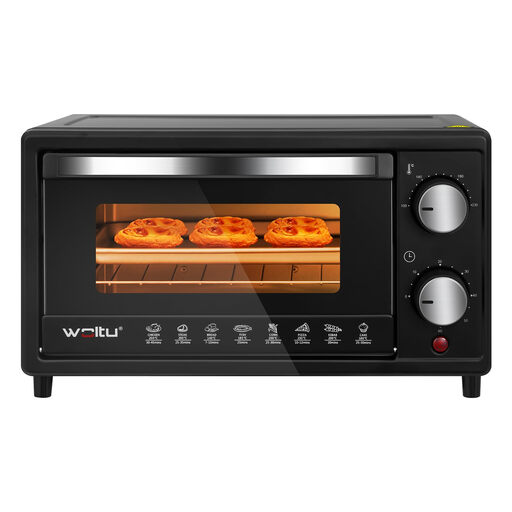 No image available
Woltu mini oven, 10 l, with pizza function
Could be an option for smaller bakes if your dish fits inside; the low stated capacity doesn’t remove the need to check the dimensions.
Listed in the product name: 10 l and a temperature range of 100 to 230 °C.
View at Joybuy
 No image available
Woltu mini convection oven, 28 l
Could be worth considering for larger bakes if the cooking space and footprint suit your kitchen; check whether your dish will fit by comparing the specific dimensions.
Listed in the product name: 28 l, temperature control and timer.
View at Joybuy
 No image available
HAUSWIRT C40 smart convection oven, 35 l
Could suit larger bakes if the appliance fits in the space you have and your dish fits inside.
Listed in the product name: thermometer, four-level baking rack and LED display.
View at Joybuy
 No image available
OIMIS smart stainless-steel air fryer toaster oven combo, 30 l
Could be suitable for independent baking if your dish fits inside; the listed features don’t confirm that it will.
Listed in the product name: 1800 W, 21 presets, rotisserie and dehydrator functions; designed for pizzas up to 13 inches.
Keep flammable materials such as curtains or wooden tables away while the appliance is in use, and clean the cooking space after each use.
View at Joybuy
Frequently asked questions
How can I check whether my cannelloni dish will fit in a mini oven?
Measure the dish’s external dimensions, including the handles, as well as the height of the filled dish. Compare these with the specific model’s usable internal dimensions, shelf height and air-circulation guidance. The stated capacity in litres alone won’t tell you whether it will fit.
What temperature and heating function do cannelloni need?
This depends on the recipe and the oven’s functions. Check that the appliance has the heating function specified, and follow the recipe and the instructions for your particular model when setting the temperature and cooking time.
What should I consider when setting up and looking after an appliance in a shared kitchen?
Follow the setup and cleaning instructions for the specific appliance, and check that the shared space is suitable for it. Check the cable and appliance for damage; the VDE advises against continuing to use appliances with damaged parts or faults. A removable crumb tray doesn’t replace cleaning the cooking space.
Can I compare electricity costs directly using the rated power or energy label?
No, rated power alone isn’t a reliable way to compare costs. The German consumer advice centre recommends looking at actual energy consumption; the European Commission excludes small and portable ovens from the scope of the relevant energy labelling rules for ovens.
What warranty rights apply when buying a new oven?
If you buy from a business seller in the EU, the European Commission’s consumer information says you’re entitled to a minimum two-year legal guarantee from the date you receive the goods. An additional manufacturer’s guarantee can’t reduce these legal rights; for service queries, check who your contractual partner is.


