For anyone planning their lunch carefully
You want to choose a roll whose crust and texture work well with the filling. Information about proving time or how it’s made can help you choose, but the name alone won’t determine whether you like it.


For a special university canteen lunch, choose a roll based on whether you want a freshly bought variety, one explicitly labelled wholemeal or a hearty multigrain option. Multigrain doesn’t automatically mean wholemeal, so check the ingredients and allergen information for each variety. If you’re shopping between appointments, it’s also important to know whether the roll is ready to eat or needs baking first.
You want to choose a roll whose crust and texture work well with the filling. Information about proving time or how it’s made can help you choose, but the name alone won’t determine whether you like it.
If you’re specifically looking for wholemeal, check that it’s explicitly labelled as such rather than relying on a dark crust or the word ‘multigrain’. The German Nutrition Society makes the same recommendation.
What matters is the information for the specific roll and, where relevant, its filling. Seeds or several types of grain in the name are no substitute for ingredient and allergen information.
First decide which feature matters most for your university canteen lunch. Then check the information for the specific variety and make sure buying and preparing it will fit into your lunch break.
| Criteria | What to check | Who it matters to |
|---|---|---|
| Flavour and texture | Choose a crust and crumb structure to suit your planned filling; check information about the dough-making process for the specific variety only. | If the filled roll is going to make my lunch special, flavour and texture come first for me. Around 33% of consumers put this at the top of their list. |
| Wholemeal | Look for the explicit ‘wholemeal’ label; ‘multigrain’ and a dark colour aren’t enough. | Before a long afternoon at university, I want to choose a wholemeal roll deliberately rather than relying on its colour. For around 25% of consumers, wholemeal is the main criterion. |
| Ingredients and allergens | Check the information for your chosen variety and filling separately; look out for ‘may contain’ warnings if needed. | If I need to avoid certain ingredients, I need reliable information about the exact roll I’m choosing. Checking allergens and ingredients is a priority for around 25% of consumers. |
| Buying and preparation | Check whether you’re buying fresh or bake-at-home rolls and how much time you have before eating. | Between two events, I want to have lunch without having to find unexpected time to use the oven. A quick, predictable routine is the priority for around 17% of consumers. |
A multigrain roll can contain several types of grain without being a wholemeal roll. The German Nutrition Society advises checking for the explicit ‘wholemeal’ label.
If wholemeal is your main buying criterion, check the label first, then choose your variety and filling.
Grains and seeds can contain allergens that are relevant to your choice. You can’t judge a roll just by its name, even if it looks plain.
For packaged products, check the current packaging. For loose rolls, ask for allergen information about the specific variety, and check any filling separately.
Frozen or part-baked rolls need to be prepared before you eat them. EDEKA’s multigrain roll, for example, is designed to be defrosted and then baked.
Check the preparation instructions before you buy. If you want to eat straight away, choose a roll that’s ready to eat instead.
Bake-at-home rolls need time before your break and access to an oven.
The ranges at in-store bakeries and specialist counters can vary from branch to branch. So a general list of brands won’t tell you which rolls you’ll find on your way to the canteen.
If you need a particular variety for lunch, check the branch you can get to and have a suitable alternative in mind.
REWE positions Feine Welt as a range for special meals. Whether a suitable roll is available depends on the specific branch and variety.
A possible supermarket option if you can check the ingredients of a specific multigrain variety and allow time to bake it.
Lidl combines an in-store bakery with Deluxe, a brand positioned as a premium range.
ALDI Nord lists different types of rolls under MEIN BESTES, including wheat and wholemeal varieties.
ALDI SÜD lists a range of fresh and packaged rolls on its range pages.
A bakery option if you can buy a ready-to-eat roll shortly before your lunch break.
A regional specialist bakery option if there’s a branch on your way to the canteen.
This Joybuy selection includes multigrain and Kaiser rolls for baking at home. It’s suitable for a university canteen lunch if you can plan the preparation before your break; if you need something to eat straight away between appointments, a ready-to-eat option is more practical.
 No image available
A multigrain option if you’re preparing lunch in advance and can bake the rolls before eating.
Multigrain alone doesn’t confirm that the rolls are wholemeal. If that matters to you, check the wholemeal label and the ingredients and allergen information on the current packaging.
 No image available
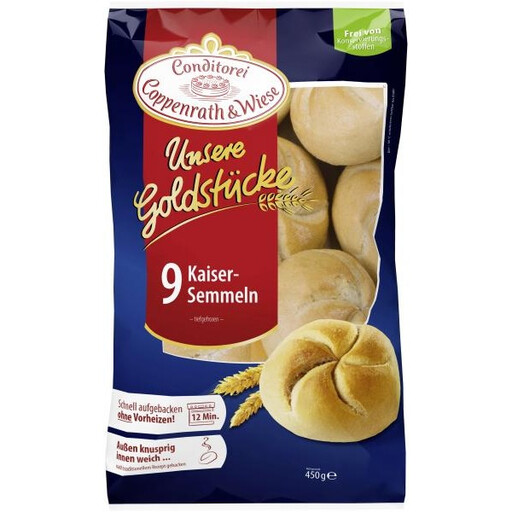
The pack of nine Kaiser rolls is worth considering if you’re planning several meals and can bake them before eating.
For an impromptu lunch, you’ll need to factor in the time needed to bake them in the oven. Check the current packaging if wholemeal labelling or allergens are important to your choice.
Look for the explicit ‘wholemeal’ label on the product or packaging. The German Nutrition Society points out that a dark colour or the label ‘multigrain’ isn’t enough.
Yes. In Germany, allergenic ingredients must also be declared for loose products, as explained by the Lower Saxony State Office for Consumer Protection and Food Safety. Ask for information about the specific variety and, if you’re having a filled roll, check the filling too.
No. The term ‘multigrain’ doesn’t indicate whether a roll is suitable for someone with a particular allergy. Check the ingredients and allergen information for the roll you choose, as well as any ‘may contain’ warnings and the filling, if applicable.
Until you’re ready to eat them, store them at room temperature in a dry place away from light, as recommended by the consumer advice centre for bread and rolls. If you buy them in the morning, plan how you’ll transport them and when you’ll add the filling.
If you’re looking for a particular variety, check local availability and the current packaging. EDEKA notes that its multigrain roll may not be available in every store and that packaging information can differ from the product page.