
Lieferung heute & morgen

Qualitätsgarantie

Willkommens-Angebote freischalten: KOSTENLOSE Lieferung | Bis zu 80 % RABATT | Kostenlose 30-Tage-JoyPlus-Testphase
App herunterladen
High-quality car ambient lighting can transform the driving experience, lending the interior a personal, modern touch often found only in luxury vehicles. However, the market for aftermarket kits is vast and confusing. Many products promise easy installation and impressive effects, but in practice, the same flaws often lead to disappointment and wasted money. Before you make a decision, you should know the typical pitfalls.
The 3 Most Common Problems with Budget-Friendly Retrofit Kits:
To avoid these problems, you should base your choice on objective technical features. Three parameters are of central importance.
The electronics in passenger cars operate on direct current (DC) of 12 volts. Any lighting system you retrofit must be explicitly designed for this voltage. Look for products that allow for a direct connection to the cigarette lighter or a secure connection to the fuse box. Systems designed for household use with 230V alternating current (AC) or 5V USB power are unsuitable and potentially dangerous without proper, safe voltage converters.
The method of light generation significantly determines the visual quality. There are two fundamental technologies here:
Modern systems offer flexible control options. Car interior lighting with an app is standard today and usually offers the greatest range of functions. Check if the app is available for iOS and Android and supports features like colour changing, brightness control, scheduling, and music synchronisation. An additional physical remote can be practical for quickly operating basic functions without a smartphone.
Instead of making a blanket recommendation, we have identified products tailored to different user profiles and requirements.

Why This Fits Their Persona: This kit is specifically designed to retrofit a starlight headliner in a car. It is aimed at users who aspire to the luxurious look of high-end vehicles and are willing to undertake a more involved installation for a stunning result.
By using hundreds of individual optical fibres, it achieves an authentic and non-uniform distribution of points that cheap LED strips cannot imitate. The system is explicitly designed for 12V operation in a car.
Authentic star effect through fibre optic technology. Control via app and remote. Music synchronisation for dynamic effects.

Why This Fits Their Persona: Ideal for hobbyists looking for a comprehensive and customisable solution. The 18-in-1 set includes light strips for the dashboard, doors, door handles, storage compartments, and car footwell lighting, enabling complete illumination of the interior.
The use of acrylic light guides ensures homogeneous light distribution without hotspots. The system is designed as a complete 12V kit, which ensures compatibility. Control is centralised via an app.
Comprehensive set for full interior lighting. Uniform light appearance thanks to acrylic strips. App control with Dreamcolor effects (multiple colours simultaneously).
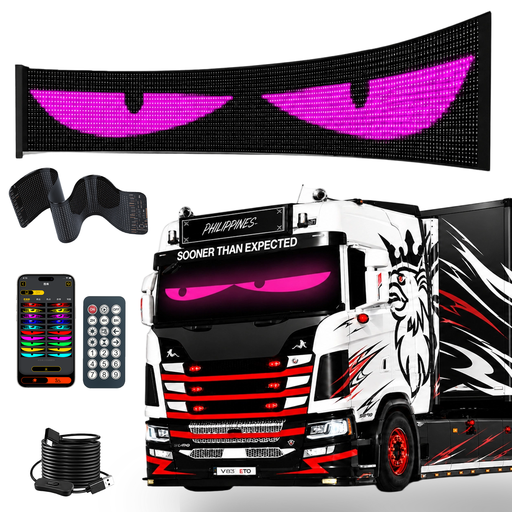
Why This Fits Their Persona: For drivers seeking a striking yet easy-to-install external solution. This flexible LED display attaches to the windscreen and serves more as a programmable showpiece than as classic ambient lighting. Perfect for meetups and events.
This product bypasses typical installation problems as it is not permanently integrated into the trim. It is powered by USB and designed as a standalone module, which minimises compatibility issues with the vehicle's electrical system.
Very simple installation with no interference with the vehicle's electronics. Programmable text and animations via app. Waterproof construction (according to IP65).
We have compiled a complete, up-to-date list of products that fully meet these strict selection criteria and safety regulations.
The effort varies greatly depending on the system. Simple sets for car footwell lighting or USB-powered displays are often installed in minutes (plug-and-play). Comprehensive fibre optic systems that are inserted into the gaps of the dashboard and door panels require more patience and a delicate touch. Retrofitting a starlight headliner is the most complex, as this usually requires removing the headliner.
No. Modern LED interior lighting is extremely energy-efficient. The power consumption of a complete ambient system is typically very low, comparable to that of a mobile phone charger. When the engine is running, the load on the alternator and battery is negligible. However, when the engine is off, the lights should not be left on for many hours to avoid draining the battery.
Local traffic regulations often govern permissible vehicle lighting. As a general rule, interior lighting is allowed as long as it does not distract or dazzle the driver and does not emit light outwards that could irritate other road users or be confused with signal lights. Flashing lights or colours like blue and red, which are reserved for emergency vehicles, are generally prohibited while driving. A static, dimmed ambient light in colours like white, orange, or green is usually tolerated. However, the driver always bears the final responsibility. Regulations are often more relaxed when the vehicle is stationary (e.g., at car shows).