
Lieferung heute & morgen

Qualitätsgarantie

Willkommens-Angebote freischalten: KOSTENLOSE Lieferung | Bis zu 80 % RABATT | Kostenlose 30-Tage-JoyPlus-Testphase
App herunterladen
High-quality ambient lighting can transform a vehicle's interior, creating an atmosphere typically found only in luxury-class models. However, the market for aftermarket kits is overwhelming. Many products overpromise and underdeliver, leading to disappointment instead of an enhanced driving experience. This guide highlights the most common pitfalls and explains the technical features that truly matter, enabling you to make an informed decision.
Before choosing a kit, it's crucial to understand the typical flaws of budget-friendly products. These issues often lead to a result that falls short of expectations, making the investment feel wasted.
To avoid the aforementioned problems, you should pay close attention to a few technical specifications during your selection. These largely determine the quality, longevity, and visual effect of your new LED interior car lighting.
The type of light guide is crucial for achieving homogeneous illumination. While older or cheaper kits often rely on simple fibre optics that are only lit from the ends, acrylic light guides have established themselves as the superior technology. These strips contain the LEDs directly within them and are coated with a diffuse acrylic layer. The result is a continuously uniform glow without visible light points, similar to a neon tube. If you're looking to retrofit light guides in your car, acrylic is the preferred choice for a professional appearance.
Most kits offer RGB ambient lighting, where all LEDs on a strip display the same colour simultaneously. However, for dynamic effects, a more advanced technology is necessary:
A modular system with one main controller and several sub-controllers significantly simplifies installation. The main controller is powered centrally (e.g., at the centre console). The lighting elements in the doors or footwell are then connected to their own decentralised sub-controllers, which receive power locally (e.g., from the power window switch). All controllers synchronise wirelessly. This design eliminates the need to run cables from each individual light all the way across the vehicle to the main controller.
Based on the criteria above, we've identified several products that provide a suitable solution for different user profiles and requirements.

Why This Fits Their Persona: Ideal for users looking for a comprehensive upgrade for the dashboard, doors, and footwell without a premium budget. The 14-in-1 set offers an extensive package for a complete look.
The set uses acrylic light guides for even illumination, thus avoiding visible hotspots. The modular design with main and sub-controllers prevents a messy tangle of cables.
Extensive package (14 pieces) including footwell and door handle lights. Universally trimmable strips for flexible adaptation to any vehicle.

Why This Fits Their Persona: Perfect for DIY tuners and tech fans who want maximum control and dynamic effects. The Dreamcolor technology and dual-zone control allow for a high degree of customisation.
This set uses RGB Smart IC (Dreamcolor) to go beyond static single colours and enable fluid animations. The "LotusLamp X" app offers advanced features like dual-zone control, indicating more mature software.
Dual-Zone Control: Allows for separate adjustment of colours and modes for different areas (e.g., dashboard vs. footwell). Comprehensive 18-in-1 set including lights for door storage compartments.
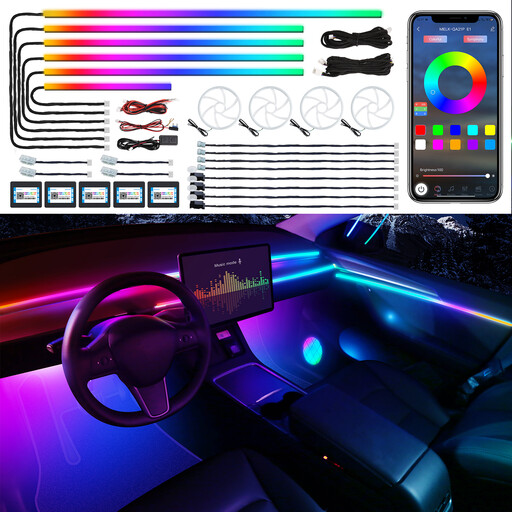
Why This Fits Their Persona: For the enthusiast who accepts no compromises and wants to illuminate every corner of the interior. This set offers the maximum scope for a complete and impressive transformation.
By combining Dreamcolor technology, dual-zone control, and a modular setup with 5 controllers, it enables a complex yet clean installation, making even the most demanding lighting concepts achievable without a cable mess.
Maximum Scope: The 22-in-1 set includes additional lights for the speaker grilles in the doors (Door horn light), creating a unique and fully integrated look. High LED count (600) for intense brightness.
We've compiled a complete, up-to-date list of products that fully meet these strict selection criteria and relevant safety regulations.
In most regions, interior vehicle lighting is generally permitted as long as it does not blind or distract the driver and does not emit light outwards that could confuse other road users. According to general traffic regulations (such as Germany's § 49a StVZO), lights inside the vehicle must not impair the driver's vision. The systems presented here are designed for the interior and, when set correctly to a non-excessive brightness, comply with these rules. Red or blue lighting that could be mistaken for an emergency signal from the outside should be avoided.
Modern retrofit kits are designed for DIY installation. The acrylic strips are typically wedged into existing gaps in the dashboard and door panels. An included pry tool helps to open these gaps slightly. Power is usually supplied via the 12V socket (cigarette lighter) or by connecting to the fuse box. Systems with sub-controllers greatly simplify wiring, as only short cable runs are needed within the doors. Some basic technical skill is helpful.
The difference lies in how the LEDs are controlled. On a standard RGB strip, all LEDs are wired in parallel. They can only display one colour at a time, together. On a Dreamcolor or RGBIC strip, a small microchip (IC - Integrated Circuit) is responsible for each segment of LEDs. This allows the app to assign a different colour or brightness to each segment, enabling dynamic effects like rainbow gradients, chasing light animations, or multi-colour scenes. For a modern and dynamic ambiance, RGBIC is the more advanced choice.