
Lieferung heute & morgen

Qualitätsgarantie

Willkommens-Angebote freischalten: KOSTENLOSE Lieferung | Bis zu 80 % RABATT | Kostenlose 30-Tage-JoyPlus-Testphase
App herunterladen
Atmospheric ambient lighting, once found only in luxury vehicles, can now be retrofitted into almost any car. The market offers a plethora of kits that promise to let you customise your interior. However, the selection is vast, and not every product lives up to its advertising. This guide highlights the most common pitfalls to avoid when buying and explains the crucial technical features to help you make an informed decision.
Many vehicle owners invest in a retrofit kit only to be disappointed shortly after. Certain shortcomings separate high-quality systems from unusable products.
To avoid the problems mentioned above, you should check three core technical aspects before purchasing. These largely determine the quality, durability, and functionality of your new LED interior car lights.
The method of light transmission is crucial for a uniform lighting effect.
Reliable control is the heart of modern RGB ambient lighting. Look for a stable Bluetooth connection and a well-reviewed app for iOS and Android. Key features that enhance user convenience include:
Power is typically supplied via the car's 12V electrical system. Simple kits use the cigarette lighter, which allows for a plug-and-play installation. More comprehensive systems for retrofit footwell lighting and door lighting are often connected directly to the fuse box. Ensure the kit includes all necessary components, including:
Based on the quality criteria mentioned, we have compiled a selection of products for various applications.
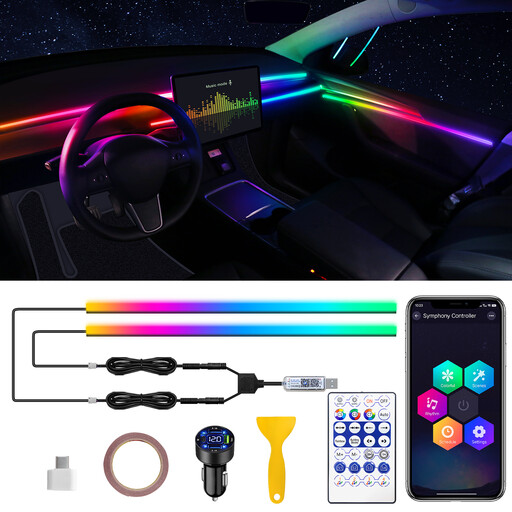
Why This Fits Their Persona: Ideal for users who want a simple and quick upgrade for their dashboard or centre console without having to deal with complex wiring. The USB/Type-C power supply makes it universally compatible.
The acrylic light strips ensure uniform illumination without hotspots. The simple plug-and-play installation via USB avoids the pitfall of complicated wiring.
Very simple installation thanks to USB power; control via app, remote control, or touch button.
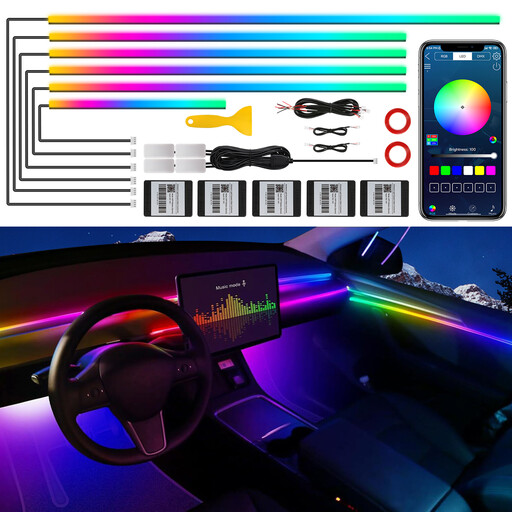
Why This Fits Their Persona: Perfect for tuning enthusiasts who want comprehensive and harmonious lighting for the entire vehicle interior. The 14-in-1 set covers the dashboard, doors, door handles, and footwell.
The system uses one main controller and four sub-controllers. This structures the wiring and prevents a tangled mess of cables, while ensuring synchronised control of all elements.
Comprehensive scope of delivery for a complete interior design; Dreamcolor technology for dynamic colour gradients.
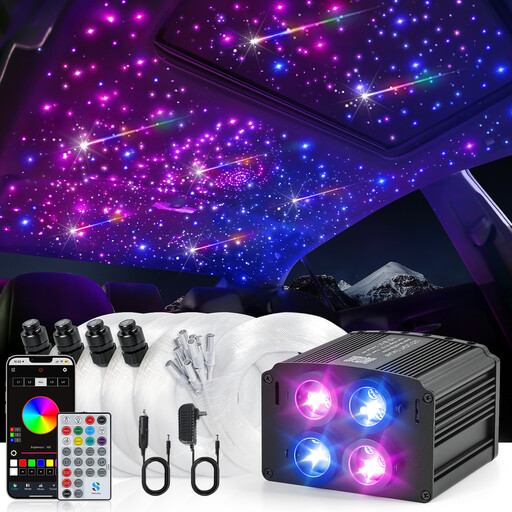
Why This Fits Their Persona: For anyone who wants to achieve the ultimate luxury look of a starlight headliner in their own vehicle. This kit is specifically designed for installation in the headliner and creates a realistic night sky effect.
Unlike weak, static lights, this kit offers a 32W light source with twinkle and meteor effects, creating a significantly more dynamic and realistic appearance.
Combined twinkle and meteor effect in one device; RGBW light source allows for pure white light; control via app and RF remote control.
We have compiled a complete, up-to-date list of products that fully meet these strict selection criteria and safety requirements.
The legal situation is nuanced. In principle, interior lighting must not distract the driver or dazzle other road users while driving. It must not shine outwards or reflect strongly in the windows. Dimmed, static lighting is generally tolerated. Flashing or rapidly changing colours while driving can be classified as illegal. It is recommended to turn off the lighting while driving or reduce it to a subtle, static setting and, if in doubt, to consult the current regulations of the German Road Traffic Licensing Regulations (StVZO).
The difficulty level largely depends on the scope of the kit. Simple LED strips for the car interior with a USB or 12V plug can often be installed in just a few minutes. Comprehensive kits that also illuminate doors and the footwell require routing cables behind trim panels. Most kits include a special pry tool for this purpose. With a little patience, these projects are feasible for skilled DIY enthusiasts but require more time.
Modern LED systems have a very low power consumption. If the system is connected to a power source that is only active when the ignition is on (e.g., the cigarette lighter), there is no risk of draining the battery when the vehicle is parked. Many systems also feature a low-voltage cut-off as an additional safety measure.