
Lieferung heute & morgen

Qualitätsgarantie

Willkommens-Angebote freischalten: KOSTENLOSE Lieferung | Bis zu 80 % RABATT | Kostenlose 30-Tage-JoyPlus-Testphase
App herunterladen
For a long time, high-quality ambient lighting was a hallmark of luxury vehicles. Today, it's possible to retrofit this feature in almost any car, giving the interior a personal and modern touch. The market offers a wide variety of retrofit kits, but the selection can be overwhelming. Many products overpromise and underdeliver.
This guide helps you avoid the common pitfalls of purchasing and make an informed decision. We'll show you which technical features truly matter for finding a durable and visually appealing solution for your vehicle.
Before you invest, you should be aware of the shortcomings that lead to disappointment with many inexpensive sets:
To avoid the problems mentioned above, you should pay attention to three crucial technical parameters when making your choice. These determine the quality, longevity, and visual effect of your new car interior LED lighting.
The method of light transmission is critical for a uniform appearance.
Control via an app is convenient, but it shouldn't be the only option.
A good kit for car interior tuning has a modular design and covers all relevant areas. A comprehensive set should include the following components:
Here are three recommendations tailored to different user profiles that meet the quality criteria mentioned above.
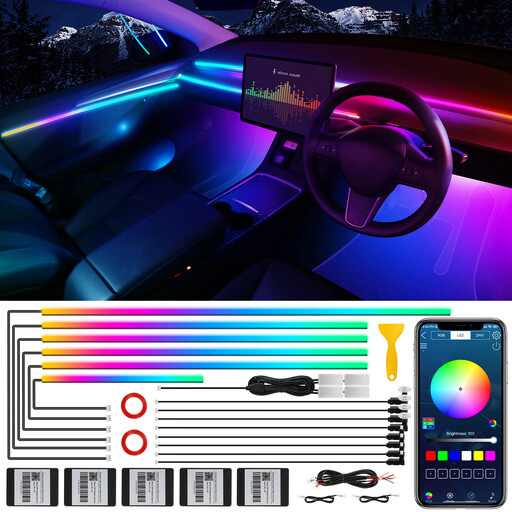
Why This Fits Their Persona: Ideal for users seeking an impressive upgrade without superfluous components. The set focuses on essential areas like the dashboard, doors, and footwell, offering a great entry point into the world of ambient lighting.
Thanks to acrylic technology with 600 LEDs, it ensures uniform illumination and avoids the "spotty lighting" pitfall.
Combines app control ("LotusLamp X") and a physical touch button for flexible operation. Dual-zone control allows for separate management of the footwell area.

Why This Fits Their Persona: For enthusiasts who want seamless and detailed illumination of the entire interior. This kit leaves nothing to be desired, lighting up door storage and speakers in addition to the standard areas.
The modular system with one main and four sub-controllers addresses the "hidden cable complexity." Installation is simplified, as the lights for each door connect to a local controller.
Maximum scope of delivery (22-in-1) for complete integration into the vehicle interior, including lights for door handles, storage compartments, and speakers.

Why This Fits Their Persona: Perfect for tech-savvy users who value maximum control and customisation. The ability to independently light different zones in the car with different colours and modes offers a high degree of personalisation.
This kit counters "unstable app control" with a dedicated system (the "LotusLamp X" app) and a dual-zone architecture that enables stable and responsive operation of its complex features.
The independent dual-zone control allows the acrylic light strips (dashboard/doors) and the auxiliary lights (footwell/door handles) to operate in different colours or modes simultaneously.
We have compiled a complete, up-to-date list of products that fully meet these strict selection criteria and local regulations.
Yes, retrofitting LED interior lighting is generally permitted. However, according to the German Road Traffic Licensing Regulations (StVZO), the lighting must not dazzle or distract the driver. Furthermore, it must not be visible from the outside or irritate other road users. In particular, the use of blue light effects, which could be confused with emergency vehicles, should be avoided. As long as the lighting is subtle and does not compromise driving safety, it is compliant.
Most modern kits are designed for DIY (Do-It-Yourself) installation. The thin acrylic or fibre-optic strips are inserted into the existing gaps between the trim panels of the dashboard and doors. A special pry tool is included with most sets. Power is typically supplied via the 12V socket (cigarette lighter) or by connecting to the fuse box. Permanent modifications to the vehicle are usually not necessary.
LEDs are known for their extremely low power consumption. While driving, the additional load on the alternator and battery is negligible. To prevent the battery from draining when the car is parked, it is advisable to connect the lighting system to a circuit that is only active when the ignition is on. Many kits also feature a memory function that remembers the last setting and a standby mode with minimal power consumption.