
Lieferung heute & morgen

Qualitätsgarantie

Willkommens-Angebote freischalten: KOSTENLOSE Lieferung | Bis zu 80 % RABATT | Kostenlose 30-Tage-JoyPlus-Testphase
App herunterladen
For a long time, high-end ambient lighting was a feature reserved for premium-class vehicles. Today, retrofitting a custom LED interior lighting system in your own car is more accessible than ever. However, the market for retrofit kits is saturated and filled with products of widely varying quality. Many car owners invest in a set, only to be disappointed by uneven light, flickering LEDs, or an unreliable app shortly after.
As your Joybuy Product Recommendation Officer, I'm here to help you identify the crucial features. This guide will show you what to look for when making your selection to avoid common purchasing mistakes and find a solution that provides a lasting upgrade to your vehicle's interior.
Before you make a purchase, you should be aware of three common problems that frequently occur with budget-friendly retrofit kits:
To avoid these issues, focus on three technical features that determine the quality and durability of your new interior lighting.
The type of light guide is critical for a uniform appearance. Look for sets that use acrylic light guides. Unlike simple fibre optics, these strips are often equipped with a continuous chain of LEDs. The light is generated directly along the entire length, not just fed in from the ends. The result is a consistently uniform and rich colour without distracting differences in brightness. This technology, often marketed as an RGB light strip for cars, creates a professional, factory-installed look.
Most people are familiar with the term RGB, where all LEDs on a strip can only display a single colour at a time. A significant advancement is RGBIC technology, often marketed as a Dreamcolor LED strip.
Carefully check what's included in the box. A good kit should contain not only the light strips themselves but also all necessary controllers (main and sub-controllers for different zones), sufficiently long connection cables, and an installation tool. Consider which areas you want to illuminate:
Modular systems with one main controller and several sub-controllers are often more stable as they distribute the load and ensure synchronised control of all components.
Here are three recommendations tailored to different needs and vehicle projects.
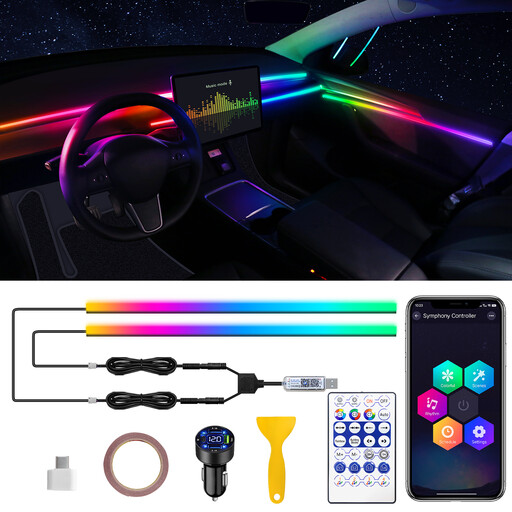
Why This Fits Their Persona: Ideal for anyone who wants to achieve maximum effect on the dashboard with minimal effort. The USB/Type-C power supply eliminates the need for complicated wiring to the on-board electronics. Perfect for leased vehicles or a quick start.
This set uses acrylic light guides for even illumination without hotspots. Its simple design as a 2-in-1 kit for the dashboard avoids the complexity and potential issues of incomplete, larger sets.
Plug-and-Play Installation: Powered directly via the vehicle's USB or Type-C port. Dreamcolor Effects: Offers dynamic colour gradients thanks to RGBIC technology.
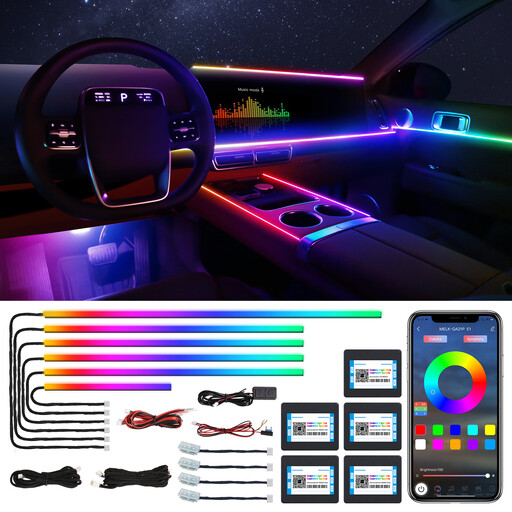
Why This Fits Their Persona: For hobbyists aiming for comprehensive and harmonious lighting throughout the entire interior. The 10-in-1 set covers the dashboard, four doors, and footwells, offering advanced customisation options with dual-zone control.
With 600 LEDs and acrylic light guides, a high and uniform light density is ensured. The multi-controller system (1 main, 4 sub-controllers) provides stable, synchronised control and prevents overloading a single controller.
Dual-Zone Control: Allows for separate adjustment of colours and modes for different areas (e.g., dashboard vs. footwells). High LED Density: 600 LEDs ensure intense and gapless illumination.

Why This Fits Their Persona: For perfectionists who make no compromises and want to illuminate every corner of the interior. This 18-in-1 set includes additional light elements for door handles and storage compartments, allowing for seamless integration into the vehicle's design.
This set is designed as a true all-in-one package, covering detailed areas that other kits miss. This avoids the need to purchase additional individual parts. The modular controller system ensures stable performance for all 18 light elements.
Maximum Coverage: Also illuminates door handles and storage compartments for complete integration. Dual-Zone Control: Enables complex, multi-colour light scenes throughout the entire vehicle interior.
We've compiled a complete, real-time updated list of products that fully meet these strict selection criteria and rigorous safety standards.
The installation time heavily depends on the scope of the kit and your experience. A simple USB set for the dashboard can be installed in under 30 minutes. A comprehensive 18-in-1 set that requires removing door panels can take several hours for a novice. It is recommended to test the lights before installation and to plan the routing paths carefully.
Modern LED systems are very energy-efficient. While driving, the power consumption is negligible compared to the alternator's output. If the lighting remains active for an extended period (many hours or days) with the engine off, it can drain the battery. However, many kits are wired to the ignition (turning on/off with the car) or feature low-voltage protection to prevent deep discharge of the battery.
This is a crucial quality difference. RGB strips can only display one single colour across the entire strip at a time. You can change the colour, but you cannot display multiple colours simultaneously. RGBIC strips have an additional chip that allows individual sections of the strip to be controlled independently. This enables dynamic effects such as colour gradients, running light animations, and rainbow patterns, which create a much higher-quality and more vibrant atmosphere.