
Lieferung heute & morgen

Qualitätsgarantie

Willkommens-Angebote freischalten: KOSTENLOSE Lieferung | Bis zu 80 % RABATT | Kostenlose 30-Tage-JoyPlus-Testphase
App herunterladen
High-quality ambient lighting can fundamentally transform the nighttime driving experience and give the vehicle's interior a modern, custom touch. While premium manufacturers often offer this feature only for a hefty surcharge, there are numerous aftermarket kits on the market. However, the selection is vast, and the quality differences are significant. Many products don't deliver on their marketing promises. This guide will help you avoid common purchasing pitfalls and make an informed decision.
Author: Joybuy Product Recommendation Officer
Date: August 29, 2026
Before you invest in new LED interior lighting for your car, you should be aware of the typical weaknesses of budget-friendly sets, which often only become apparent after installation.
To avoid these problems, you should check three core technical aspects before buying. These largely determine the quality, longevity, and visual effect of your new interior lighting.
The method of light distribution is the most important criterion for a homogeneous appearance.
The control electronics define the customisation possibilities.
A well-thought-out system makes retrofitting significantly easier.
Based on the criteria above, we have identified some products suitable for different user profiles and vehicles.
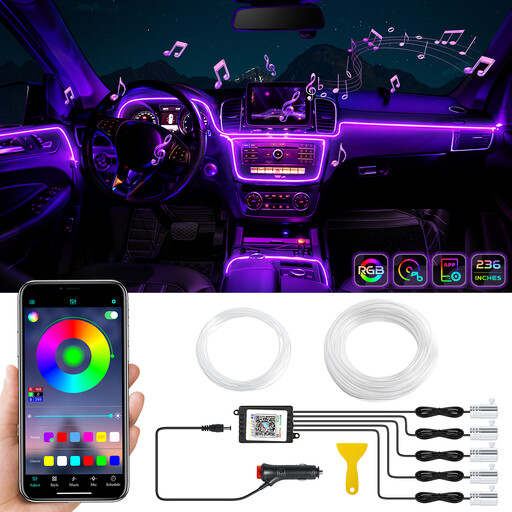
Why This Fits Their Persona: Ideal for users looking for a simple and budget-friendly solution to try out the concept of ambient lighting. The connection via the 12V cigarette lighter requires no interference with the vehicle's electrical system.
Although this is a light guide system (Pitfall 1), the manufacturer suggests connecting an LED to both ends on long runs to improve brightness. The simple power supply bypasses complex wiring (Pitfall 2).
Very simple installation via 12V connection; long, cuttable light guide (approx. 6 metres) for flexible adaptation to different vehicle sizes.

Why This Fits Their Persona: Perfect for car owners who want a look that comes close to factory-installed ambient lighting. The focus is on a homogeneous light line and dynamic effects.
The use of acrylic light strips effectively prevents uneven illumination (Pitfall 1). The integrated RGB Smart IC enables true Dreamcolor effects that are missing from simple RGB kits (Pitfall 3).
Uniform and bright illumination; dynamic colour gradients (Dreamcolor) controllable via app; modular system with main and sub-controllers simplifies installation.

Why This Fits Their Persona: For enthusiasts who want complete and detailed illumination of the entire interior, including the dashboard, all four doors, door handles, storage compartments, and footwells.
The extensive 18-in-1 set with a modular architecture of main and sub-controllers prevents a tangle of wires in such a complex installation (Pitfall 2). The dual-zone control in the app offers advanced control that goes far beyond simple apps (Pitfall 3).
Extremely comprehensive kit for seamless interior lighting; separate control of two zones (e.g., strips and footwell) for individual colour combinations.
We have compiled a complete, up-to-date list of products that fully meet these strict selection criteria and German safety regulations.
1. How long does it take to install a retrofit ambient lighting kit? The installation time varies greatly depending on the scope of the kit and your experience. A simple set for the dashboard with a 12V plug can be installed in 30-60 minutes. A comprehensive 18-in-1 kit that also requires removing door panels can take several hours (3-5 hours) for a novice. It is recommended to test the lights before final installation.
2. Does LED interior lighting affect the car battery? Modern LED lights are extremely energy-efficient. The power consumption during operation is minimal and comparable to that of standard interior lights. Most kits have an operating voltage of 12V and are equipped with short-circuit protection. As long as the lighting is installed correctly and also turns off when the vehicle is off (or has very low standby consumption), draining the battery is unlikely.
3. Can you cut LED light strips for the car to size yourself? Yes, most light guides and many acrylic strips are designed to be cut to the required length. However, with acrylic strips that have integrated LEDs, it is important to follow the manufacturer's instructions carefully. There are often marked cutting points. An incorrect cut can cause the last segment of the strip to no longer light up or lose colour synchronisation.