
Lieferung heute & morgen

Qualitätsgarantie

Willkommens-Angebote freischalten: KOSTENLOSE Lieferung | Bis zu 80 % RABATT | Kostenlose 30-Tage-JoyPlus-Testphase
App herunterladen
High-quality ambient lighting can significantly enhance the driving experience and aesthetics of a car's interior. What was once a feature reserved for premium vehicles is now accessible for almost any car, thanks to a wide variety of retrofit kits. However, the market is crowded and filled with products of widely varying quality. Many drivers invest in sets that soon disappoint with uneven illumination, flickering lights, or unstable controls.
As your Joybuy Product Recommendation Officer, I have analysed the most common pitfalls to provide you with objective guidance. This guide will show you which technical features to look for and how to find a kit that meets your needs, without being blinded by marketing promises.
Before making a decision, you should be aware of the typical flaws common in low-cost retrofit kits. Avoiding them is the first step toward a satisfying result.
To avoid the problems mentioned above, you should base your choice on objective criteria. The following three parameters are crucial for the quality and longevity of your new interior lighting.
The method of light distribution is the most important quality indicator. Instead of relying on simple LED strips, high-quality systems use light guides.
For most DIY applications to retrofit car light guides, acrylic strips offer an excellent balance of flexibility and homogenous light distribution.
The control unit and its software determine how versatile your lighting customisation can be.
Before buying, consider which areas of the vehicle you want to illuminate. The kits are often labelled as "X-in-1".
Here are some product recommendations tailored to different needs and vehicle types.
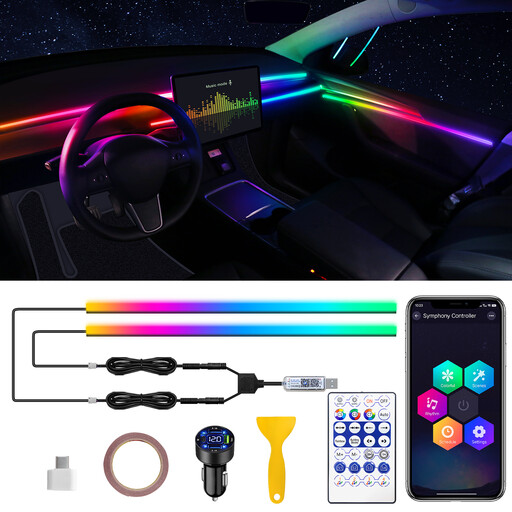
Why This Fits Their Persona: Ideal for a straightforward and targeted upgrade of the dashboard. Power delivery via USB or Type-C makes installation extremely simple, as it requires no tampering with the vehicle's electrical system. Perfect for leased vehicles or for users looking for a quick, non-permanent solution.
The acrylic light strip ensures uniform illumination without hotspots. The simple plug-and-play installation via USB avoids any cable mess or complex wiring.
Powered by USB/Type-C, allowing for installation with no technical expertise. Despite its simple setup, it offers Dreamcolor effects and app control.

Why This Fits Their Persona: This kit offers a balanced combination of features and coverage. It's suitable for car owners who want comprehensive lighting for the dashboard, doors, and footwells without stretching the budget for an 18-in-1 or 22-in-1 kit.
The modular system with a main controller and four sub-controllers greatly simplifies wiring. The dual-zone control allows for more sophisticated lighting scenarios than basic apps.
The dual-zone control allows different areas (e.g., strips and footwells) to be controlled independently in terms of colour and mode. The 14-in-1 set covers all key areas.

Why This Fits Their Persona: For the tuning enthusiast who wants no compromises. This kit offers maximum coverage, illuminating details like door handles and storage compartments in addition to the standard areas. It allows for a complete and highly detailed interior customisation.
Despite its extensive scope, the installation remains manageable thanks to the modular system with five controllers. The Dreamcolor RGB Smart IC technology ensures that even complex, dynamic effects run smoothly and in sync across all 18 components.
Maximum lighting coverage (18-in-1) for seamless illumination. The large number of components is supported by a well-designed modular system and a powerful control unit.
We have compiled a complete, up-to-date list of products that fully meet these strict selection criteria and safety regulations.
1. Is retrofitting ambient lighting legal? Retrofitting LED car interior lighting is generally permissible, but regulations vary by region. For example, under Germany's StVZO (Road Traffic Licensing Regulations), the lighting must not distract or dazzle the driver, nor may it emit light outwards in a way that could confuse other road users. In particular, colours or light effects that could be mistaken for emergency vehicle signals are prohibited. Discreet, non-flashing lighting is usually tolerated while driving, but intense use should be reserved for when the vehicle is stationary. Always check your local traffic laws.
2. How difficult is the installation of such a kit? The effort depends heavily on the scope of the kit. Simple USB strips for the dashboard can be installed in minutes. Comprehensive sets, like an 18-in-1 kit, can take several hours depending on the vehicle and your experience. However, most modern kits are designed for DIY installation. They include the necessary tools (e.g., a pry tool for opening trim panel gaps) and use plug-in connectors, so no soldering is required. The biggest challenge is routing the cables invisibly behind the trim panels.
3. Can I cut the light strips to the required length? Yes, most acrylic and fiber optic light strips are designed to be cut to size by the user. However, it is crucial to follow the manufacturer's instructions precisely. Some acrylic strips have resistors at the end. If you cut in the wrong place, the last section of the strip may not light up or the colours may no longer be in sync. Therefore, measure carefully and test the functionality before the final installation.