
Lieferung heute & morgen

Qualitätsgarantie

Willkommens-Angebote freischalten: KOSTENLOSE Lieferung | Bis zu 80 % RABATT | Kostenlose 30-Tage-JoyPlus-Testphase
App herunterladen
High-quality ambient lighting can significantly enhance the driving experience and give your vehicle's interior a modern, custom touch. While this feature often comes with a hefty price tag on new cars, aftermarket kits offer an accessible alternative. However, the market is crowded and filled with products whose marketing promises don't always match reality. This guide will help you avoid common pitfalls and make an informed decision.
Choosing the wrong system often leads to disappointment. Pay close attention to the following three points to avoid a bad investment:
To avoid the problems mentioned above, you should check three core technical parameters before buying. These are crucial in determining the quality and functionality of your new interior lighting.
Instead of traditional fibre optics that merely transmit light, more advanced systems use acrylic light guides. In these interior car LED strips, the LEDs are integrated directly and at regular intervals. This ensures a completely uniform and soft light distribution without any drop in brightness or distracting hotspots. The result is even illumination that rivals factory-installed systems.
The type of control is critical for customisation. Look for the following features:
The "X-in-1" designation indicates how many separate light elements and controllers are included in the kit. A larger kit is not necessarily a better choice. Consider which areas you want to illuminate:
Based on the criteria above, we have identified a few products that are well-suited for different user profiles.
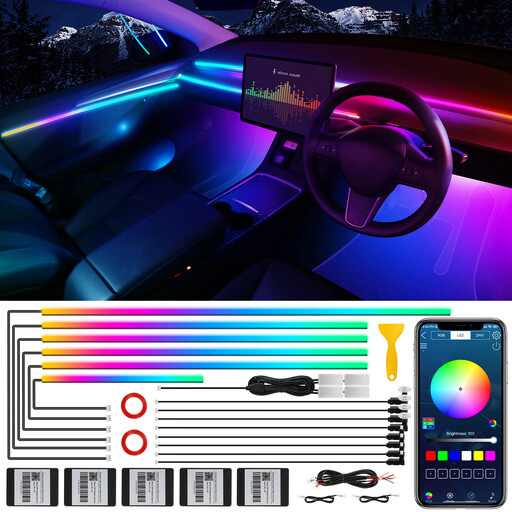
Why This Fits Their Persona: Ideal for getting started. This kit focuses on essential areas like the dashboard and footwell, offering modern Dreamcolor effects without breaking the bank. It's a solid foundation for a noticeable upgrade.
The acrylic light guides with 600 LEDs ensure uniform brightness and avoid the typical "hotspots" of basic fibre optic kits.
Offers Dreamcolor technology and dual-zone control via app and a touch button, which is not a given in this price range.

Why This Fits Their Persona: For users looking for a comprehensive solution. This 14-in-1 kit extends the lighting to include key accents like door handle lights, creating a cohesive overall look that goes beyond a basic installation.
The modular system, with one main and four sub-controllers, significantly simplifies wiring and prevents a tangled cable mess.
Comprehensive coverage including door handles for an integrated design. The dual-zone control allows for different colours for the cockpit and doors.

Why This Fits Their Persona: For tuning fans who want no compromises. This 18-in-1 kit illuminates nearly every corner of the interior, including the door storage compartments, creating a seamless and impressive lighting experience.
Despite its large scope, control remains clear and reliable thanks to the "LotusLamp X" app and dual-zone functionality, which is not a given for such complex kits.
Maximum lighting coverage with 18 elements for a complete interior design. Includes lights for door storage bins, which are often overlooked.
We have compiled a complete, up-to-date list of products that fully meet these strict selection criteria and UK safety regulations.
Modern kits are increasingly designed for DIY installation. The acrylic strips are thin and flexible enough to be fitted into the existing gaps of the dashboard and door panels. Many kits also include a pry tool to help lift trim pieces slightly without causing damage. Power is typically drawn from the vehicle's 12V electrical system (e.g., from the fuse box or cigarette lighter), which is manageable with a basic understanding of car electrics.
LEDs are known for their durability. The diodes in these kits typically have a lifespan of many thousands of operating hours. Since they run on a low 12V voltage and generate little heat, the stress on the components is minimal. With proper installation, you can expect a long service life.
The power consumption of LED lighting is very low. Compared to other consumers in the car, like the air conditioning or audio system, the energy demand of ambient lighting is minimal. When the engine is running, the alternator charges the battery, so there is no negative effect. Most systems also feature a memory function and short-circuit protection, ensuring the safety of the vehicle's electrical system.