
Lieferung heute & morgen

Qualitätsgarantie

Willkommens-Angebote freischalten: KOSTENLOSE Lieferung | Bis zu 80 % RABATT | Kostenlose 30-Tage-JoyPlus-Testphase
App herunterladen
Many vehicle owners want to customise their car's interior beyond the standard factory-installed options. A retrofitted car ambient lighting system offers the opportunity to enhance the driving experience with customisable light accents. This article serves as a guide, providing objective information to help you select a suitable system. We will look at different technologies, control options, and what's included in the kits, so you can make an informed decision.
Before making a purchase, several technical aspects should be considered to ensure the product meets your requirements. The following points provide an overview of the most important features of retrofit kits.
The method of light transmission is crucial for the final visual result. Modern systems often rely on acrylic light guides. Unlike older fibre-optic solutions, where the light is often bright only at the ends and fades towards the middle, acrylic strips provide consistently uniform and bright illumination. This creates a clean, high-quality appearance that closely resembles a factory-fit solution. Look for products that explicitly mention this technology if you value even light distribution.
The operation of car interior lighting varies by model. The most common options are:
The "X-in-1" designation indicates how many individual lighting elements and controllers a kit consists of. For example, a "10-in-1" kit might include light strips for the dashboard and the four doors, as well as four footwell lights. An "18-in-1" kit often expands on this with additional lights for door handles and storage compartments. Consider which areas of your vehicle you want to illuminate beforehand to choose the appropriate kit size.
Here is a selection of retrofit kits that cover different requirements and applications.
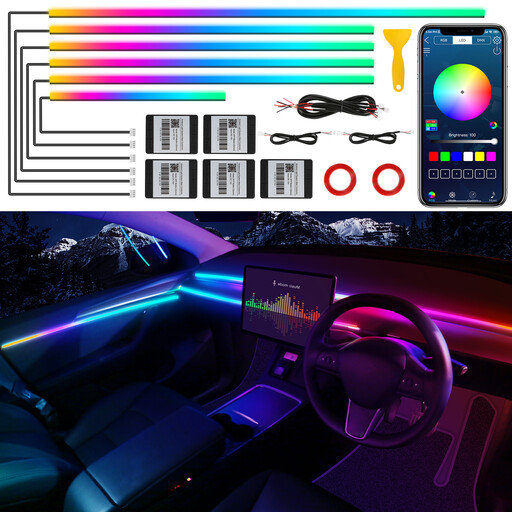
Why it stands out: This kit provides a comprehensive solution for retrofitting ambient lighting. It combines acrylic light strips for the dashboard and doors with separate footwell lights and enables synchronised control throughout the vehicle via a system of main and sub-controllers.
Pros:
Who is it for? For vehicle owners looking for a complete and well-integrated lighting solution for the main areas of the interior (dashboard, doors, footwell) who also value dynamic light effects.

Why it stands out: As an extension of the 10-in-1 concept, this 18-in-1 kit offers maximum coverage for detailed interior lighting. In addition to the standard areas, it also illuminates the door handles and door storage compartments, creating a particularly cohesive overall look.
Pros:
Who is it for? For tuning enthusiasts and those with an eye for detail who want to implement seamless, full-coverage ambient lighting throughout the entire vehicle interior.
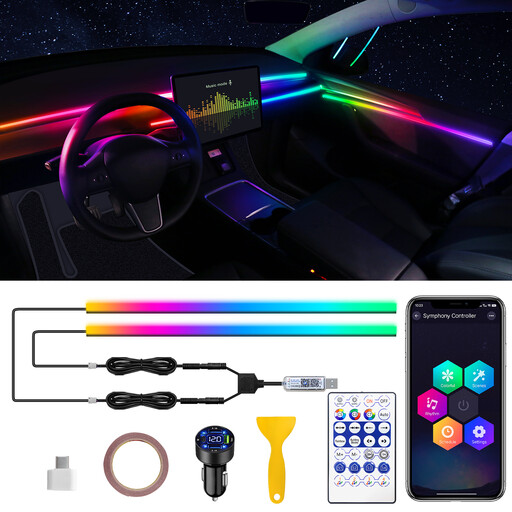
Why it stands out: This kit is focused on simple installation and use. Powered by USB or Type-C, it is ideal for a quick and uncomplicated upgrade of the dashboard without needing to wire into the fuse box.
Pros:
Who is it for? For beginners or users looking for a quick, easy, and reversible solution to primarily equip their vehicle's dashboard with modern car ambient lighting.
The products presented cover common use cases. However, if you are looking for different configurations, lengths, or specific accessories for your vehicle, there is a wide range of other options to explore.
Discover more products in our Car Interior Accessories category.
Is retrofitting ambient lighting legal? Installing interior lighting is generally permissible. However, according to most local traffic regulations, the lighting must not blind or distract the driver. Furthermore, it must not shine outwards or imitate the colour of dashboard warning lights, so as not to confuse other road users. A subtle, downward-facing, or indirect light is usually tolerated.
How is a retrofitted interior lighting system powered? Power is typically supplied in one of three ways:
Can you cut the LED strips to the correct length yourself? Yes, many LED strips for cars, especially those with acrylic light guides, are trimmable. Manufacturers usually provide marked cutting points. It is important to follow the instructions carefully to avoid damaging the strip's functionality. An incorrect cut can cause a section of the strip to stop working or prevent the colours from synchronising.