
Lieferung heute & morgen

Qualitätsgarantie

Willkommens-Angebote freischalten: KOSTENLOSE Lieferung | Bis zu 80 % RABATT | Kostenlose 30-Tage-JoyPlus-Testphase
App herunterladen
A car ambient lighting LED can enhance the look of your interior, highlight the centre console or add a fresh touch to a tuning project. At the same time, LED kits differ significantly in terms of connection, vehicle compatibility, light distribution and installation. If you only focus on the number of colours or an especially long strip, you risk overlooking important buying criteria.
This guide shows what motorists in the UK should look out for in 2026 – from LED interior car lighting and the LED starlight headliner through to LED lighting technology for VW Golf, BMW, Mercedes-Benz and off-road vehicles.
RGB kits often boast millions of colours, music modes and dynamic effects. However, these features say little about whether the light is distributed evenly inside the vehicle. With simple light guides, brightness can drop off at the ends. Acrylic light strips, on the other hand, use continuous light distribution along the strip. What really matters is the material, LED arrangement and length, not just the number of available colours.
A kit may be designed for many vehicles in principle, but it still needs to be adapted to the dashboard, door panels or footwell. Check before you buy:
With a car interior LED strip, you should also know whether the strip is fitted into gaps, crevices or attached with adhesive tape.
Decorative vehicle ambient lighting is primarily intended for the interior. Headlights, rear lights and externally mounted light strips, on the other hand, are subject to additional requirements. Before installing them for use on public roads, you must check the vehicle type, approval, certification marks and installation regulations. A product description that says "LED" or "dynamic indicators" does not replace a check of legal compliance.
Many interior kits operate on 12 V DC and are designed for connection in the vehicle. Other models are powered via USB or USB-C. If the voltage and connection don't match, the lighting may respond weakly or become damaged. With a kit that has multiple controllers, you should also check whether all areas are controlled together or separately.
An RGB LED light strip for cars with an acrylic profile can produce a more even light line than a simple light guide with only a few feed points. However, acrylic strips cannot be bent arbitrarily. Tight bends can impair light transmission. Flexible profiles are suitable for the dashboard and door lines; for a LED headliner lighting conversion, fibreglass or PMMA fibre strands are usually used.
Bluetooth app control is practical when you want to adjust colours, brightness, speed or timers directly from your smartphone. Pay attention to:
The music function generally responds to sounds picked up by the microphone on the controller or smartphone. It is therefore not necessarily linked to the vehicle's audio signal.
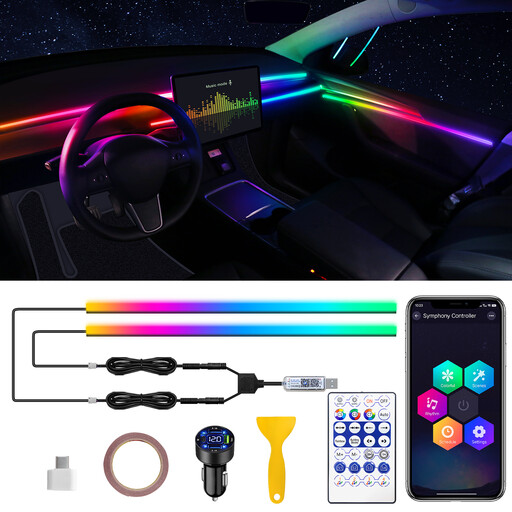
Why it fits: Two 55.1-inch acrylic strips with USB and Type-C connection are ideal for the dashboard, centre console or individual trim lines.
The USB connection reduces installation effort compared to kits that need hardwiring. The acrylic structure is designed for even light output.
12 V, 410 LEDs, RGB colour modes, app, remote control and button control, plus music synchronisation.

Why it fits: The 14-in-1 kit is designed for users who want to style the footwell, door handles and several interior zones together.
Multiple sections and controllers make structured routing easier. When cutting to size, you must observe the designated end area.
Six LED strips, four footwell lights, four door handle lights, 175 inches total length and Bluetooth app control.
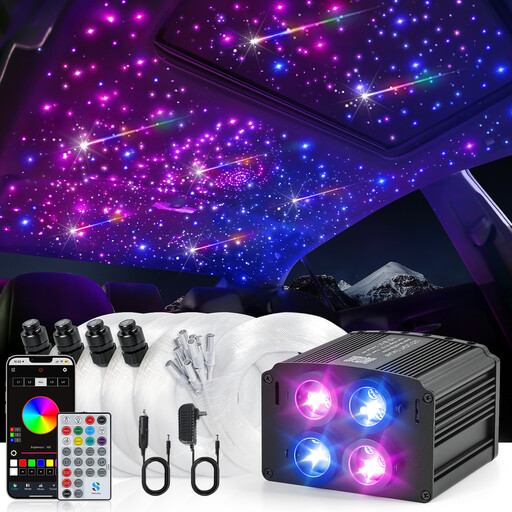
Why it fits: For a comprehensive LED starlight headliner or a custom LED headliner lighting setup with many light points.
The required fibre length should be planned before drilling. The light module needs an accessible, ventilated installation location.
32 W light module, 1,000 fibre strands, 240 meteor light fibres, four separately controllable connections, app and RF remote control.
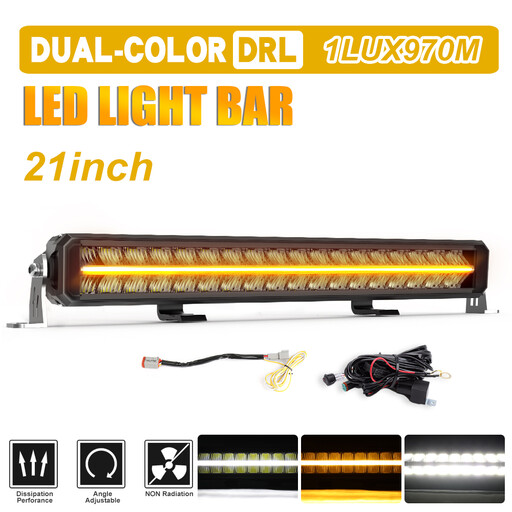
Why it fits: For trucks, SUVs, ATVs and off-road vehicles where a robust exterior light is needed for use away from public roads.
Voltage range, mounting position and intended use must all match. For road use, legal approval must be checked separately.
21 inches, 9–30 V DC, IP68 rating, white driving light, amber position light and adjustable brackets.
For specific vehicle models, there are also LED retrofit solutions, such as LED rear lights for VW Golf 7, LED car headlights for BMW or lighting for the Mercedes-Benz C-Class. With these products, compatibility is especially important. The model year, body variant, existing connectors and trim level must match the product description.
The TYPY rear light set for the VW Golf 7 is, according to the product information, intended for TDI and TSI models from model years 2015 to 2021, but not for the GTI or Golf R. The unit includes brake, reverse, fog and indicator functions with a sequential turn signal, among others. Before ordering, you should compare the shape of the original light and your vehicle data.
For headlights for the BMW 2 Series, BMW E90, VW Golf 7 or Mercedes-Benz C-Class, professional installation is advisable. Before fitting, check approval for your specific vehicle type, headlight levelling, error messages in the on-board network and the regulations for use on public roads.
In our selection you will find various lighting kits for the interior, vehicle and off-road applications. Before buying, check the technical data, vehicle compatibility and the intended place of use.
Depending on the kit, the power supply is via 12 V, USB or USB-C. Before installation, all components should be connected and tested. Cables should be routed so that they do not interfere with pedals, airbags, seat rails or controls.
The lifespan depends on factors such as heat, voltage, moisture, mechanical stress and the quality of the power supply. A manufacturer's stated operating life is a guideline and not a guarantee of actual service life in the vehicle.
Subtle interior lighting must not impair the driver's vision or obscure any safety-relevant controls. Exterior lights, headlights, rear lights and dynamic indicators must meet the applicable approval and installation requirements. Before using them on public roads, you should check your vehicle documents, certification marks and, if necessary, consult a professional garage.