
Lieferung heute & morgen

Qualitätsgarantie

Willkommens-Angebote freischalten: KOSTENLOSE Lieferung | Bis zu 80 % RABATT | Kostenlose 30-Tage-JoyPlus-Testphase
App herunterladen
An LED car ambient lighting system can add colour to your dashboard, doors and footwells. But there’s a fine line between a clean, professional retrofit and a set that ends up gathering dust. Not every LED interior car light can be neatly routed, evenly operated or easily controlled.
Claims like “10-in-1” or “22-in-1” often refer to the number of lighting zones included, not necessarily the length or quality of the light guides. What really matters is which areas are actually covered: LED strips for the interior, footwell lights, door handles, storage compartments or door speakers.
So, check before you buy:
Bluetooth control is convenient, but it requires a compatible app, activated Bluetooth and a stable connection. Depending on the model, apps such as “LED LAMP”, “LotusLamp X”, “Lotus Lantern”, “Magic Lantern” or “StarLamp” are used. Check before buying which app is specified for the particular set and whether your smartphone supports iOS or Android.
Also, keep realistic expectations about music sync: a built-in sensor reacts to sound picked up by the microphone. This isn’t necessarily a direct connection to your vehicle’s stereo or audio system. Road noise and ambient sounds can affect the light changes.
Acrylic and fibre-optic systems can be routed along gaps and trim strips. However, a bend that’s too tight, excessive pinching or forcing them into place can impair light transmission. “Cuttable” also doesn’t mean you can cut anywhere. With some sets, you must maintain a sufficient distance from resistors or connection points.
Most retrofittable ambient lighting systems are designed for 12 V DC. Some sets connect directly to the vehicle’s power supply, while others use a USB port, a USB-C adapter or a cigarette lighter plug. The voltage must match your vehicle and the controller. A higher voltage can damage components; if the supply is too low, brightness and response speed may drop.
If you’re making a direct connection, the electrical installation should be carried out professionally. A set with a USB or 12V plug is usually simpler for DIY users, but it doesn’t automatically offer automatic shut-off when the vehicle is switched off.
An acrylic light strip distributes light along a visible, flexible edge. It can be fitted into an interior gap and, in many vehicles, requires fewer individual visible LEDs. A classic LED fibre-optic car light, on the other hand, channels light from individual LED sources through a fibre or a transparent tube.
Pay attention to:
An RGB LED car strip set can offer static colours or dynamic effects. With Dreamcolor LED Strip systems, individual light sections are controlled separately using smart IC technology. Separate control is practical if, for example, you want different colours for the dashboard and footwells.
Product descriptions distinguish between simple RGB modes, dual-zone control and multiple independently controllable areas. The number of LEDs alone doesn’t tell you much about the control logic. Check whether brightness, speed, timer, scenes and music mode are available in the app.
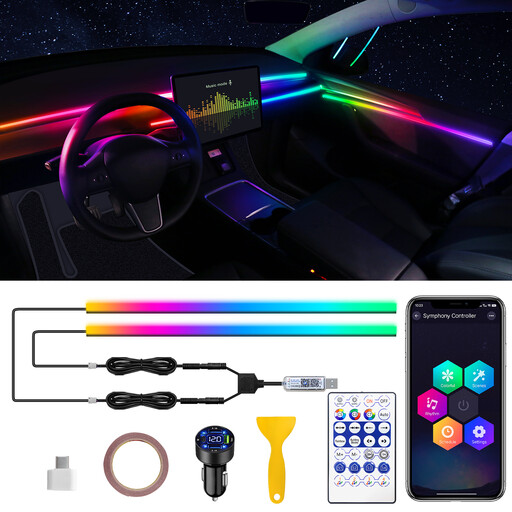
Why this product fits the profile: The set focuses on two 55.1-inch strips for the dashboard and uses USB and USB-C adapters. It’s ideal for a straightforward retrofit without multiple door modules.
The limited scope makes the actual coverage easier to assess. The product description also mentions manual shut-off via app, button or remote control.
USB/USB-C connection, app and remote control, 410 LEDs according to the product specification, plus music mode.
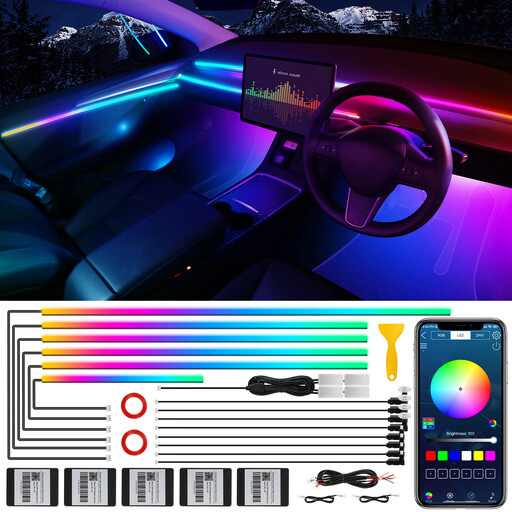
Why this product fits the profile: The combination of six acrylic strips, four footwell lights, multiple controllers and dual-zone control is designed for a structured interior layout.
The product description specifies 12 V, a temperature range of -20 °C to 60 °C, and includes advice on testing before installation and avoiding sharp bends.
600 LEDs according to the product specification, separate zones, app control, dynamic RGB modes and four footwell lights.

Why this product fits the profile: In addition to the dashboard and footwells, this set includes modules for door handles and door storage compartments. That makes it ideal for vehicle owners who want to style multiple interior areas.
The included areas and five controllers are listed in the product description. Still, you should check cable lengths and installation points against your own vehicle before buying.
Footwell, door handle and door storage compartment modules, 600 LEDs according to the specification, dual-zone control and LotusLamp-X app.

Why this product fits the profile: This set is designed for a headliner with fibre-optic points, not for classic footwell or door lighting. It’s aimed at ambitious DIY projects that create a visible starry-sky effect.
The product specification lists 1,000 fibre strands at 3 m length, four connections and a 12 W light source. This makes it easier to plan the installation effort in advance.
Four independently controllable connections, app and RF remote control, music mode and mixed fibre diameters.
We’ve put together a complete, regularly updated list of products that fully meet these strict selection criteria and the safety regulations in force in the EU.
Test your LED interior car light before final installation. Clean and dry the adhesive surfaces, route cables away from moving parts, and keep the controller away from areas with strong heat or moisture. Light sources should not obstruct your field of vision or any controls. The lighting should not be distracting while driving; also check whether the specific installation is permitted for use on public roads.
For cuttable strips, first mark all the sections you need. Cut only at the designated points and leave enough room for connections and bends. Making changes later is much more difficult once components are glued or fitted into trim panels.
Many sets work with 12 V, a cigarette lighter plug or USB/USB-C. More comprehensive kits use a main controller and additional sub-controllers for doors and footwells. Before installation, check the supply voltage and follow the instructions for your specific set.
The lifespan depends on operating time, temperature, humidity, mechanical stress and the quality of the power supply. Without specific manufacturer data, it’s not possible to give a reliable general figure. Overheating, kinks and incorrect voltage can shorten the service life.
Power consumption depends on the number of LEDs, brightness, length and the chosen effect. Static, dimmed colours generally use less power than constantly bright dynamic modes. If the system is permanently connected, you should also arrange a suitable shut-off to avoid unnecessarily draining the vehicle battery.