
Lieferung heute & morgen

Qualitätsgarantie

Willkommens-Angebote freischalten: KOSTENLOSE Lieferung | Bis zu 80 % RABATT | Kostenlose 30-Tage-JoyPlus-Testphase
App herunterladen
High-quality ambient lighting can transform a vehicle's interior, creating a modern, personalised atmosphere. However, the market for aftermarket kits is overwhelming. Many products overpromise and underdeliver, leading to disappointment. Before making a decision, it's crucial to understand the most common pitfalls to avoid a poor investment.
This guide focuses on the objective criteria that are essential when choosing an LED interior lighting system for your car. We'll highlight key technical differences and help you find a system that meets your standards for both aesthetics and functionality.
The decision to buy a retrofit kit is often influenced by marketing claims that don't hold up in practice. Pay close attention to these three weaknesses:
To avoid the issues mentioned above, you should check three core technical aspects before buying. These largely determine the quality and longevity of your new car interior LED lighting.
The type of light guide is critical for achieving uniform illumination.
The control chips (ICs) define the system's visual capabilities.
Aftermarket kits are often advertised as "10-in-1," "18-in-1," etc. This number describes the contents of the package. A larger kit isn't automatically better; it must suit your vehicle and your goals. Check which components are included:
A modular system with a main controller and several sub-controllers simplifies the wiring, as the strips in the doors connect directly to a local controller instead of having to be routed across the vehicle to the main module.
Based on the criteria above, we have identified several products suitable for different user profiles and use cases.
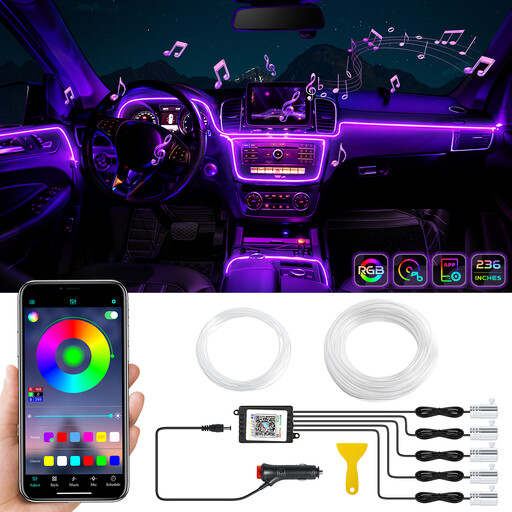
Why this kit is a great fit: Ideal for users looking for a simple and cost-effective solution to accentuate the main lines of the interior (e.g., the dashboard). The long, cut-to-size fibre optic cable offers flexibility for a straightforward DIY installation.
The kit includes 5 separate LED modules that can be connected at different points along the light guide. This ensures more even brightness than systems with only one light source and prevents dark spots.
Features RGB-IC (Dreamcolor) for dynamic effects and a music-sync LED car function. It is easily powered via the 12V socket (cigarette lighter).

Why this kit is a great fit: For drivers who want a comprehensive and integrated lighting solution. The 18-in-1 kit covers the dashboard, all four doors, door handles, storage compartments, and the footwell, creating a cohesive overall look.
The use of acrylic light strips ensures perfectly uniform illumination without hotspots. The modular system with a main controller and four sub-controllers significantly simplifies wiring and prevents cable clutter.
Offers Dual-Zone Control, allowing different areas of the car (e.g., strips and footwell) to light up in different colours or modes simultaneously. Control is managed via the car ambient lighting app or a touch button.

Why this kit is a great fit: For the discerning user who wants maximum customisation. This kit offers the most extensive coverage, illuminating the speaker grilles in the doors in addition to all other areas for a complete show car look.
Despite its extensive scope, the installation remains manageable thanks to the modular controller architecture. The acrylic technology guarantees consistent, high-quality light across all the individual components.
The most comprehensive lighting coverage available in an aftermarket kit. It offers full RGB-IC functionality with music synchronisation and app control for all 22 components, enabling an impressive and dynamic light show.
We have compiled a complete, up-to-date list of products that fully meet these strict selection criteria and safety regulations.
Retrofitting interior lighting is generally permissible as long as it complies with local traffic regulations. The key is that the lighting must not dazzle or distract the driver, nor should it emit light outwards in a way that could confuse other road users. Flashing red or blue lights, which could be mistaken for emergency vehicles, are prohibited. Ensure the system is dimmable and set to a subtle brightness while driving.
Modern retrofit kits are designed for DIY installation. The process typically doesn't require soldering or major modifications to the vehicle's electronics. The light strips are wedged into the gaps between interior trim panels, often using an included pry tool. Power is usually supplied via a 12V plug for the cigarette lighter or by connecting to the fuse box, which may require a bit more experience. It's always a good idea to test the lighting before final installation.
This is a crucial technical distinction. An RGB LED strip can only display one single colour across its entire length at any given time. You can change the colour, but you can't display multiple colours at once. An RGB-IC strip (often called Dreamcolor, Symphony, or Magic Color) has integrated circuits (ICs) that allow individual LEDs or small segments of the strip to be controlled independently. This makes dynamic, flowing effects like rainbow gradients or chasing light animations possible, creating a much more vibrant atmosphere.