Joybuy Insights

Complete Guide to Retrofitting Car Ambient Lighting

A retrofitted ambient lighting system can modernise a vehicle's interior and create a custom atmosphere. However, the market for aftermarket kits is overwhelming. Many products overpromise and underdeliver, leading to disappointment. Before you make a decision, it's crucial to understand the most common pitfalls and know which technical features truly matter.

This guide will help you filter out the low-quality options. We'll highlight the critical product features and show you how to avoid typical problems like uneven illumination or complicated installations from the outset.

The 3 Most Common Problems with Budget-Friendly Retrofit Kits

Many car owners invest in interior LED lighting only to discover flaws shortly after installation. These three issues are particularly common:

  1. Uneven Light Distribution: Inexpensive kits often use simple fibre optic tubes fed by only one or two LEDs at the ends. The result is bright spots at the start and a significant drop-off in light towards the middle of the strip, creating a patchy and unprofessional look.
  2. Complicated and Messy Wiring: Kits without a well-designed controller system often require each individual light element to be wired directly to the central power source. This leads to a tangled mess of cables behind the trim panels, which is not only unsightly but also complicates the installation.
  3. Unstable App Control and Limited Features:App-controlled ambient lighting is standard today. However, with low-quality products, the companion app is often poorly programmed, constantly loses connection, or offers only rudimentary settings. Dynamic effects or reliable music synchronisation are frequently missing.

What Really Matters When Choosing a Kit: The Core Parameters

To avoid the problems mentioned above, you should carefully examine three technical aspects before buying. These are the key determinants of the quality, durability, and user experience of your new interior lighting.

1. Light Technology: Acrylic Light Guides Instead of Simple Fibre Optics

The method of light transmission is critical for uniform illumination. Look for products that use acrylic light guides. Unlike simple fibre optics that only passively transmit light, acrylic strips are often embedded with a continuous chain of LEDs.

  • Advantage: Every section of the strip illuminates actively and with equal intensity. The result is a consistently uniform and bright interior car LED lighting system that rivals the factory-installed lighting in premium vehicles. This effectively prevents dark spots.

2. Control and Connectivity: App Quality and Feature Set

Modern RGB interior lighting thrives on its dynamic effects. This is where high-quality kits distinguish themselves:

  • App Stability: Look for information about the app used (often mentioned in the product data sheet or descriptions, e.g., "Lotus Lantern," "Magic Lantern"). A stable Bluetooth connection is essential for a frustration-free experience.
  • RGB vs. RGB-IC (Dreamcolor): Standard RGB strips can only display one colour at a time across their entire length. Car LED strips with RGB-IC (Independent Chip) technology allow individual segments of the strip to display different colours. This is the foundation for dynamic effects like colour gradients or "chasing" lights.
  • Music Sync: A good car lighting with music function uses a microphone built into the controller to precisely match the light effects to the beat of the music, rather than just blinking randomly.

3. Kit Contents and Installation Design

A well-thought-out kit makes retrofitting footwell lighting and installing it on the dashboard and doors significantly easier.

  • Controller System: Comprehensive kits often use a system with one main controller and several sub-controllers. The main controller receives power centrally, while the sub-controllers (e.g., in the doors) only need short cable runs to the local light elements. This drastically reduces the wiring effort.
  • Appropriate Lengths and Accessories: Check if the lengths of the light guides are sufficient for your vehicle model and whether the necessary installation tools (e.g., a pry tool for removing trim) are included. Cut-to-size strips offer maximum flexibility.

Curated Selection To Match Needs

Based on the quality criteria mentioned, we have identified some products that are suitable for different user profiles.
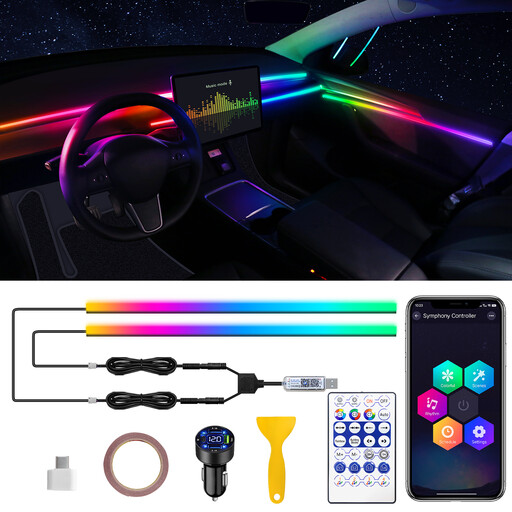
MATCH FOR: Beginners Focused on the Essentials
Dreamcolor Acrylic Interior Car LED Strip Light with USB/Type C, RGB 2 in 1

Dreamcolor Acrylic Interior Car LED Strip Light with USB/Type C, RGB 2 in 1

Why This Fits Their Persona: Ideal for users looking for a straightforward and quick dashboard upgrade. The USB/Type-C power supply eliminates the need for complex wiring to the fuse box, allowing for a plug-and-play installation.

How It Avoids the Trap

The acrylic light guides with integrated LEDs provide bright, even illumination across the dashboard, thus avoiding the problem of patchy light strips.

Key Advantage & Pros

Simple installation via USB; Dreamcolor technology for dynamic effects; Control via app, remote, or touch button.

MATCH FOR: Tech Enthusiasts
Acrylic Interior Car LED Strip Light with Wireless APP, 14 in 1

Acrylic Interior Car LED Strip Light with Wireless APP, 14 in 1

Why This Fits Their Persona: Perfect for DIYers seeking a comprehensive solution for the dashboard, doors, and footwells. The kit offers a wide array of light elements and centralised control for a cohesive look.

How It Avoids the Trap

The system, featuring one main controller and four sub-controllers, prevents a messy tangle of wires, as the strips in the doors and footwells connect locally to the sub-controllers.

Key Advantage & Pros

Comprehensive 14-in-1 kit for full interior illumination; Music sync via an integrated microphone; App control for colours and modes.
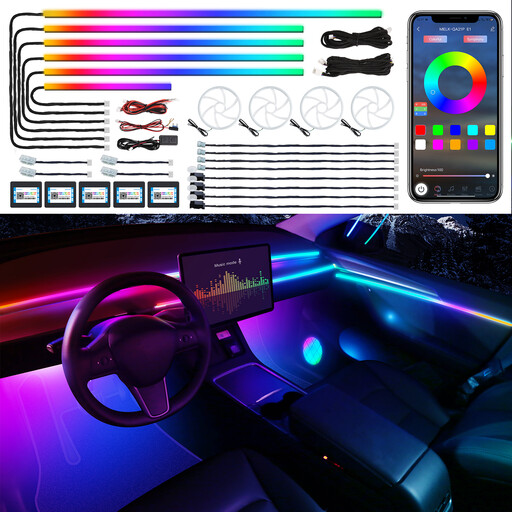
MATCH FOR: Customisers Demanding a Complete Setup
Dreamcolor Acrylic Interior Car LED Strip Light with Wireless APP, RGB 22 in 1

Dreamcolor Acrylic Interior Car LED Strip Light with Wireless APP, RGB 22 in 1

Why This Fits Their Persona: For drivers who make no compromises and want complete, detailed illumination of the entire interior—including door handles, storage compartments, and even speaker surrounds.

How It Avoids the Trap

The advanced app control with dual-zone functionality ensures stable and personalised operation. Different areas of the car can be controlled independently in colour and mode, going far beyond the capabilities of a basic app.

Key Advantage & Pros

Massive 22-in-1 package; RGB-IC technology for dynamic colour gradients; Dual-zone app control for maximum customisation.

Looking for More Options?

We have compiled a complete, real-time list of products that fully satisfy these strict selection criteria and UK safety regulations.

Frequently Asked Questions (FAQ)

1. Can you install ambient car lighting yourself? Yes, most aftermarket kits are designed for DIY installation. The light strips are typically wedged into the gaps between the trim panels of the dashboard and doors. Power is usually supplied via the cigarette lighter or by a direct connection to the 12V fuse box. An included pry tool makes it easier to open the panel gaps.

2. How is the interior LED lighting powered in a car? There are two common methods:

  • Cigarette Lighter/12V Socket: This is the simplest plug-and-play solution, requiring no modification to the vehicle's electrical system.
  • Hardwiring: This involves connecting the kit directly to the fuse box. This allows for a hidden installation and often enables the lighting to turn on automatically with the ignition. This method requires a basic understanding of vehicle electrics.

3. What is the difference between RGB and Dreamcolor (RGB-IC)?

  • RGB: A standard RGB LED strip can only display a single colour across its entire length at any given time. While you can change the colour (e.g., from red to blue), you cannot display red and blue simultaneously.
  • Dreamcolor (RGB-IC): These strips have an "Independent Chip" (IC) for each LED segment. This allows each section of the strip to be controlled independently. It enables dynamic effects like rainbow gradients, chasing lights, and more complex animations that are not possible with standard RGB.