
Lieferung heute & morgen

Qualitätsgarantie

Willkommens-Angebote freischalten: KOSTENLOSE Lieferung | Bis zu 80 % RABATT | Kostenlose 30-Tage-JoyPlus-Testphase
App herunterladen
A custom LED interior car lighting setup enhances the driving experience and gives your vehicle a personal touch. However, the market for retrofit kits is crowded and confusing. Anyone looking to retrofit ambient car lighting faces a vast array of products whose quality differences often only become apparent after installation. This guide highlights the key criteria for selecting the right system and helps you avoid common purchasing mistakes.
Many vehicle owners invest in car atmosphere lighting, only to be disappointed by uneven illumination or technical flaws shortly after. Three problems are particularly common:
To avoid these issues, you should carefully examine three technical aspects before making a purchase. These factors are crucial in determining the quality, longevity, and user experience of your new ambient lighting.
The type of light guide is critical for achieving uniform illumination. Modern systems rely on acrylic light strips for the car interior. Unlike passive fibre optics, these acrylic strips have LEDs directly integrated and distributed throughout.
The control over colours and effects is a key feature. There is a significant technological difference here:
The "5-in-1", "14-in-1", or "22-in-1" designation refers to the number of individual light components and control units in the kit. A comprehensive kit allows for a complete and clean installation. Look for kits that include one main controller and several sub-controllers. This design enables a decentralised power supply for individual elements (e.g., in the doors) while still synchronising them via the main controller. For example, this makes it easy to retrofit footwell lighting without having to run long cables across the vehicle.
Based on the quality criteria mentioned, we have put together various configurations for different user profiles.
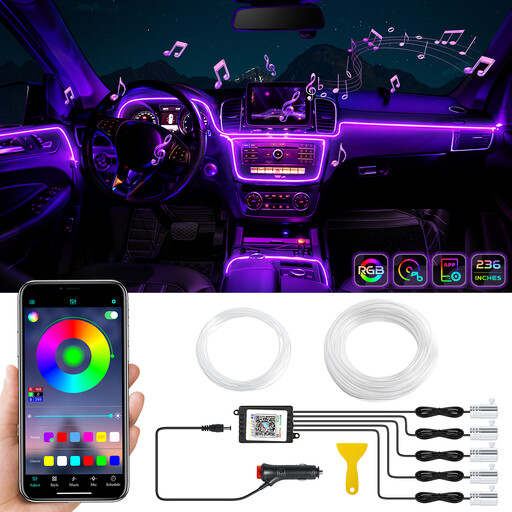
Why This Fits Their Persona: Ideal for beginners aiming for a targeted upgrade of the dashboard and centre console. The kit focuses on the essential areas, preventing overwhelm for a first-time installation due to its manageable scope.
The continuous, 6-metre light guide is powered by 5 LED sources. This ensures significantly more uniform illumination than basic single-point systems and prevents dark spots.
Simple plug-and-play installation via the 12V socket. The light guide is flexible and can be cut to size, allowing for universal adaptation to almost any vehicle cockpit.

Why This Fits Their Persona: For vehicle owners who want complete and harmonious interior lighting. This kit covers the dashboard, doors, door handles, storage compartments, and the footwell.
The modular system, with one main and four sub-controllers, prevents cable clutter. The acrylic light guides with Dreamcolor technology guarantee brilliant and uniform illumination in all areas.
A very comprehensive package for a full conversion. Control via the "Magic Lantern" app enables dynamic colour changes and music synchronisation.

Why This Fits Their Persona: For users who demand maximum control and customisation. The dual-zone function allows different areas of the interior to be illuminated independently with various colours and effects.
This kit goes beyond standard apps, offering advanced features like dual-zone control via the "LotusLamp X" app. The high LED count (600 LEDs) ensures above-average brightness and colour vibrancy.
The ability to control two light zones (e.g., dashboard and footwell) separately opens up a high degree of personalisation. The system is modular and designed for complete interior coverage.
We have compiled a complete, up-to-date list of products that fully meet these strict selection criteria.
Yes, most acrylic or fibre optic light guides in retrofit kits are designed to be cut to the required length by the user. However, it is crucial to follow the manufacturer's instructions carefully. With some acrylic strips that have integrated LEDs, you must be careful not to cut through a resistor or an LED, as this could impair the function of the remaining strip.
The most common methods are connecting to the 12V cigarette lighter socket or hardwiring to the vehicle's fuse box. Plug-and-play kits with a 12V plug are the easiest for DIY installation and require no modifications to the vehicle's electrical system. Hardwiring offers a seamless, hidden installation but should be carried out by a professional workshop if you are unsure.
High-quality retrofit kits are designed for 12V operation and include safety features like short-circuit protection. When installed correctly according to the manufacturer's instructions, no interference with the onboard electronics is expected. These systems have a very low power draw and typically do not place any additional strain on the vehicle's electrical system.