
Lieferung heute & morgen

Qualitätsgarantie

Willkommens-Angebote freischalten: KOSTENLOSE Lieferung | Bis zu 80 % RABATT | Kostenlose 30-Tage-JoyPlus-Testphase
App herunterladen
A custom-designed car ambient lighting system can completely transform the driving experience, lending the interior a modern, personal touch. However, the market for retrofit kits is crowded and confusing. Many products overpromise and underdeliver, leading to disappointment instead of an atmospheric ambiance. Before you make a decision, it's crucial to know the most common pitfalls and understand which technical features truly matter.
This guide will help you separate the wheat from the chaff. We'll highlight the typical shortcomings of budget-friendly kits and explain which parameters you should focus on to find a durable and functional solution for your vehicle.
The selection of LED strips for car interiors is vast, but not all products are created equal. Watch out for these three common weaknesses to avoid making a bad purchase:
To avoid the problems mentioned above, you should concentrate on objective technical specifications. These three parameters are decisive for the quality and functionality of your new ambient lighting.
The type of light strip is fundamental to the visual quality.
The control technology determines the variety of lighting effects.
Terms like "10-in-1" or "18-in-1" refer to the number of individual light sources and controllers in the set. A typical kit may include:
Look for kits with a modular design featuring a main controller and several sub-controllers. This simplifies the wiring, as not every single element needs to be routed directly to the main controller. Power is usually supplied via the 12V socket (cigarette lighter), which makes installation easier.
Based on the criteria above, we have selected a few products from our range that are suitable for different user profiles.
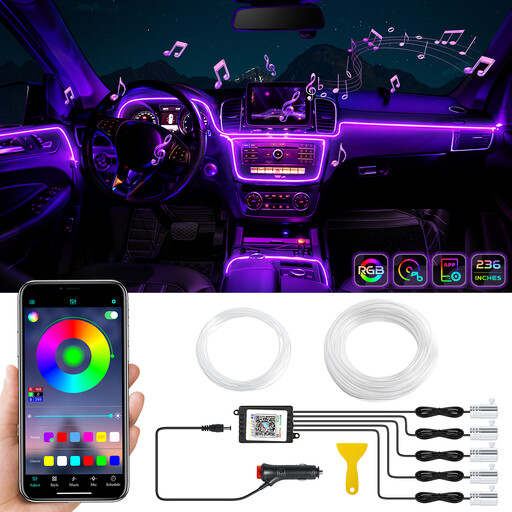
Why This Fits Their Persona: Ideal for users looking for a simple and affordable solution to get started with ambient lighting. The kit focuses on basic illumination for the dashboard and centre console.
The kit uses a long fibre optic cable that can be cut to size. The product description suggests connecting an LED to both ends of a fibre for higher brightness, which counteracts the drop in luminosity.
Simple installation via the 12V socket (plug-and-play). Control is managed through the well-established "Lotus Lantern" app, which offers basic RGB colour changes and a music mode.
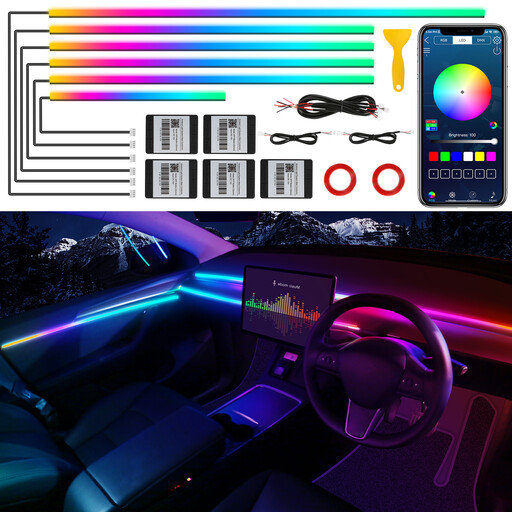
Why This Fits Their Persona: Perfect for tuning fans who value dynamic lighting effects. This kit specialises in "Dreamcolor" (RGBIC) technology to create flowing colour gradients and music-synchronised animations.
By using Acrylic Light Strips with integrated LEDs, it ensures high and uniform brightness, which is essential for displaying dynamic "Dreamcolor" effects. No brightness drop-off.
The RGB Smart IC technology enables complex lighting modes. The "LED LAMP" app also offers dual-zone control, allowing different areas of the car to be lit independently.

Why This Fits Their Persona: This comprehensive kit is aimed at car owners who want a complete and seamless integration of lighting throughout the entire interior, including the dashboard, doors, footwells, handles, and storage compartments.
The system uses one main controller and four sub-controllers. This significantly reduces cable clutter, as the lights in the doors and other areas connect to the nearest sub-controller instead of running all wires across the car.
Comprehensive 18-in-1 kit with 600 LEDs for maximum coverage and brightness. The "LotusLamp X" app enables dual-zone control, so the footwell lighting can be a different colour from the light strips, for example.
We've compiled a complete, real-time updated list of products that fully meet these strict selection criteria and UK safety regulations.
1. Can you retrofit car ambient lighting yourself? Yes, most kits available on the market are designed as car tuning accessories for self-installation (DIY). They usually come with the necessary tools, such as a pry tool. The light strips are typically wedged into the gaps between the trim panels of the dashboard or doors. Powering the system via the 12V socket requires no interference with the vehicle's electronics.
2. How is the LED interior lighting powered? The most common and simplest method is to connect it to the vehicle's 12V socket (cigarette lighter). Many kits come with a suitable adapter. Advanced users also have the option to wire the system directly to the fuse box for an invisible installation. However, this should only be done with adequate knowledge of vehicle electrics. All models presented here operate on a safe 12V operating voltage.
3. What is the difference between RGB and RGBIC (Dreamcolor)? The difference lies in how the LEDs are controlled. With a standard RGB strip, all LEDs always light up in the same colour. You can change the colour, but only one colour is visible at a time. With RGBIC (Dreamcolor), each LED segment has its own chip and can be controlled independently of the others. This allows for dynamic effects such as colour gradients, chasing lights, or rainbow animations on a single strip.