
Lieferung heute & morgen

Qualitätsgarantie

Willkommens-Angebote freischalten: KOSTENLOSE Lieferung | Bis zu 80 % RABATT | Kostenlose 30-Tage-JoyPlus-Testphase
App herunterladen
A flat car battery always seems to happen at the worst moment: on the commuter car park, just before a holiday trip, or while camping far from a garage. A car battery booster can be a practical alternative to jump leads and relying on a stranger’s help in these situations. However, these devices differ significantly in starting current, vehicle compatibility, operation and extra features.
As Joybuy’s Product Recommendation Officer, I’ve filtered the key details from the product data to show you what motorists in the UK should look for when buying. It’s not about the biggest numbers on the box, but about finding the right combination of 12-volt compatibility, safety features and realistic use cases.
Many products boast a high Peak Current – the maximum current possible for a very short burst. This figure alone, however, doesn’t tell you how well a device will start your car in real-world conditions. You should also check the stated starting current, the maximum engine size it can handle, and whether it’s suitable for petrol or diesel engines.
A small petrol car generally needs different reserves to a large diesel in an SUV, van or motorhome. Figures like “up to 10.0 litres diesel” or “up to 6.0 litres petrol” are manufacturer estimates and shouldn’t be taken as a guarantee for every vehicle.
With a jump starter power bank, capacity figures in mAh and Wh can differ. What’s more, the usable capacity is lower than the nominal rating because energy is lost during voltage conversion. So when buying, you need to look at several pieces of data together:
A booster that sits unused in the boot for months should be checked regularly and charged according to the manufacturer’s instructions.
A jump starter with a compressor can be handy if your tyre pressure is low. However, the maximum pressure in PSI isn’t the same as pumping speed. For everyday use, a clear display, automatic shut-off and suitable valve adaptors are often more important than a high maximum figure.
USB outputs, a power bank for the car, an LED emergency light or a 12-volt output are also practical. You should consider whether you actually need these features. A compact device without a compressor can be stored more easily in the glovebox, while a multi-function unit offers more versatility for campers and travellers.
First, check your vehicle’s electrical system: the devices featured here are designed for 12-volt vehicles. This typically includes cars, motorcycles, SUVs, vans and certain boats. For large diesel engines, you should check the manufacturer’s limits particularly carefully.
A petrol jump starter with sufficient reserve can be enough for many cars. For a diesel, a vehicle with a large battery, or a van, higher current reserves and robust clamps make sense. Hybrid vehicles should only be used if the manufacturer explicitly states compatibility.
Safety features are among the most important selection criteria. Look for:
Smart battery clamps can detect an incorrect connection. However, they don’t replace the need to check the terminals. Red goes to the positive terminal, black to the negative terminal or a suitable earth point as per the instruction manual. Damaged, leaking or frozen batteries must not be started with a booster.
A portable jump starter should be stored in a dry, clean place away from strong heat. Temperatures inside a parked vehicle can rise significantly, so check the stated operating and storage temperature.
After use, the device should be recharged. For long periods without use, many manufacturers recommend regular recharging – for example, every two to six months. Always follow the specific instruction manual.

Why this product fits the profile: This compact 12-volt booster is ideal for drivers looking for a basic car jump starter with power bank and light functions.
The specs state 1200 A peak current, 600 A starting current and clear suitability for 12-volt petrol and diesel vehicles. The stated dimensions of 165 × 84 × 30 mm make storage easy.
12800 mAh battery rating, LCD display, USB output and LED with constant light, strobe and SOS modes.
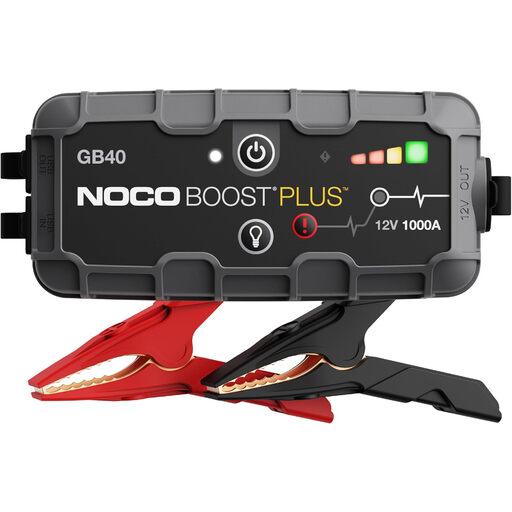
Why this product fits the profile: This model is aimed at users who value compact design, safety features and clearly defined vehicle coverage.
The product data mentions spark and reverse polarity protection, plus an IP65-certified housing. The engine limits are up to 6.0 litres petrol and 3.0 litres diesel.
1000 A peak current, 100-lumen LED with seven modes and power bank function, weighing around 1.1 kg.
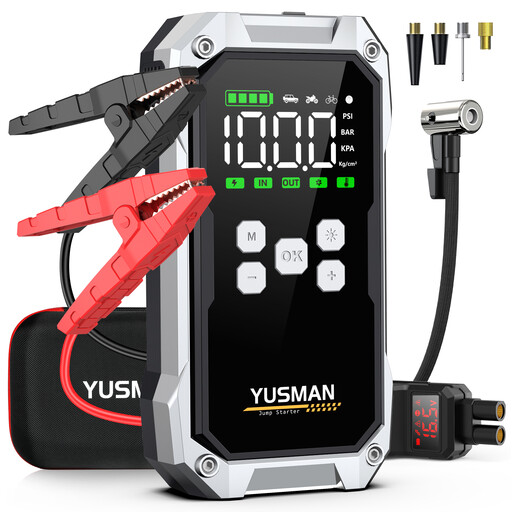
Why this product fits the profile: For families, campers and travellers, the combination of diesel jump starting, a car air compressor and USB charging is particularly relevant.
The specs mention intelligent protection against short circuits, overheating, overload and reverse polarity. Tyre pressure is shown on the LCD display.
5000 A peak current, 21800 mAh capacity rating and integrated compressor with a maximum of 150 PSI.
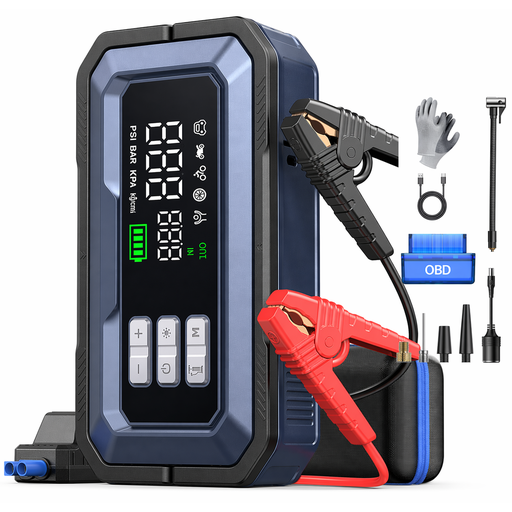
Why this product fits the profile: This model is designed for users with larger vehicles and multiple requirements around jump starting, tyres, lighting and 12-volt accessories.
The product description lists 10 safety features, temperature monitoring and automatic compressor shut-off at the preset pressure.
7000 A peak current, 150-PSI compressor, 160-watt DC output, 18-watt PD charging and OBD2 adaptor.
We’ve put together a full, regularly updated list of products that fully meet these strict selection criteria and the safety regulations in force across the EU.
First, switch off all electrical consumers and the ignition. Connect the jump lead to the booster, then attach the red clamp to the positive terminal and the black clamp to the negative terminal or a suitable earth point. Wait for the “ready” indicator or the corresponding signal from the device, then start the engine following the instructions. After starting, remove the clamps. The exact order may vary depending on the model.
The lifespan depends on the battery chemistry, storage conditions, charge cycles and usage. Regular checks, dry storage and recharging according to the manufacturer’s instructions help maintain readiness. A device with a damaged housing, swollen battery or faulty cables should not be used.
Even unused lithium batteries slowly lose charge. In addition, high temperatures inside the vehicle can accelerate ageing. So you should check the charge level before longer journeys and recharge the device during extended periods without use, following the manufacturer’s guidelines.