
Lieferung heute & morgen

Qualitätsgarantie

Willkommens-Angebote freischalten: KOSTENLOSE Lieferung | Bis zu 80 % RABATT | Kostenlose 30-Tage-JoyPlus-Testphase
App herunterladen
A click, a stutter, then silence—a dead car battery is more than just an annoyance, especially on a cold morning or when you have an important appointment. A reliable car battery charger is therefore a wise investment for many vehicle owners. But the market is overwhelming and full of technical promises. Not every device delivers on its claims, and in the worst-case scenario, a bad purchase can damage your expensive vehicle battery.
As your Joybuy Product Recommendation Officer, I'm here to help you separate the wheat from the chaff. We'll highlight the most common pitfalls and show you which technical features truly matter, so you can make an informed decision.
Marketing claims can be misleading. Many devices advertise features that have limited practical use or even pose risks if not implemented correctly.
To avoid the pitfalls mentioned above, you should check three core technical aspects before buying. These determine the safety, efficiency, and longevity of your battery.
The most critical factor is the match between the charger and the battery. Check the charger's specifications carefully.
The charging current, measured in Amperes (A), determines the charging speed. The choice depends on the battery capacity (in Amp-hours, Ah) and the intended use.
A rule of thumb for charging time is: Battery Capacity (Ah) / Charging Current (A) ≈ Charging Time in Hours.
An intelligent charger is standard today and offers crucial safety features. Look for the following characteristics:
Based on the objective criteria mentioned above, we have identified some products that are well-suited for specific user profiles.
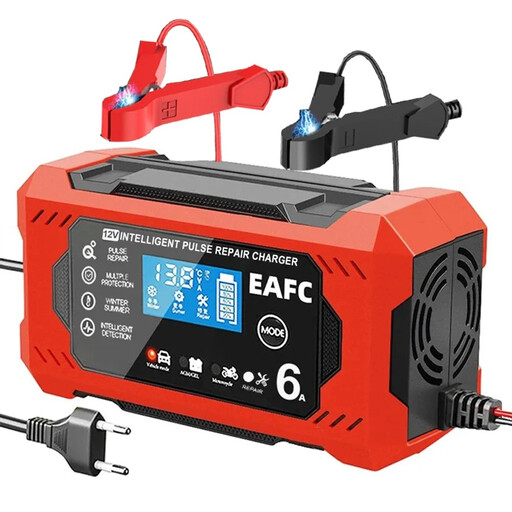
Why This Fits Their Persona: A straightforward and cost-effective solution for standard cars and motorcycles. With a 6A charging current, it is sufficiently powerful to charge common lead-acid batteries (including AGM and Gel) overnight or as needed.
The device focuses on core functions: it is explicitly suitable for AGM and Gel batteries and features microprocessor-controlled charging with the necessary safety features, without making exaggerated repair promises.
Automatic switching mode and LCD display for easy operation. Provides basic safety features like reverse polarity and short-circuit protection.
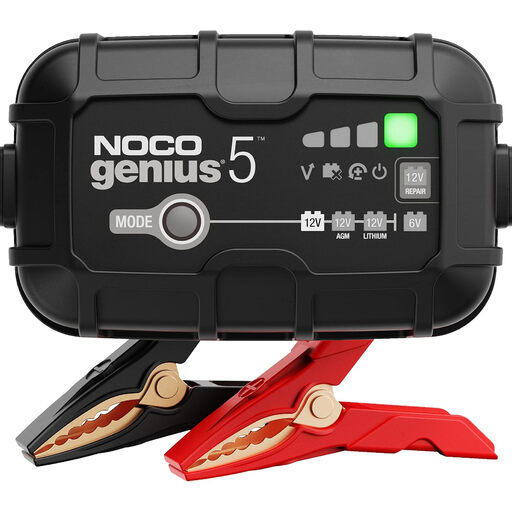
Why This Fits Their Persona: Ideal for drivers of modern vehicles with start-stop batteries (AGM/EFB) or for owners of motorcycles and classic cars who need reliable maintenance charging over the winter. Covers a wide range of battery types.
This device addresses the pitfalls directly: it explicitly supports AGM and lithium batteries and, according to the manufacturer, has an integrated thermal sensor that adapts the charging cycle to the environment, thus protecting the battery.
Broad compatibility with 6V and 12V lead-acid and lithium batteries. The desulfation and maintenance functions are designed for long-term battery care.

Why This Fits Their Persona: For owners of SUVs, vans, RVs, or multiple vehicles. The high 10A charging current significantly reduces charging time for large batteries (up to 230 Ah) and offers performance headroom.
Offers the same advanced compatibility and safety features as the GENIUS5, but with double the power. The "Force Mode" for reviving batteries with 0V is a real technical function for experienced users, not an empty marketing promise.
High charging current of 10 Amps for fast charging. According to the manufacturer, it can revive deeply discharged batteries from as low as 1V. Integrated thermal sensor for optimized charging cycles.
We have compiled a complete, up-to-date list of products that fully meet these strict selection criteria and safety regulations.
1. How long does it take to charge a car battery? The charging time depends on three factors: the battery's capacity (in Ah), its current state of charge, and the charger's current (in A). You can get a rough estimate by dividing the battery capacity by the charging current. A 60 Ah battery that is 50% discharged will take about 6 hours to fully charge with a 5A charger (30 Ah / 5 A = 6 h).
2. Can I leave a car battery charger connected permanently? Yes, if it is a modern, intelligent charger with an automatic maintenance charging function. Such devices monitor the state of charge and switch to a maintenance mode after the battery is full. They only deliver small current pulses as needed to compensate for self-discharge. This is ideal for winterizing seasonal vehicles.
3. How do I know if my charger is suitable for my start-stop battery (AGM/EFB)? Check the product description and technical specifications of the charger. It must explicitly list compatibility with "AGM" or "EFB". Many devices have a special mode that can be selected with the push of a button. Using an unsuitable charger can shorten the lifespan of these special battery types.