
Lieferung heute & morgen

Qualitätsgarantie

Willkommens-Angebote freischalten: KOSTENLOSE Lieferung | Bis zu 80 % RABATT | Kostenlose 30-Tage-JoyPlus-Testphase
App herunterladen
A dead car battery is more than just an annoyance—it means lost time and unexpected hassle. However, when searching for a car battery charger, you're quickly flooded with marketing promises and technical specs. Not every device delivers on its claims. Many buyers invest in products that fail when they're needed most or are unsuitable for their vehicle.
Before you make a decision, you should know the most common pitfalls that lead to a bad purchase:
To ensure your new device reliably serves its purpose, you should check three core technical parameters. These determine the performance, safety, and longevity of your battery.
The charging current, measured in Amperes (A), indicates how quickly a battery is charged. Your battery's capacity is specified in Ampere-hours (Ah). A simple rule of thumb is that the charging current should be about 10% of the battery capacity to ensure an efficient and gentle charge.
Choosing the wrong charging program can ruin an expensive battery. Therefore, check carefully which battery types the charger supports.
Define your primary use case to find the right device.
Based on these criteria, we have put together a selection of products that are suitable for specific user groups and their requirements.

Why it's a good fit: This device is a reliable, smart charger for drivers who want a hassle-free solution for regular maintenance and charging of their 6V and 12V batteries. It's easy to use and covers the most common vehicle and battery types.
It avoids the compatibility trap with explicit modes for AGM and lithium (LiFePO4) batteries. As a dedicated charger, it focuses on a high-quality charging and maintenance function instead of offering weak additional features.
Integrated thermal sensor to adapt charging cycles to the ambient temperature. Features a desulfator mode to restore battery performance.

Why it's a good fit: For drivers who want maximum peace of mind in emergencies. With 4000A of peak current, this device reliably starts even large petrol and diesel engines. The extremely fast charging function gets it ready to go again in no time.
This device is a specialised jump starter power bank, not a weak compromise. It focuses on extremely high jump-starting power and rapid recharging, which is often lacking in multi-function devices.
Very high peak current of 4000A. Supports 100W two-way fast charging, allowing the device itself to be fully recharged in just 1.2 hours. Also serves as a powerful power bank for laptops.
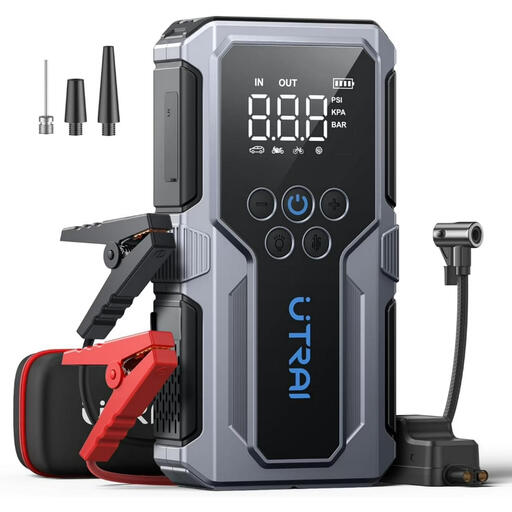
Why it's a good fit: This multi-function device is a solid choice for anyone needing a versatile emergency tool on the go. It combines a powerful jump starter with a useful air compressor for inflating tyres—ideal for RVs, SUVs, and camping trips.
It avoids the trap of the weak multi-function device by delivering solid performance specs for each function: 3000A peak current for jump-starting and a 150 PSI compressor are more than sufficient for most applications.
Combines a jump starter, air compressor, and power bank in one compact unit. The digital LCD screen clearly displays battery status and tyre pressure.
We have compiled a complete, up-to-date list of products that fully meet these strict selection criteria and safety standards.
1. How long does it take to fully charge a car battery? The charging time depends on the battery's capacity (in Ah), its state of charge, and the charger's current (in A). As a rough estimate, you can divide the battery capacity by the charging current. A 60 Ah battery that is 50% discharged will take about 6 hours with a 5A charger (30 Ah / 5 A = 6 h). Smart chargers optimise the process, which can affect the duration.
2. Can a charger revive a deeply discharged battery? Yes, many modern smart chargers have a special mode for reviving deeply discharged batteries (often below 8V). Devices like the NOCO GENIUS5 can even recover batteries with as little as 1V. However, if a battery is physically damaged or heavily sulfated, revival is often no longer possible.
3. Is a battery maintainer a good idea for my seasonal vehicle (motorcycle, classic car)? Absolutely. A battery maintainer monitors the battery voltage and only applies a charge when needed. This prevents self-discharge during long periods of inactivity, counteracts sulfation, and maximises the battery's lifespan. It's a small investment that can prevent the costly, premature replacement of a battery.