
Lieferung heute & morgen

Qualitätsgarantie

Willkommens-Angebote freischalten: KOSTENLOSE Lieferung | Bis zu 80 % RABATT | Kostenlose 30-Tage-JoyPlus-Testphase
App herunterladen
A weak or dead car battery is more than just an annoyance—it can derail your plans and lead to unexpected costs, especially during the cold months. A suitable car battery charger is therefore a wise investment for any vehicle owner. However, the market is crowded and full of technical promises. Many devices advertise features that offer little practical benefit or can even be harmful to modern batteries.
Before you make a decision, it's crucial to understand the most common pitfalls. This ensures your money is well-invested and that you actually extend your battery's lifespan, rather than shortening it.
Choosing the wrong device often leads to frustration and, in the worst-case scenario, a damaged battery. Pay close attention to these three points to avoid making a poor purchase:
To find the right automotive battery charger, focus on the technical specifications that truly matter. These three core parameters are crucial for performance and safety.
The most fundamental characteristic is voltage. Most cars and motorcycles use a 12V system. In contrast, trucks, some RVs, and agricultural machinery use 24V systems. Some chargers are switchable and cover both voltage ranges.
Even more important is compatibility with the battery type. A smart battery charger automatically detects the connected battery type or can be set manually. Ensure the device is explicitly suitable for your battery type:
The charging current, measured in Amperes (A), determines the charging speed. A good rule of thumb for selection is that the recommended charging current should be about 10% of the battery's capacity (Ah). For a 60 Ah car battery, a charger with around 6 A would be ideal.
Furthermore, a smart battery charger offers multi-stage charging cycles (e.g., desulphation, bulk charge, analysis, maintenance charge) that protect the battery and maximise its lifespan.
Instead of presenting an overwhelming list, we have matched select products to typical use cases.
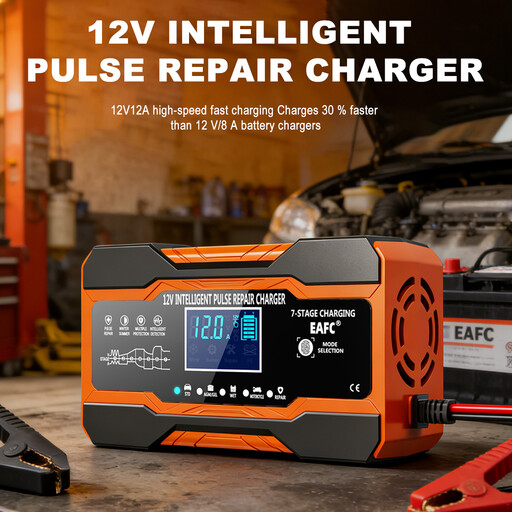
Why it's a good fit: Ideal for drivers looking for a powerful and versatile charger for standard 12V systems without a large budget. It covers the most common use cases, from rapid charging to maintenance.
This device offers explicit modes for AGM and GEL batteries, thus avoiding the incompatibility pitfall common with basic chargers.
With 12A, it provides a strong charging current for car batteries and includes a pulse repair mode for maintaining older batteries.

Why it's a good fit: Perfect for owners of multiple vehicles (e.g., a car and a motorcycle) or classic cars who prioritise precise, gentle charging and maintenance to maximise battery lifespan.
As a highly advanced smart charger, it precisely adapts the charging cycle to the battery's condition and type, including 6V, 12V, AGM, and Lithium (LiFePO4). This prevents damage from incorrect charging profiles.
Features precise charge control and a desulphation function. The moderate 5A charging current is ideal for maintenance charging and for both car and motorcycle batteries.

Why it's a good fit: The right choice for owners of SUVs, vans, RVs, or workshops who need to charge both 12V and 24V systems and require high charging power for large-capacity batteries.
It delivers the necessary high power (up to 400W) to charge large batteries efficiently, avoiding the pitfall of an underpowered charger that would be unsuitable for such tasks.
The ability to switch between 12V and 24V offers maximum flexibility for a mixed fleet of vehicles. Its robust metal housing is designed for demanding use.
We have compiled a complete, up-to-date list of products that fully meet these strict selection criteria and safety standards.
The charging time depends on three factors: the battery's capacity (in Ampere-hours, Ah), its state of discharge, and the charger's current (in Amperes, A). You can get a rough estimate with this formula: (Battery Capacity in Ah / Charging Current in A) x 1.2 = Approximate Charging Time in Hours. The 1.2 factor accounts for charging losses. For example, a 70 Ah battery that is 50% discharged (requiring 35 Ah) will take approximately 8.4 hours to charge with a 5 A charger.
In some cases, modern smart chargers with a repair or reconditioning mode can. If a battery has lost capacity due to sulphation, targeted electrical pulses can partially dissolve these crystals. However, if the battery's voltage has dropped below a critical level (often under 7-8V) or if there is an internal cell short, most chargers will no longer recognise the battery for safety reasons, or the revival attempt will fail.
Yes, as long as you are using a smart battery charger with a built-in maintenance charging function. These devices continuously monitor the battery's state of charge. Once the battery is full, they switch to a maintenance mode, delivering only a minimal current to compensate for self-discharge. This prevents overcharging and keeps the battery ready to start for months. With basic chargers lacking this automatic feature, there is a risk of overcharging, which can damage the battery.