
Lieferung heute & morgen

Qualitätsgarantie

Willkommens-Angebote freischalten: KOSTENLOSE Lieferung | Bis zu 80 % RABATT | Kostenlose 30-Tage-JoyPlus-Testphase
App herunterladen
A weak or dead car battery is more than just a nuisance—it can disrupt your plans and lead to unexpected costs. Battery performance often degrades after long periods of inactivity, such as with seasonal vehicles or during the cold season. A suitable car battery charger is therefore a wise investment. However, the market is crowded and full of marketing promises. Before you make a decision, you should be aware of the most common pitfalls that can lead to a bad purchase.
Many devices advertise features that don't live up to their promises in practice, or they lack crucial functions for modern vehicles.
To find the right device for your needs, focus on two core technical aspects that determine performance and safety.
The charging current, measured in Amperes (A), determines how quickly a battery is charged. A simple rule of thumb is that the charging current should be about 10% of the battery's capacity (Ah). A 12V charger with 6A is sufficient for most car and motorcycle batteries (approx. 40-100 Ah). For larger batteries in SUVs, vans, or RVs, models with 10A, 15A, or more are a better choice to reduce charging time.
Even more important is compatibility. Ensure that the charger is explicitly designed for your vehicle's battery type. A smart charger often offers selectable modes for:
A dedicated AGM charger or LiFePo4 charger precisely adjusts the charging voltage and cycle to meet the requirements of these battery technologies.
Modern chargers are more than just power sources. A smart charger monitors the battery's condition and adjusts the charging process in multiple stages. This protects the battery and maximises its lifespan.
The function as a maintenance charger is especially valuable. In this mode, the device can remain permanently connected to the battery without overcharging it. It compensates for self-discharge and keeps the battery always ready to go—ideal for convertibles, classic cars, boats, or a motorcycle battery charger during winter storage.
Instead of presenting a confusing list, we have matched some models based on typical user profiles.
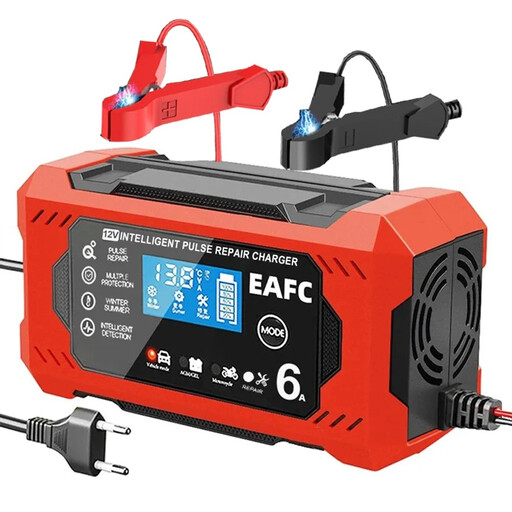
Why this model is a good fit: Ideal for drivers looking for a reliable and straightforward solution for standard car or motorcycle batteries. It covers basic charging and maintenance needs without breaking the bank.
Provides all necessary safety features like reverse polarity and overheat protection and is suitable for common battery types (AGM, GEL, Lead-Acid). This prevents the purchase of an unsafe or incompatible cheap device.
Microprocessor-controlled, automatic charging process; LCD display for status and a pulse repair mode.
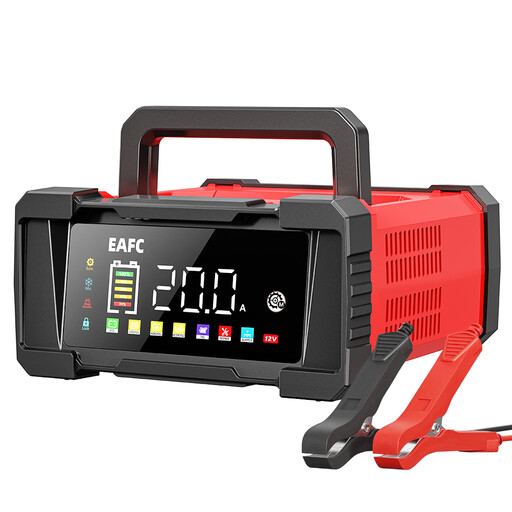
Why this model is a good fit: Perfect for owners of SUVs, vans, or multiple vehicles. The high 20A charging current significantly shortens waiting times, and its compatibility with 12V and 24V systems, as well as LiFePo4 batteries, offers maximum flexibility.
This device bypasses the compatibility trap with its 7 selectable charging modes, explicitly designed for AGM/GEL, LiFePo4, and other battery types. You are buying a future-proof device for almost any battery.
High charging current (20A for 12V); 12V/24V switching; 9-stage charging cycle and comprehensive protection features.

Why this model is a good fit: For anyone who prefers a multifunctional emergency tool over a dedicated charger. It combines a powerful jump starter for petrol and diesel vehicles with a 150 PSI air compressor and a power bank.
This device clearly positions itself as a jump starter, not just a charger. It avoids the trap of unrealistic repair promises by focusing on its core function: quickly starting a vehicle in an emergency.
3-in-1 functionality: Jump starter, tyre inflator, and power bank; compact design with a digital display and LED emergency light.
We have compiled a complete, up-to-date list of products that fully meet these strict selection criteria and safety standards.
1. How long does it take to charge a car battery? The charging time depends on the battery's capacity (in Ah) and the charger's current (in A). As a rough estimate, you can divide the battery capacity by the charging current and add about 10-20% for charging loss. A 60 Ah battery will take approximately 11-12 hours to fully charge with a 6A charger.
2. Can a charger revive a deeply discharged battery? It depends on the level of deep discharge and the battery's condition. Many smart chargers with a pulse repair mode can often revive a battery whose voltage has dropped below the normal level. However, if the battery is internally damaged or its voltage has reached a critical low point (often below 8V), recovery is usually no longer possible.
3. What exactly is a maintenance charger? A maintenance charger is designed to keep a battery at its optimal state of charge over a long period (weeks or months). It delivers a very low current to compensate for natural self-discharge without overcharging the battery. This is the ideal solution for seasonal vehicles like motorcycles, convertibles, or RVs during their storage period.