
Lieferung heute & morgen

Qualitätsgarantie

Willkommens-Angebote freischalten: KOSTENLOSE Lieferung | Bis zu 80 % RABATT | Kostenlose 30-Tage-JoyPlus-Testphase
App herunterladen
A weak or dead car battery is often why a vehicle won't start, especially on cold mornings. Instead of waiting for roadside assistance or paying for a costly battery replacement at a workshop, the right car battery charger can be a practical and cost-effective solution. It not only recharges the battery but, with many models, also provides maintenance and even reconditioning.
This guide will help you navigate your options. We'll explain the key features of modern chargers and present a selection of devices suitable for various applications, from simply charging a car battery to maintaining truck and marine batteries.
The market is filled with a wide variety of chargers. To find the right model for your needs, a few technical aspects are crucial.
The most fundamental feature is the supported voltage. Most cars, motorcycles, and lawnmowers use 12V batteries. In contrast, trucks, buses, or some boats are often equipped with 24V systems. A 12V/24V car battery charger offers the greatest flexibility, as it covers both voltage levels and is therefore suitable for a mixed fleet of vehicles.
Compatibility with the specific battery type is also important. Modern vehicles use different technologies:
A smart charger often detects the connected battery type and voltage automatically, selecting the appropriate charging program.
Modern chargers can do more than just charge. Two functions are particularly useful:
Some chargers have a built-in battery tester that analyses the battery's condition before charging. This provides insight into whether the battery can still hold a charge. Key safety features also include protection against reverse polarity, overheating, short circuits, and overvoltage, ensuring safe use even for novices.
Based on the criteria mentioned, we have compiled a selection of products that cover different needs.
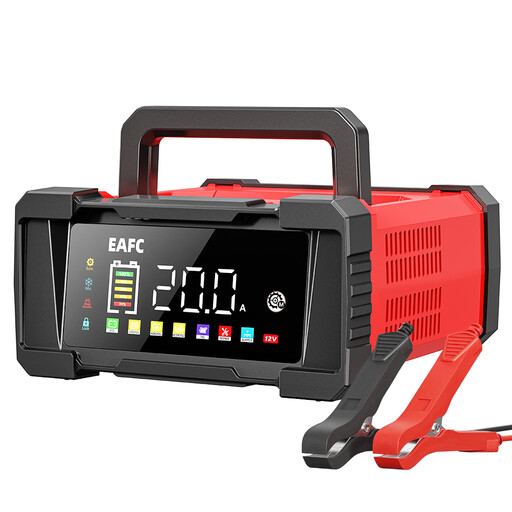
Why it stands out: This device combines high charging power (20A at 12V, 10A at 24V) with broad compatibility. It supports not only common lead-acid batteries (AGM, GEL, WET) but also modern LiFePO4 batteries. This makes it a flexible tool for households with various types of vehicles.
Advantages:
Who is it for? For car owners and DIY enthusiasts looking for a single, powerful device for their car, truck, motorcycle, boat, or lawnmower, who also value ease of use.
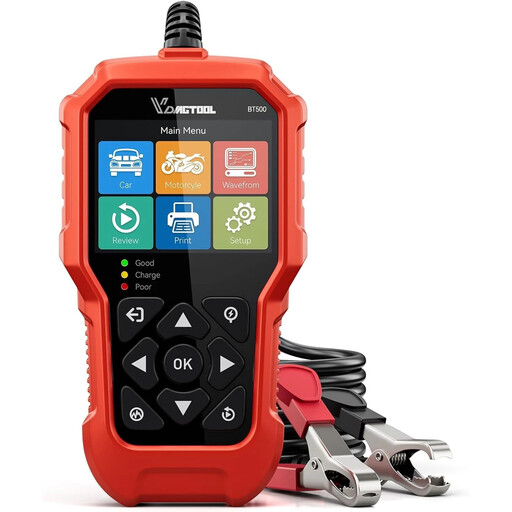
Why it stands out: The VDIAGTOOL BT500 is not a charger, but a specialised battery tester. It provides precise data on the health of the battery and the vehicle's charging system. It measures parameters like cold cranking amps (CCA), internal resistance, and performance during startup (cranking test) and while running (alternator test).
Advantages:
Who is it for? For advanced home mechanics, small workshops, and anyone who wants to perform an informed diagnosis before replacing a battery to avoid unnecessary costs.

Why it stands out: With a rated power of 400W and a peak current of up to 30A (at 12V), this charger is built for performance. Its robust metal casing makes it durable for use in the garage or workshop. It is designed to rapidly charge even large or deeply discharged batteries.
Advantages:
Who is it for? For users who need a powerful and durable truck battery charger or a solution for large car and commercial vehicle batteries, and who value simple, automatic operation.
The products featured here cover a broad spectrum of needs. For users who have specialised requirements for heavy commercial vehicles or other specific applications, our Truck Battery category offers an expanded selection of devices and accessories.
Yes, many modern chargers with a pulse repair function can, under certain circumstances, recondition deeply discharged lead-acid batteries. They attempt to reduce sulfation on the lead plates using targeted current pulses. However, this does not work on batteries with a shorted cell or other mechanical defects.
A regular charger either shuts off when the battery is full or must be disconnected manually. A battery maintainer is designed to remain connected indefinitely. It monitors the battery voltage and automatically delivers small charging currents as needed to keep the battery at an optimal state of charge. This is ideal for seasonal vehicles.
With daily use and a functioning alternator, external charging is generally not necessary. For vehicles that are only used for short trips or are left standing for weeks, it is recommended to connect the battery to a charger every 4 to 6 weeks, ideally in maintenance mode, to maximise its lifespan.