
Lieferung heute & morgen

Qualitätsgarantie

Willkommens-Angebote freischalten: KOSTENLOSE Lieferung | Bis zu 80 % RABATT | Kostenlose 30-Tage-JoyPlus-Testphase
App herunterladen
A car battery charger must be suitable not only for the vehicle battery, but also for the charging situation. A car with a start-stop system has different requirements from a motorcycle, motorhome or solar battery storage system. If you focus solely on a high amp rating or terms such as “Repair” and “Pulse”, you can quickly end up buying a device that is technically unsuitable for the battery.
A 12V battery charger is suitable for many cars, motorcycles and smaller boats. A 24V battery charger, on the other hand, is required for certain lorries, commercial vehicles or series-connected battery systems. A 12-volt charger must not be used with a 24-volt system.
The battery design is also crucial:
A device that supports several battery types will usually require you to manually select the appropriate charging programme. The term “intelligent” is therefore no substitute for checking the technical specifications.
A charger rated at 20 or 30 A can charge a larger battery faster than a 5 or 6 A device. However, a high charging current may be unsuitable for small motorcycle batteries. The permitted charging parameters specified by the battery manufacturer and the capacity in Ah are the deciding factors.
As a general guide, a 5 A charger is more suitable for small to medium battery capacities and long-term maintenance. A 10 to 20 A device is more practical for larger car batteries or more frequent charging. Its suitability must be checked against the specific product details.
A battery repair device or pulse charger may offer special charging and maintenance programmes, depending on the model. These functions can be helpful for certain battery conditions, but they do not replace a faulty battery. Deep discharge, damaged cells or an internal short circuit cannot be reliably fixed by a charging programme.
Phrases such as “extend battery life” should therefore be understood as a description of the function, not as a guaranteed result. If a battery is visibly damaged, swollen or leaking, stop using the charger.
First check the system voltage: 6V, 12V or 24V. Then look at the charging current and permitted capacity range. A charger should not subject the battery to an unsuitable current for prolonged periods.
The following details are also relevant for a 12-volt car battery:
A trickle charger is particularly suitable for vehicles that are not driven for extended periods during winter, while stored in a garage or between camping trips. It monitors the battery voltage and maintains the charge level using a reduced current.
It is important to check whether the model is expressly approved for permanent connection. A device with automatic charge maintenance is not automatically suitable for every battery chemistry. Lithium batteries require an appropriate lithium charging programme.
A 12V LiFePO4 battery normally features an integrated battery management system, or BMS for short. Among other things, this monitors voltage, temperature and current. The charger must provide a suitable LiFePO4 charging profile.
With a deep-cycle battery, motorhome battery or battery for a solar storage system, the required energy capacity is also important. A 12-volt battery with a capacity of 100 Ah theoretically stores less energy than a 12-volt model with 300 Ah. The selection therefore depends on both the Ah rating and the intended daily load.
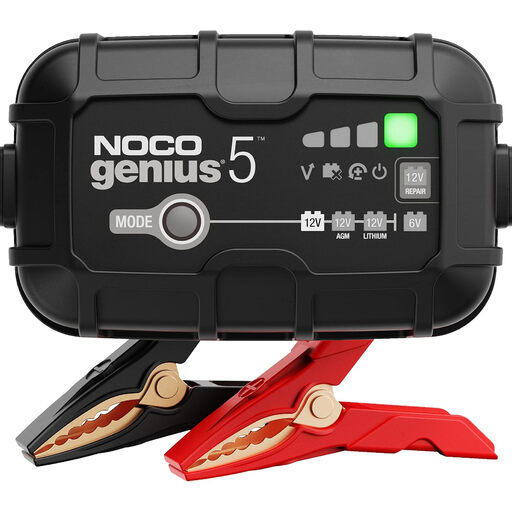
Why this product suits the profile: According to the product description, this model supports 6- and 12-volt batteries, as well as AGM, GEL, lead-acid, start-stop and LiFePO4 batteries. Its 5 A charging current is sufficient for many everyday applications.
The choice of different charging programmes reduces the risk of buying a device designed exclusively for one type of battery. The capacity limits must still be compared in advance.
6V/12V support, 5A charging current and automatic trickle charging according to the product details.
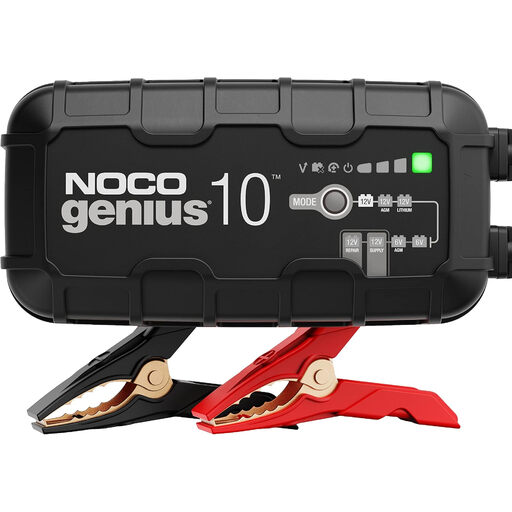
Why this product suits the profile: According to the product description, this fully automatic device is designed for 6V and 12V, AGM, GEL, EFB, deep-cycle and LiFePO4 batteries, and supports batteries up to 230 Ah.
According to the product description, the temperature monitoring takes the ambient temperature into account. This helps you choose a device with a controlled charging process rather than one selected solely for its high current rating.
10A charging current, 230 Ah rating, temperature compensation and CE, RoHS and WEEE markings according to the product data.

Why this product suits the profile: According to the product description, this device is designed for 12V and 24V lead-acid batteries, including AGM, GEL, SLA and WET. This makes it suitable for users with different types of vehicle.
The separate 12V and 24V specifications make the system voltage clear. According to the product description, this model is not designed for lithium batteries.
12V/24V operation, charging status and voltage display, plus several protection functions according to the product details.
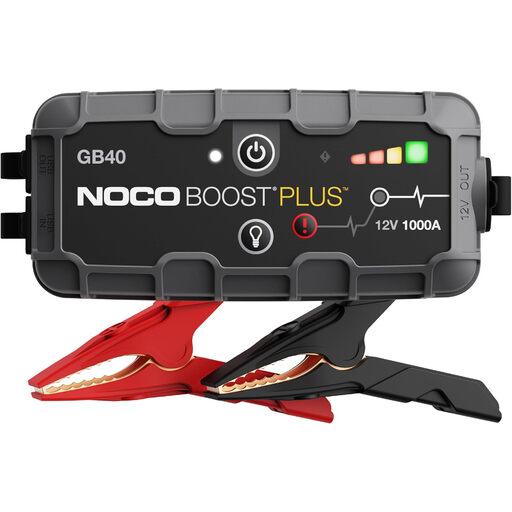
Why this product suits the profile: According to the product description, this portable 12V jump starter is designed for petrol engines up to 6.0 l and diesel engines up to 3.0 l. It also serves as a power bank for mobile devices.
The specifications for engine size and the 12V system define the intended use. This prevents a portable car jump starter from being mistakenly bought for 24V vehicles or high-voltage systems.
1000A peak current, IP65 housing, LED light and integrated protection functions according to the product description.
We have put together a complete, regularly updated list of products that fully meet these strict selection criteria and the safety regulations applicable in the EU.
Before connecting the charger, read the instruction manual and check the battery for damage. With a conventional charger, first connect the clamps correctly to the positive and negative terminals before switching on the power supply. The order may differ with modern devices.
A low-power charger takes longer, but does not automatically use less energy during the charging process than a more powerful model. Efficiency, charge level and charging time are the key factors. For continuous trickle charging, a low, automatically regulated current is more sensible than a permanently high charging current.
Charging time depends on the capacity, charge level, battery type and charging current. A rough calculation is: capacity in Ah divided by charging current in A. In practice, charging losses and the final charging phase extend the process. A 60 Ah battery charged at 5 A will therefore not be fully charged in exactly twelve hours.
A trickle charger expressly designed for this purpose can remain connected for longer periods if the battery is compatible and the installation is correct. Check whether the model offers an automatic switch to maintenance mode. LiFePO4 batteries require a suitable lithium charging profile.
A charger supplies the battery with energy in a controlled manner over an extended period. A jump starter power bank, on the other hand, delivers a high current for a short time to help start an engine. It does not replace a full charge and cannot repair a faulty battery. A charger is suitable for regular maintenance, while a car jump starter is designed for emergencies.