
Lieferung heute & morgen

Qualitätsgarantie

Willkommens-Angebote freischalten: KOSTENLOSE Lieferung | Bis zu 80 % RABATT | Kostenlose 30-Tage-JoyPlus-Testphase
App herunterladen
A car battery charger should reliably charge a vehicle battery, maintain it during long periods of inactivity and, depending on the model, assist with a deeply discharged battery. In practice, however, poor purchases often happen not because of the price, but because of unsuitable charging programmes, missing safety features or misleading information about charging power.
This buying guide from the Joybuy Product Recommendation Officer shows which parameters are crucial before purchasing a 12V battery charger, a 12V/24V car battery charger or a motorcycle battery charger.
Specifications such as 15 A, 20 A or 30 A describe the possible charging power under certain conditions. The actual charging time also depends on the battery capacity in Ah, the state of charge, the temperature and the battery type. A 20 A charger does not continuously deliver 20 A to every battery.
For smaller motorcycle batteries, a high charging current may be unsuitable. Conversely, for a vehicle with a large battery or a motorhome, a weaker device may require longer charging times.
A battery charger with a repair function or pulse charger can assist with certain states of charge and with sulphation. However, it cannot reliably restore a deeply damaged, internally short-circuited or completely worn-out battery. Product descriptions should therefore clearly distinguish between charging, maintenance charging and repair mode.
A 12 V charger is not automatically suitable for every 12 V battery. AGM, GEL, EFB, wet and LiFePO4 batteries sometimes require different charging profiles. Particularly for lithium iron phosphate batteries, an explicitly stated LiFePO4 charging mode is essential.
An intelligent battery charger detects the state of charge and adapts the charging process in several stages. Look for explicit support for your battery type:
A start-stop battery charger should explicitly mention AGM or EFB batteries. The term "universal" alone is not sufficient proof.
For many cars and motorcycles, a 12V battery charger is sufficient. A 12V/24V car battery charger makes sense if you also need to charge lorries, vans, boats or larger machinery. Check whether 24 V is actually listed as a separate charging range and what current is available then.
Equally important is the stated capacity range. A model for 4 to 100 Ah is different from a device that supports batteries up to 230 Ah. The Ah rating must match the battery and does not replace checking the state of charge or battery condition.
For home use, reverse polarity protection, short-circuit protection, overheat protection, overcurrent protection and overcharge protection are relevant features. A display can show voltage, current, temperature, charging phase or error status. This makes monitoring easier, but does not replace correctly selecting the charging programme.
A maintenance charger should automatically switch to a monitoring or maintenance phase once charging is complete. For winter storage, classic cars or motorhomes, a long connection cable or a permanently mountable ring terminal connection is also practical.
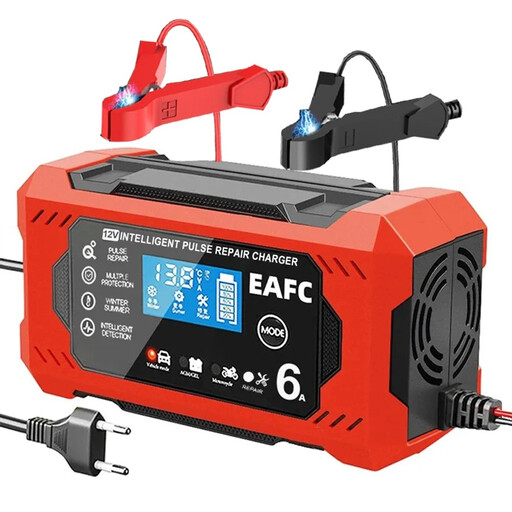
Why this product fits the profile: This 12 V device is designed for batteries from 4 to 100 Ah and is aimed at car and motorcycle owners with modest charging needs.
The stated capacity range helps avoid a device with an oversized charging current for small batteries. The manufacturer also mentions safety features against reverse polarity, overheating and short circuits.
6 A charging current, LCD display, automatic charging function and modes for AGM, GEL, SLA and wet batteries according to product specifications.
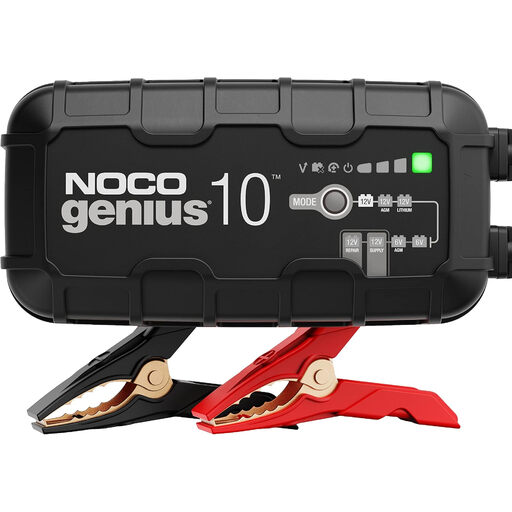
Why this product fits the profile: Suitable for users who want a 6 V and 12 V device with charging, maintenance and desulphation functions for multiple vehicle types.
The product description explicitly mentions AGM, GEL, EFB, lead-acid, LiFePO4 and start-stop systems. A temperature sensor is said to adapt the charging cycle to the ambient conditions.
10 A charging current, support for 6 V and 12 V, maintenance charging up to 230 Ah, plus CE, RoHS and WEEE certifications according to product data.
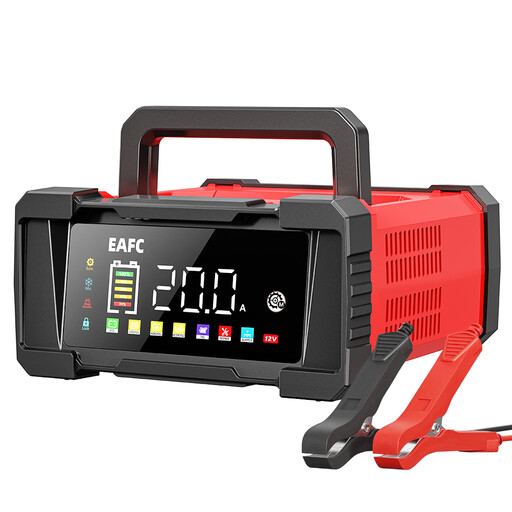
Why this product fits the profile: This portable device is aimed at workshops, motorhome owners and vehicle enthusiasts with various 12 V and 24 V applications.
The seven selectable modes separate STD, LiFePO4, AGM/GEL, MOTORCYCLE, REPAIR and SUPPLY, among others. This allows you to tailor the charging profile more precisely than with a single-mode device.
20 A at 12 V and 10 A at 24 V according to product specifications, colour display, 9-stage charging process and multiple safety features.
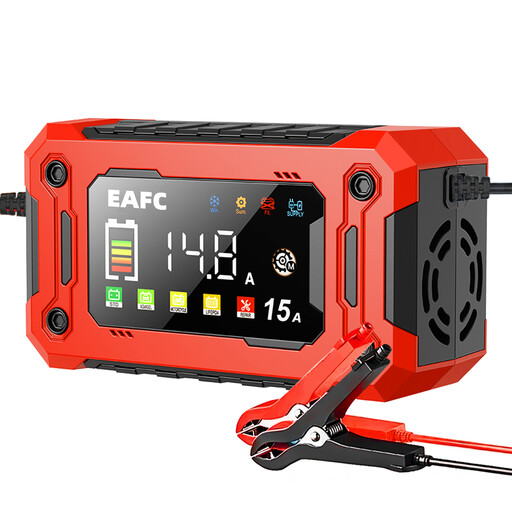
Why this product fits the profile: A practical option for cars, SUVs and motorcycles when you want a clearly visible display and automatic shut-off.
The display shows the state of charge and operating mode. Summer and winter modes are also mentioned, along with an automatic charging stop when the battery is full.
15 A charging current, pulse repair mode, temperature modes and support for AGM, EFB, GEL and other lead-acid batteries according to the product description.
We have compiled a complete, regularly updated list of products that fully meet these strict selection criteria and the safety regulations in force in the EU.
Only charge batteries in a suitable, well-ventilated area. The instructions from the vehicle and charger manufacturer take precedence. A lithium charging programme must not be used for a conventional lead-acid battery, and vice versa.
The duration depends on the capacity, state of charge, charging current and battery condition. As a rough technical guideline: the higher the capacity relative to the available charging current, the longer the process takes. The final charging phase often requires additional time because the charging current is automatically reduced.
An automatic maintenance charger is generally designed for longer connection periods, provided the manufacturer explicitly states this mode of operation. The device should monitor the state of charge and switch between charging and maintenance. Before connecting, check the battery type, environment, ventilation and the instruction manual.
No. AGM batteries require a suitable AGM programme. A LiFePO4 charger must be explicitly approved for lithium iron phosphate batteries. If this information is missing, the device should not be selected for this battery type.