
Lieferung heute & morgen

Qualitätsgarantie

Willkommens-Angebote freischalten: KOSTENLOSE Lieferung | Bis zu 80 % RABATT | Kostenlose 30-Tage-JoyPlus-Testphase
App herunterladen
A car battery charger needs to match your battery, your vehicle and how you plan to use it. If you only focus on a high amp rating or big marketing claims, you could easily end up with a device that doesn’t support your battery type, charges too slowly, or isn’t there when you need it most.
Three things in particular lead to the wrong purchase:
A 12V car battery charger is suitable for many cars, motorbikes, quads and smaller boats. For larger commercial vehicles or 24V battery systems, you’ll need a device that can switch accordingly. Before you buy, check the information on your battery or in your vehicle handbook.
The construction type is also crucial:
A battery charger for AGM and GEL should clearly state the appropriate modes. For lithium batteries, only use a charger that supports that particular battery type.
A high charging current shortens the potential charging time, but it isn’t suitable for every battery. A device with 6 A, for example, is fine for smaller car and motorbike batteries, while 10 to 20 A can be more practical for larger capacities. The key figure is the Ah range specified by the manufacturer.
According to its specifications, the NOCO GENIUS10 supports 6V and 12V batteries up to a capacity of 230 Ah and works with a charging current of 10 A. For smaller batteries, a motorbike battery charger with a lower charging current can be easier to handle.
An intelligent battery charger typically monitors voltage and charging progress. Useful safety features include protection against:
For vehicles that are parked up over winter or for long periods, a maintenance charger with automatic switching is relevant. It keeps the battery at a suitable charge level without continuously charging at maximum current. Ring terminals can be more practical than clamps for permanently fitted connections.
A pulse charger or a function described as a battery repair device may be intended for certain sulphation or charging issues. However, this doesn’t guarantee that an aged, damaged or deeply discharged battery will become fully usable again.
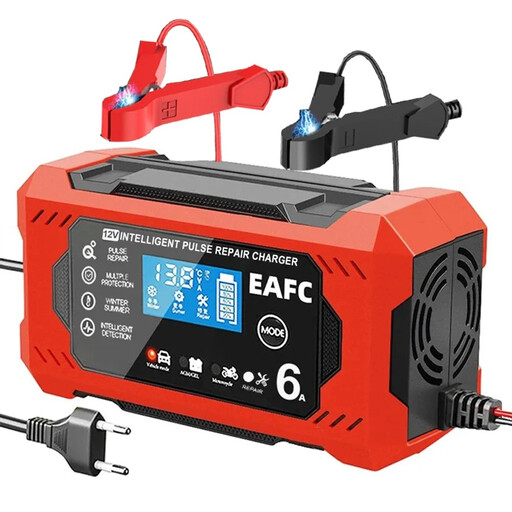
Why this product fits the profile: This device is designed for 12V lead-acid batteries and specifies a range of 4 to 100 Ah. That makes it suitable for many car and motorbike batteries in private use.
The stated capacity range makes it easier to check compatibility before buying. An LCD display, plus protection against reverse polarity, overheating and short circuits, supports controlled use.
6 A charging current, LCD display, AGM, GEL, EFB and flooded battery modes, plus a pulse charging function according to the product description.
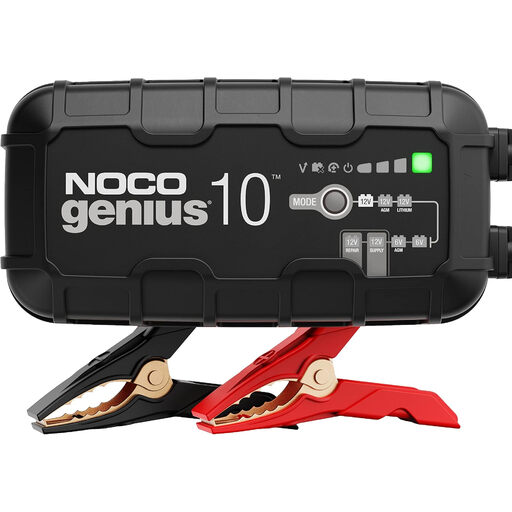
Why this product fits the profile: The automatic charger supports 6V and 12V as well as several lead-acid battery types and LiFePO4 batteries. It is intended for cars, motorbikes, motorhomes and tractors.
Compatibility is clearly specified by battery type and voltage. A temperature sensor adjusts the charging cycle to the ambient conditions, according to the manufacturer.
10 A charging current, 6V/12V selection, maintenance mode and stated support for AGM, GEL, EFB, LiFePO4 and start-stop systems.
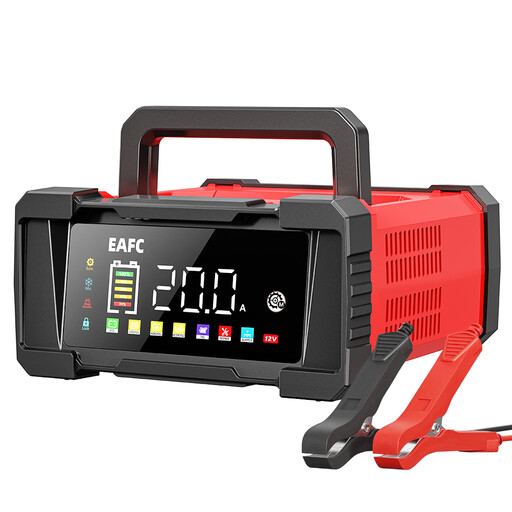
Why this product fits the profile: This switchable device is aimed at users with cars, vans, boats, lawnmowers or larger vehicle batteries.
The voltage selection prevents a purely 12V device from being used on a 24V system. The manufacturer also highlights the difference between the charging and repair functions.
20 A at 12V, 10 A at 24V, seven modes, 2 m cable and support for AGM, GEL, WET, EFB and LiFePO4 according to the product description.
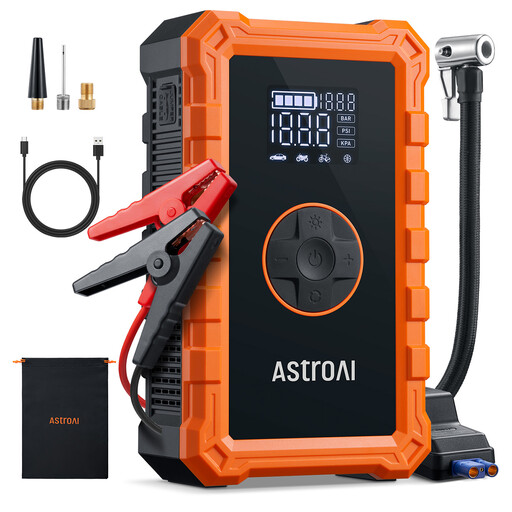
Why this product fits the profile: This portable booster combines a car jump starter, power bank, LED light and tyre compressor for use on the road.
The display shows battery level, operating status, tyre pressure and error codes. A cooling-off period is recommended for the compressor after extended use.
1500 A peak current, 150 PSI tyre compressor, automatic shut-off and suitability according to the manufacturer for petrol engines up to 6.0 l and diesel engines up to 3.0 l.
Before connecting, switch off the vehicle and the charger, and read the instruction manual. The clamps must be correctly connected to the positive and negative terminals. A damaged, swollen, leaking or frozen battery must not be charged or jump-started with a booster.
A booster needs to be recharged regularly, even when not in use. Depending on the model, a charging interval of around two to six months is recommended. When using the tyre compressor, be sure to observe the specified operating and cooling times.
We have put together a complete, regularly updated list of products that fully meet these strict selection criteria and the safety regulations in force in the EU.
No. As well as the voltage, the battery type and capacity range must match. AGM, GEL, EFB and LiFePO4 batteries may require specific charging programmes.
The duration depends on the capacity, state of charge and charging current. Under ideal conditions, a 60 Ah battery will take noticeably longer to charge with 6 A than with 10 or 20 A. In practice, charging phases and safety regulations extend the time.
A charger supplies energy to the battery in a controlled manner over a longer period. A jump starter power bank, or portable booster, delivers a short, high-current burst to start the engine. It can bridge a discharged battery, but it doesn’t replace regular charging or maintenance.