
Lieferung heute & morgen

Qualitätsgarantie

Willkommens-Angebote freischalten: KOSTENLOSE Lieferung | Bis zu 80 % RABATT | Kostenlose 30-Tage-JoyPlus-Testphase
App herunterladen
A car battery charger should reliably charge a vehicle battery, maintain it over longer periods, or in certain cases help revive it. In practice, however, many devices don't match the battery you have. With AGM, GEL, EFB or LiFePO4 models in particular, incorrect charging programmes can lead to long charging times, error messages or unsuitable charging.
This buying guide from the Joybuy Product Recommendation Officer will help you assess technical specifications objectively and avoid common purchasing mistakes.
A small 12V battery charger with 5 or 6 A is suitable for many car and motorcycle batteries, but takes longer with larger capacities. A charger with 15 or 20 A works faster on bigger batteries, but isn't automatically suitable for every small battery.
Pay attention to the stated capacity in Ah. Some devices are designed for 4 to 100 Ah or 2 to 150 Ah, for example. For a battery with a significantly higher capacity, a more powerful vehicle battery charger may be worthwhile.
A battery charger with repair function or a pulse charger can use charging pulses or special charging phases for certain lead-acid batteries. However, this does not mean that a deeply discharged, damaged or leaking battery can be safely restored to use.
Product claims about pulse or sulphate treatment should therefore be understood as a technical feature, not a guarantee of longer battery life. Do not attempt to charge batteries with visible damage, deformation or a frozen cell.
A portable car battery booster delivers a high starting current for a short time. It is designed for jump-starting, not as a replacement for a permanently connected charger. A car jump starter cannot charge a battery slowly and controllably in the same way as a smart charger.
First, check whether your vehicle uses a 12V or 24V battery. Cars, motorcycles, many vans and motorhomes use 12V systems. Certain lorries, tractors or larger vehicles may require 24V.
Equally important is the chemical and construction type:
An AGM battery charger, GEL battery charger or LiFePO4 charger should only be used if the respective mode is expressly stated by the manufacturer.
A smart battery charger detects the charge level depending on the model and controls several phases, such as pre-charge, bulk charge, absorption and float. For winter storage, a battery maintainer is practical, provided the device is approved for permanent connection.
Also note:
The actual charging time depends on battery capacity, state of charge, temperature and battery condition. Advertising claims such as "fast" should therefore be checked against the stated output current.
Useful protection functions include reverse polarity protection, short-circuit protection, overheat protection, overcurrent protection and automatic shut-off when the battery is full. A display can show voltage, current, charging phase or error codes.
For use in the UK, a suitable UK plug, clear operating instructions and verifiable conformity markings such as CE are also relevant. A charger should be used in a dry, well-ventilated area and in accordance with the instruction manual.
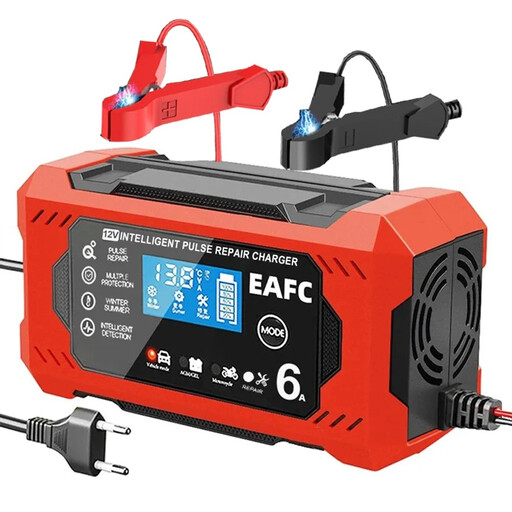
Why This Fits Their Persona: For cars, motorcycles and smaller 12V batteries with a stated capacity of 4 to 100 Ah. According to the product specifications, the device features an LCD display as well as automatic charging and protection functions.
The capacity limit and 12V rating should be clearly checked before purchase. This prevents unsuitable use on larger 24V systems.
6 A charging power, LCD display, AGM, GEL, SLA and WET modes, plus reverse polarity and overheat protection according to manufacturer specifications.
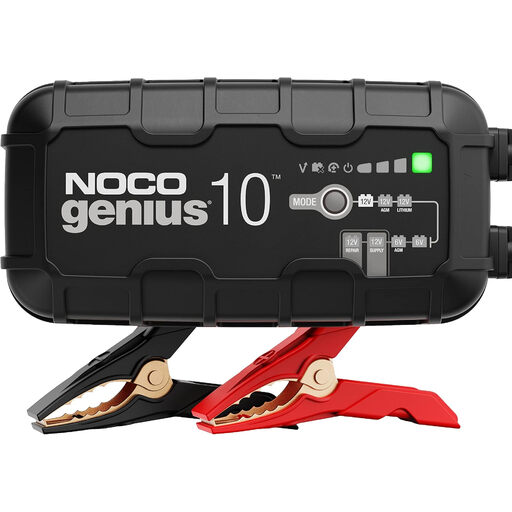
Why This Fits Their Persona: For users of cars, motorcycles, vans, motorhomes or tractors who want to look after 6V and 12V lead-acid as well as LiFePO4 batteries with one device.
The product description specifies concrete voltage and battery types. This allows you to check compatibility against your battery label before purchase.
10 A charging current, temperature monitoring, maintenance mode and, according to product specifications, support for AGM, GEL, EFB, deep-cycle and LiFePO4.
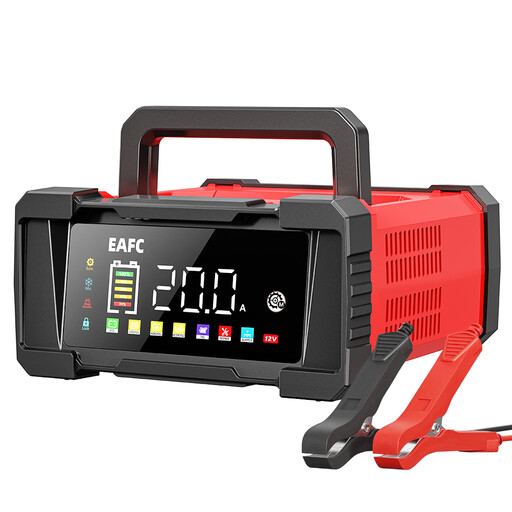
Why This Fits Their Persona: For workshops, larger vehicles, boats, lawnmowers or users with multiple battery types. According to product specifications, the portable device offers seven modes.
The switch between 12V and 24V, as well as the LiFePO4 mode, must be selected to match the battery. This specification prevents buying based on peak current alone.
20 A at 12V, 10 A at 24V, seven charging programmes, display and, according to manufacturer specifications, multi-stage protection functions.

Why This Fits Their Persona: For drivers, SUV owners and travellers who want to keep a mobile car jump starter for 12V vehicles in their car.
The booster is classified as an emergency aid, not a permanent charger. Before use, you must check the charge level, connections and vehicle voltage.
12V system, 3000 A peak current according to product specifications, 65 W USB-C charging function, LED light and ten designated protection functions.
In our category you'll find a constantly updated selection of devices for different 12V applications, battery types and charging outputs.
The charging time depends on the capacity in Ah, the current state of charge and the charging current. A 60 Ah battery will take significantly longer with a 5 A device than with a 10 or 15 A charger. The manufacturer's specification for charging current is therefore more important than a general advertising claim about charging speed.
A battery maintainer designed for this purpose can be left connected for longer periods according to the instruction manual. The prerequisites are a suitable battery type, a correct charging programme and a functioning battery. With older or damaged batteries, the charging process should be checked regularly.
No. A portable car battery booster provides energy for starting the engine in the short term. For fully charging or maintaining a battery, a suitable car battery charger is required. Before using a booster, you must observe the voltage, connection sequence and safety instructions for the specific model.