
Lieferung heute & morgen

Qualitätsgarantie

Willkommens-Angebote freischalten: KOSTENLOSE Lieferung | Bis zu 80 % RABATT | Kostenlose 30-Tage-JoyPlus-Testphase
App herunterladen
A car battery charger should do more than simply supply power: it needs to suit the battery, vehicle and intended use. Cars, SUVs, vans, commercial vehicles, motorhomes, motorbikes, boats and tractors can all have different requirements depending on the battery size and type.
Many unsuitable purchases happen because technical specifications are not read in full. For example, a high amp rating does not automatically mean that a device is suitable for every battery. Terms such as “repair”, “intelligent” and “jump starter” should also be carefully assessed before you buy.
A 12V car battery charger is designed for 12-volt batteries. However, commercial vehicles, certain boats or larger machines may require a 24-volt charger. A 12-volt device must never simply be connected to a 24-volt battery.
The charging technology must also match the battery:
A charger for lead-acid batteries is not automatically suitable for lithium batteries. Always look for explicitly stated compatibility, such as “LiFePO4” or “lithium mode”.
Charging power is measured in amps. A 20A device can charge a larger battery more quickly than a 5A or 6A model. However, a high charging current may be unsuitable for small motorbike batteries if there is no appropriate motorbike or low-current function.
As a practical guide:
Charging time also depends on the charge level, battery condition and charging method. Manufacturer specifications such as “up to 230 Ah” should therefore be understood as a compatibility range, not a fixed charging time.
Depending on the model, a battery repair charger may use pulse or special charging programmes to attempt to treat sulphation or severe discharge. This is no guarantee that the battery will be restored. A battery with an internal fault, damaged plates or significant loss of capacity may need to be replaced.
A car battery jump starter is also different from a charger. A charger usually works over a longer period. An auto battery booster, on the other hand, delivers a high current for a short time to start the engine, but does not replace ongoing battery charging.
First, check the information on the battery and in the vehicle handbook. An intelligent battery charger should detect the correct voltage or offer a clearly labelled mode. Useful programmes include:
A maintenance charger is particularly useful for vehicles that are left standing for long periods, such as seasonal motorbikes, classic cars, motorhomes or boats. It keeps the battery charged without continuously subjecting it to the maximum charging current.
Look for clearly explained protection features. These include reverse-polarity protection, short-circuit protection, overheating protection, overvoltage protection and automatic shut-off or regulation when the battery is fully charged.
A display can also show the voltage, current, charging phase or temperature. This makes monitoring easier, but does not replace selecting the correct charging mode. Devices with a fan should also be positioned so that the air inlet is not obstructed.
For the garage, a mains-powered charger with clamps and, where applicable, ring terminals is practical. For use on the go, a portable device with its own battery may be more suitable. Consider the following:
A charger designed for indoor use should not be left unprotected in the rain.
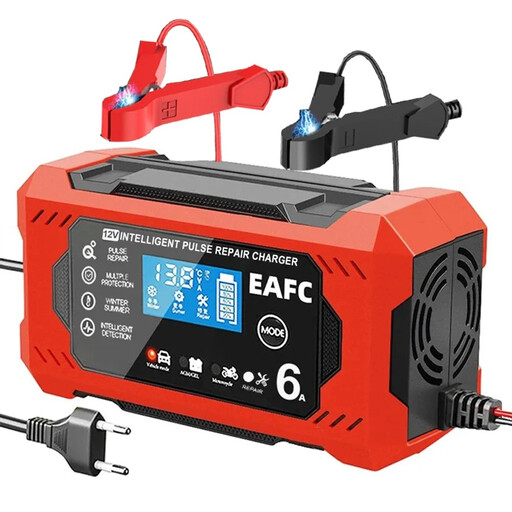
Why this product suits this profile: This 12-volt device is designed for many lead-acid batteries from 4 to 100 Ah and offers a straightforward range of functions for cars and motorbikes.
The stated battery range helps prevent over-specifying a charger for small batteries. AGM, GEL, EFB and wet-cell batteries are explicitly listed.
6A charging current, LCD display, plus reverse-polarity, short-circuit, overheating and overvoltage protection.
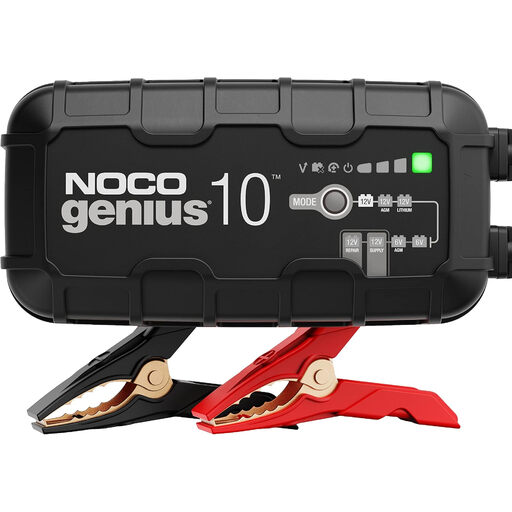
Why this product suits this profile: The device supports 6- and 12-volt batteries, including AGM, GEL, EFB, lead-acid and LiFePO4.
The selectable battery types reduce the risk of using an unsuitable charging profile. A temperature sensor adjusts the charging cycle to the ambient conditions.
10A charging current, maintenance function, 1-volt charging capability, and connections with clamps and ring terminals.
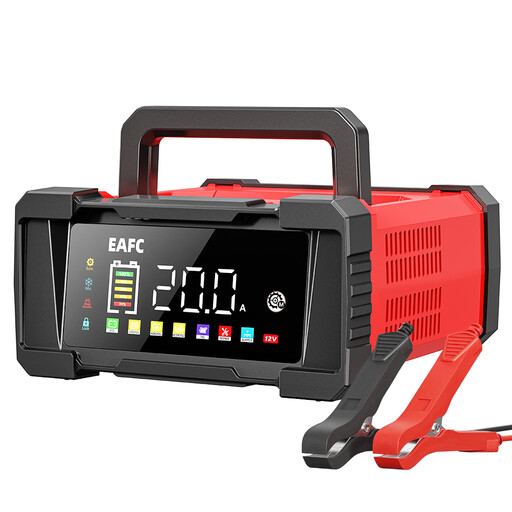
Why this product suits this profile: It is suitable for users with several vehicles or batteries, as it supports 12- and 24-volt operation as well as multiple charging programmes.
The STD, LiFePO4, AGM/GEL, MOTORCYCLE, REPAIR and SUPPLY modes make the selection clear before charging begins. The manufacturer points out that the repair function may be ineffective on damaged batteries.
20A at 12V, 10A at 24V, colour display, 2m cable and automatic charging monitoring.
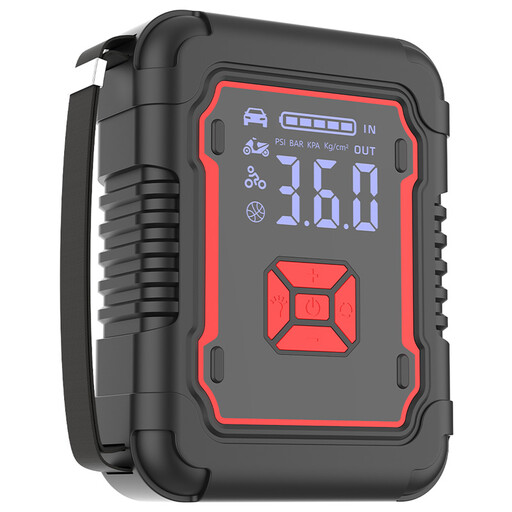
Why this product suits this profile: This auto battery booster is designed for emergency starting assistance for 12-volt petrol and diesel vehicles, combining a compressor with a power bank.
It is not presented as a permanent charger: its functions are designed for jump-starting, inflating tyres and USB power supply.
3000A peak current, 150 PSI or up to 10 bar compressor pressure, and 20,000 mAh battery capacity.
We have put together a complete, regularly updated list of products that fully meet these strict selection criteria and the safety regulations applicable in the EU.
Read the operating instructions before connecting the charger and switch off the vehicle. With a conventional charger, the clamps are normally attached to the battery terminals first, followed by connecting the mains plug. The exact sequence may vary depending on the device.
The following points are important:
With modern vehicles featuring a start-stop system, the battery cannot always be treated in the same way as that of an older car. The vehicle manufacturer’s instructions take priority.
Charging time depends on the battery capacity, charge level, charger and temperature. A simple estimate is: capacity in Ah divided by charging current in A, plus charging losses and the slower charging phase towards the end. A 60Ah battery charged at 6A will therefore not be fully charged after exactly ten hours.
This is only advisable with a maintenance charger or fully automatic charger specifically designed for this purpose. It must reduce the charging current once the battery is fully charged or switch to a maintenance phase. With simple mains chargers, the battery should not be left connected permanently and unattended.
A charger charges the battery over a longer period and, depending on the model, may also maintain its charge. A portable car battery jump starter, or auto battery booster, delivers a high current for a short time to start the engine. It does not normally fully recharge the vehicle battery.