
Lieferung heute & morgen

Qualitätsgarantie

Willkommens-Angebote freischalten: KOSTENLOSE Lieferung | Bis zu 80 % RABATT | Kostenlose 30-Tage-JoyPlus-Testphase
App herunterladen
A dead smartphone on the way to an important meeting or fussy kids in the back seat because their tablet has run out of power—a reliable car charger is indispensable in any vehicle. But the market is overwhelming and filled with products that promise more than they deliver. Many chargers turn out to be a poor investment, charging devices slowly or even posing safety risks.
As your Joybuy Product Recommendation Officer, I'm here to help you navigate the common pitfalls. This guide will show you which technical details truly matter, so you can make an informed decision and keep your devices powered safely and efficiently on the go.
Before we dive into the solutions, it's important to understand the most frequent issues found in inadequately tested chargers:
To avoid these problems, you should check three central technical features before buying. These determine the performance, safety, and functionality of your new charger.
The total output of a charger is measured in watts (W). A 100W car charger can theoretically deliver more energy than a 30W model. However, the crucial factor is how this power is delivered to your device. This is where charging protocols come into play:
Make sure the charger supports the protocol required by your smartphone or tablet. Only then will you benefit from the maximum charging speed.
Consider how many and what types of devices you want to charge simultaneously. A phone charger for the car for a solo driver needs fewer ports than a model for a family on a road trip.
A standard car uses a 12V electrical system, while trucks, RVs, and some vans operate on 24V. A good car charger is compatible with both systems (indicated as 12V/24V). This not only ensures a wide range of use but is also an indicator of more robust electronics that can better handle voltage fluctuations.
Based on the criteria above, we have selected a few models from our range that are suitable for different types of users.
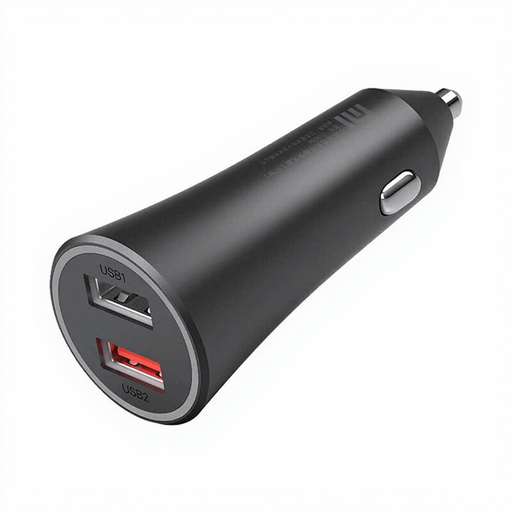
Why This Fits Their Persona: Ideal for commuters who need a straightforward and reliable solution for charging their smartphone. Its compact design and dual USB-A ports allow for charging two devices simultaneously without unnecessary frills.
Delivers a clearly defined charging output (up to 27W on a single port) with Quick Charge 3.0 support. The manufacturing quality of an established brand minimises the risk of overheating and ensures a stable fit in the socket.
Very compact and discreet design. Integrated protection mechanisms against short circuits and overcurrent.
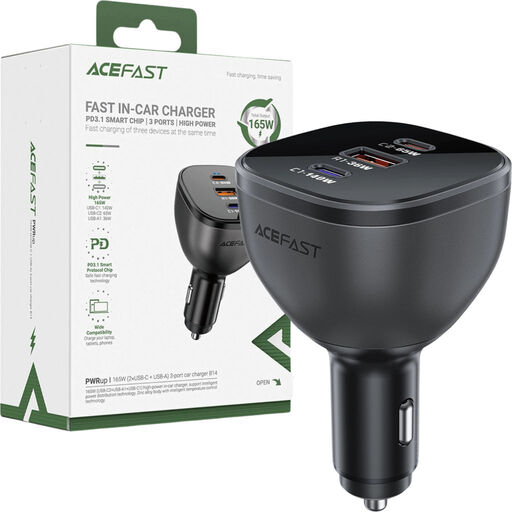
Why This Fits Their Persona: Perfect for long family road trips. With 165W of total power and three ports, it can simultaneously fast-charge smartphones, tablets, and even a power-hungry device like a laptop or a portable gaming console.
Solves the problem of slow charging when multiple devices are connected. The high power output and support for modern charging protocols ensure all devices are powered efficiently at the same time, without one port slowing down another.
Massive total output of 165W. Two USB-C and one USB-A port for maximum compatibility. Suitable for both 12V and 24V vehicles.
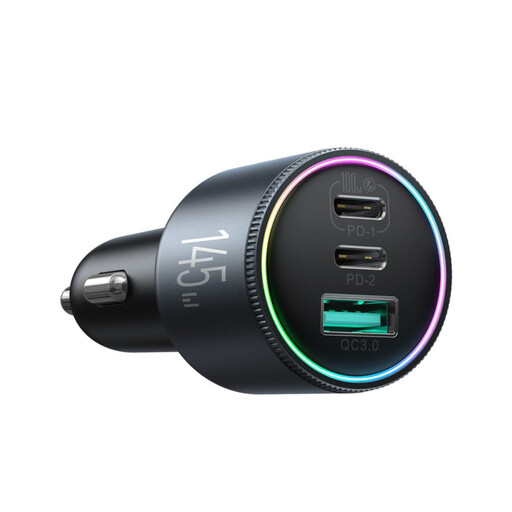
Why This Fits Their Persona: Designed for users who can't compromise on maximum performance, even on the road. With up to 100W from a single USB-C port, it's one of the few solutions capable of charging a laptop in the car. The 12V/24V compatibility makes it the top choice for truck drivers.
Provides a verifiable high-performance solution for laptops where other chargers only make empty promises. The robust metal housing ensures excellent heat dissipation under heavy load, and the included 100W cable guarantees full performance.
Delivers up to 100W via a single USB-C PD port. Includes a high-quality 100W USB-C cable. Compatible with 12V and 24V vehicle systems.
We've compiled a complete, real-time updated list of products that fully meet these strict selection criteria and relevant safety standards.
In most modern vehicles, the power supply to the cigarette lighter is cut off as soon as the engine is turned off. In this case, there is no risk. In some older models, the socket remains permanently powered. While a high-quality charger has minimal standby power consumption, it is advisable to unplug it if the car is parked for several days to prevent any battery drain.
Both are fast-charging technologies, but they work differently. Power Delivery (PD) is a universal, open standard used primarily via USB-C ports. It can deliver very high power levels (over 100W), making it suitable for tablets and laptops. Quick Charge (QC) is a proprietary technology from Qualcomm used in many Android smartphones. Many modern chargers support both standards to ensure maximum compatibility.
To charge a laptop in the car, two conditions must be met: