
Lieferung heute & morgen

Qualitätsgarantie

Willkommens-Angebote freischalten: KOSTENLOSE Lieferung | Bis zu 80 % RABATT | Kostenlose 30-Tage-JoyPlus-Testphase
App herunterladen
A car charger has to do more in daily life than just power a smartphone. Commuters charge their phone on the go, families need multiple ports for tablets and headphones, while business travellers or motorhome owners may also want to run laptops, cameras and other devices. The choice ranges from a simple USB car charger to a car charging hub with multiple sockets.
However, some typical marketing claims can lead to the wrong purchase. A high wattage, for example, does not automatically mean that every connected device will charge quickly. What really matters is how the power is distributed, the charging protocol used, and the electrical compatibility with your vehicle.
With a multi-port car charger, the stated wattage often refers to the total output power. When several devices are connected, this power is shared across the ports. A model with 120 W therefore does not necessarily deliver 120 W at every port.
When choosing, you should check:
A fast car charger can only charge at high speed if the charger and the device support the same protocol. Common standards are USB Power Delivery (PD), Quick Charge (QC) and PPS. A USB-C port alone does not guarantee fast charging.
If you want to charge a smartphone, tablet or laptop, you should therefore compare the technical specifications of both devices. A PD QC PPS car charger offers broader compatibility, but does not replace a suitable charging cable or sufficient power.
A 12V car charger is suitable for many cars. Lorries, some motorhomes and certain commercial vehicles, on the other hand, use a 24V electrical system. A model with an input range of 12–24 V DC is designed for both voltage systems, provided the manufacturer explicitly states this.
Additionally, the plug, cable and housing should not be left loose in the footwell or obstruct controls and your field of vision. If you notice unusual heat, smoke, damage or an unstable fit in the cigarette lighter adapter, disconnect the device immediately.
A multi-port car charger with six USB ports is not automatically better than a compact adapter with two ports. What matters is whether the ports are in the right place and deliver the power you need.
For a smartphone, lower power levels are often sufficient, depending on the device. Tablets and laptops usually need more power via USB-C PD. The specifications for watts (W), volts (V) and amps (A) should make sense together. With multiple devices, intelligent power distribution is particularly important.
Look for objectively described protection mechanisms such as:
A digital display showing voltage or power can make monitoring easier. However, it is no substitute for correct vehicle compatibility. For products used on the road, manufacturer details, EU responsible persons and conformity information should also be verifiable.
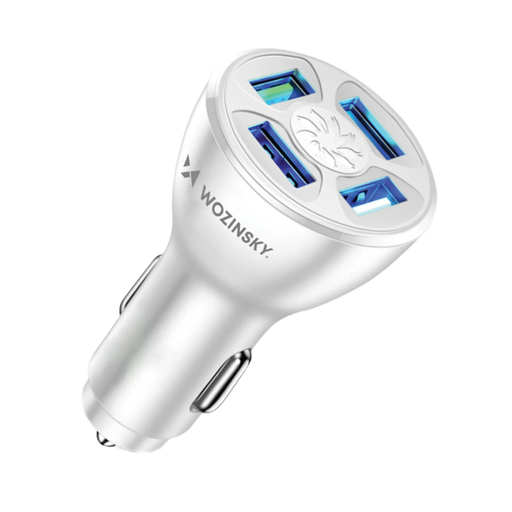
Why this product fits the profile: Four USB-A ports and 50 W total power are designed for multiple smartphones or smaller USB devices in everyday use.
The total power and number of USB-A ports are clearly stated. However, this model is not the right choice for USB-C laptops.
Four USB-A ports, Quick Charge support and 50 W total power.
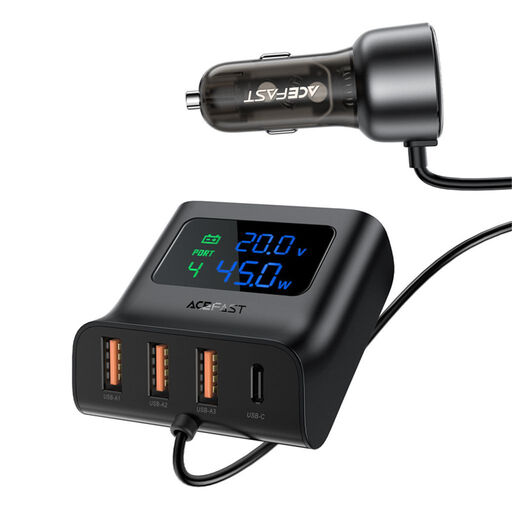
Why this product fits the profile: Four USB-A and two USB-C ports cover different cable types in cars, SUVs, lorries and motorhomes.
The input is specified as 12–24 V DC. The display shows voltage and power, making it easier to monitor when several devices are connected.
138 W total power, six ports, 110 cm cable, plus overheating, overvoltage and overcurrent protection.
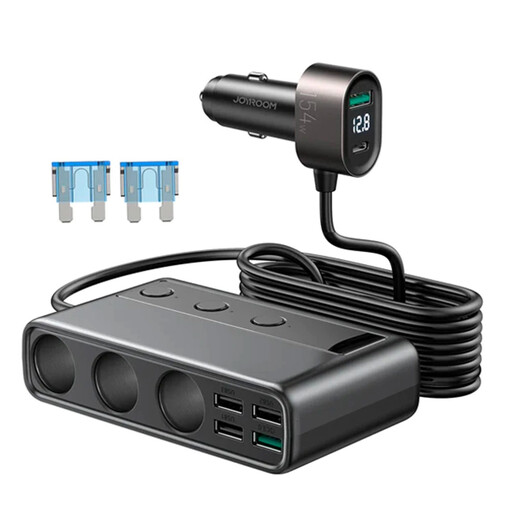
Why this product fits the profile: Families, frequent drivers and teams get USB ports plus three additional cigarette lighter sockets in one device.
The distribution across USB-A, USB-C and sockets is clearly described. The 12–24 V input covers many car and commercial vehicle types.
154 W total power, five USB-A ports, one USB-C port with PD, QC and PPS, plus three 12-volt sockets.
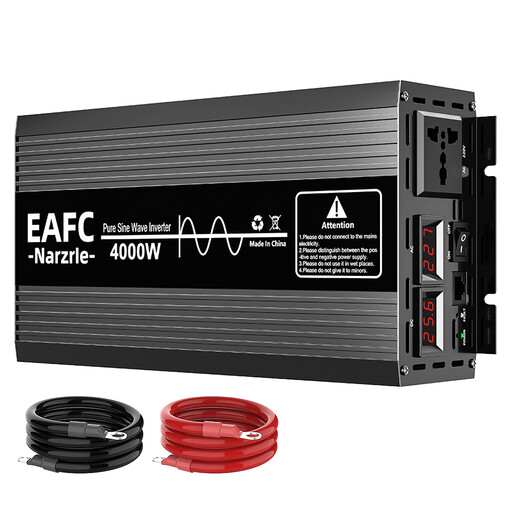
Why this product fits the profile: This 12V inverter converts DC power into 220V AC power and is aimed at users who need mains-like socket power in their vehicle.
The rated power is 2,000 W, with a peak power of 4,000 W. This distinction prevents the short-term peak figure from being mistaken for continuous power.
Pure sine wave, digital display for input and output voltage, two temperature-controlled fans and multiple protection functions.
For electric vehicles, a USB car charger is not intended for charging the vehicle battery. For that, you need a suitable EV charging station or a Type 2 wallbox. Models with 7 kW single-phase or 11 kW three-phase power must be compatible with your home installation, your vehicle and the available mains power. Installation should be carried out by a qualified electrician.
Before buying, you should check the plug type, cable length, number of phases, residual current protection, mounting location and existing circuit protection, among other things. A wallbox is therefore a different product category from a car charger for smartphones and accessories.
We have put together a complete, regularly updated list of products that fully meet these strict selection criteria and the safety regulations in force in the EU.
For a single smartphone, a port with moderate power is often sufficient. If you want to charge several phones, tablets or a laptop at the same time, you should add up the total power you need and check the charger's power distribution. The manufacturer's specification for total power is not automatically the power per port.
Only if the input is explicitly approved for 12–24 V DC. A pure 12V model is not automatically suitable for a 24V electrical system. Before connecting, compare your vehicle handbook and the product data sheet.
The lifespan depends on temperature, mechanical stress, frequency of use and the load from multiple devices. A secure fit in the cigarette lighter, free ventilation and disconnecting when not in use can reduce strain. If you notice visible damage or unusual heating, stop using the charger.