
Lieferung heute & morgen

Qualitätsgarantie

Willkommens-Angebote freischalten: KOSTENLOSE Lieferung | Bis zu 80 % RABATT | Kostenlose 30-Tage-JoyPlus-Testphase
App herunterladen
Modern vehicles are mobile command centres. Smartphones, tablets, navigation systems, and dash cams all require constant power on the go. However, the factory-installed ports often aren't enough or deliver only low charging power. The result is dead batteries and limited functionality right when you need them most. This guide will help you find a car charger that is perfectly tailored to your needs—from rapidly charging a smartphone to powering multiple devices for the whole family.
Choosing the right charger depends on your devices and your vehicle. Three criteria are especially important.
Charging power, measured in Watts (W), determines how quickly your devices charge. A basic charger often delivers only 5 to 12 watts, which is no longer sufficient for modern smartphones. Look for models that support fast-charging technologies:
A fast car charger with at least 20W to 30W per port is a good benchmark for most current smartphones.
Consider how many devices you need to charge simultaneously. For individuals, a charger with two ports (e.g., 1x USB-A, 1x USB-C) is often sufficient. Families or professional drivers who operate multiple devices like a smartphone, GPS, and dash cam will need more ports. For this, cigarette lighter splitters are ideal, turning one socket into multiple charging ports and additional 12V outlets.
Standard cars use a 12V electrical system. Trucks, RVs, and some larger vehicles, however, use a 24V system. While most chargers are designed as 12V USB adapters, not all are automatically compatible with 24V systems. If you need a truck charger, explicitly check the product specifications to ensure the device is rated for an input voltage range of 12V to 24V. Using a 12V-only device in a 24V system can damage the charger and potentially the vehicle's electronics.
Here, we present three models that cover different needs—from a minimalist charging adapter to a comprehensive power station.
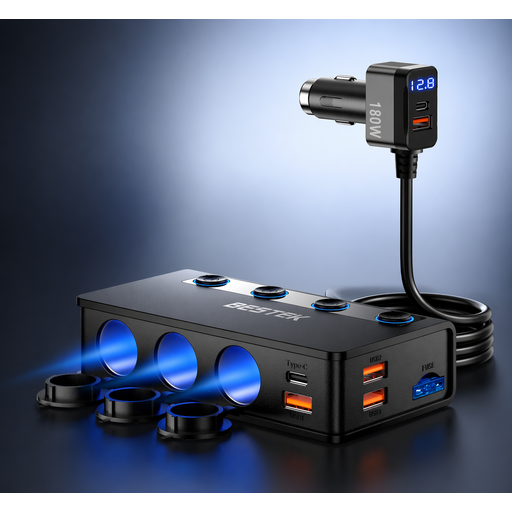
Why It Stands Out: This model is a complete charging hub. It transforms a single cigarette lighter socket into a multifunctional power source with a total of nine ports. The combination of three additional 12V/24V sockets and six USB ports offers excellent flexibility. The separate switches for each socket are particularly convenient, eliminating the need to constantly plug and unplug devices and helping to extend their lifespan.
Pros:
Who Is It For? Ideal for families, professional drivers, or tech-savvy users who run a variety of devices in their vehicle—from dash cams and navigation systems to smartphones and laptops for all passengers.

Why It Stands Out: The Anker charger focuses on the essentials: fast, reliable charging in an extremely compact form factor. It blends seamlessly into any dashboard and delivers a powerful 30W output from its USB-C port. According to the manufacturer, this can charge an iPhone 15 to 50% in about 25 minutes.
Pros:
Who Is It For? Perfect for commuters and drivers looking for a discreet yet powerful solution to replace their standard in-car phone charger. It's an excellent choice for quickly charging one or two devices, especially modern smartphones.
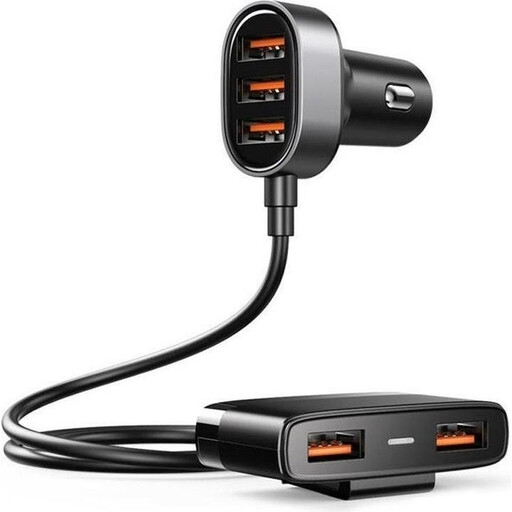
Why It Stands Out: This charger's standout feature is its 1.5-meter extension cable. It solves a common problem in larger vehicles: the lack of charging options for backseat passengers. The main adapter for the front seats offers two USB ports, while a separate hub at the end of the cable provides three more ports for those in the back.
Pros:
Who Is It For? An excellent solution for families with children, ride-sharing services, or anyone who regularly has passengers in the back and wants to offer them an easy way to charge their devices.
The products featured here cover a wide range of use cases. However, the market offers an even greater variety of models that differ in power, size, and features. If you're looking for a different combination of ports or specific features, it's worth exploring other alternatives.
Explore our full range of USB car charging sockets to find the perfect solution for your needs.
1. What is the difference between Quick Charge (QC) and Power Delivery (PD)? Power Delivery (PD) is a universal charging standard that works via the USB-C port and can deliver potentially higher power levels (over 100W) to a wide range of devices, including smartphones, tablets, and laptops. Quick Charge (QC) is a proprietary technology from Qualcomm, found mainly in Android smartphones with compatible processors, and is delivered via USB-A or USB-C ports. Many modern chargers support both standards.
2. Can I use a car charger in a truck (24V)? That depends on the specific charger. Always check the product's technical specifications. Many modern chargers are designed for an input voltage range of 12V to 24V and can therefore be used safely in both cars and trucks. Never use a 12V-only charger in a 24V electrical system, as this can cause damage.
3. Does a fast charger harm my phone's battery? No, when used correctly, a fast charger will not harm the battery. Modern smartphones and chargers communicate with each other to determine the optimal charging power. The Battery Management System (BMS) in the smartphone controls the charging process and reduces the speed once the battery reaches a high charge level to prevent overheating or excessive strain.