
Lieferung heute & morgen

Qualitätsgarantie

Willkommens-Angebote freischalten: KOSTENLOSE Lieferung | Bis zu 80 % RABATT | Kostenlose 30-Tage-JoyPlus-Testphase
App herunterladen
A car cover can shield a vehicle parked outdoors from rain, frost, snow, UV radiation, dust, leaves and bird droppings. However, for it to do its job properly, it must fit your vehicle and be securely fastened. A cover that is too large can flap in the wind, while one that is too small will leave mirrors, bumpers or side windows exposed.
As Joybuy Product Recommendation Officer, I filter product specifications according to practical buying criteria and highlight points that are easily overlooked in marketing copy.
The body shape is just as important as the length. A car cover for an SUV is not automatically suitable for a saloon because of the greater height and usually wider roof section. Likewise, a car cover for a hatchback fits differently from a cover for a notchback vehicle.
So pay attention to:
A waterproof car cover will only protect reliably against precipitation if it sits snugly and is not lifted by the wind. Elastic hems help it stay in place, but they do not replace proper fastening. For an outdoor parking space, additional straps, hooks or eyelets are important.
In strong wind, the cover should be checked regularly. Sand and dust trapped between the paintwork and the inner surface can cause rubbing marks when the cover moves. That is why the vehicle should be as clean and dry as possible before putting the cover on.
A weatherproof car cover made from multi-layer fabric can keep out rain, snow, sun and dirt. However, that does not automatically mean comparable protection against hail. A hail protection car cover needs a padded outer layer, for example made from EVA foam. Information about hailstone size or impact speed should be understood as manufacturer data and not as a general guarantee.
Choosing the right car cover by vehicle length reduces creases and tension. With the models presented below, sizes range, for example, from “up to 405 cm” for certain coupés to 535 cm for long saloons.
Measure your vehicle including the bumpers. With a coupé or hatchback, the rear shape and spoiler can affect the fit. The vehicle models listed in product descriptions serve as a guide; what really matters are your car’s actual dimensions.
For a car cover with an inner lining, the contact side is particularly important. Soft cotton or textile inner layers can reduce friction between the cover and the paintwork. Multi-layer versions combine, depending on the model, waterproof PE or PEVA layers, reflective aluminium layers and a soft inner surface.
A silver-coated 190T polyester cover, on the other hand, is lighter and can be interesting for occasional sun, dust and rain protection. A single-layer PEVA cover is usually easier to stow away, but offers a different material construction than a padded or multi-layer cover.
For a permanent outdoor parking space, three fastening points, an elastic hem or additional hooks are practical. Reflective strips improve the visibility of the covered vehicle in the dark, but do not replace adequate lighting at the parking spot.
If you need frequent access to the car, a zip can be beneficial. For short parking periods or seasonal use, a half-cover with several elastic bands can be quicker to put on.
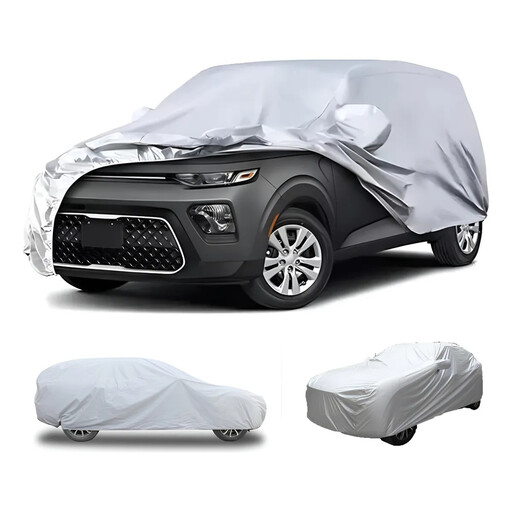
Why this product fits the profile: The single-layer PEVA cover is interesting for users looking for an easy-to-handle cover for many saloons and hatchbacks.
The product specifications give concrete dimensions of 540 × 175 × 120 cm instead of a vague universal size. You should still compare your vehicle’s measurements beforehand.
PEVA material, elastic hem, eyelet for optional securing and storage bag.
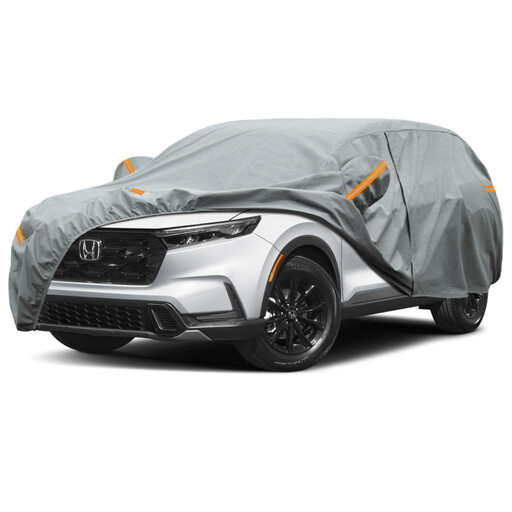
Why this product fits the profile: For large SUVs with a length of 488 to 510 cm, this model offers a clearly defined vehicle assignment.
The description explicitly distinguishes this model from hatchbacks and saloons. This avoids a common misorder with SUV covers.
Five-layer construction with a stated grammage of 180 g/m², soft inner layer, elastic hem and three windproof straps.

Why this product fits the profile: This padded cover is aimed at owners of saloons, coupés or convertibles who need an extra protective layer when hail is forecast.
The product description mentions 5 mm EVA composite material and distinguishes the cover from SUV models. The stated hail speed is manufacturer data and not a general protection guarantee.
Padded protective surface, three windproof straps, reflective elements and ventilated side areas.
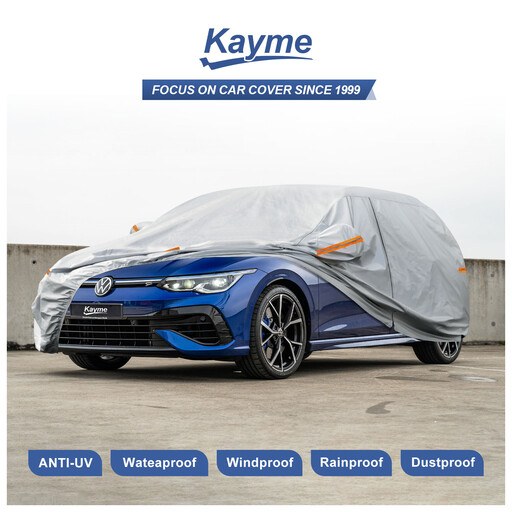
Why this product fits the profile: This model is designed for hatchbacks with a length of 415 to 450 cm and features an integrated zip for access to the vehicle.
The vehicle shape and length range are clearly stated. Mirror pockets, straps and hem support a controlled fit rather than a loosely draped cover.
Multi-layer construction with PE and PEVA layers, UV-reflective aluminium layer, soft cotton inner surface and zip.
We have compiled a complete, regularly updated list of products that fully meet these strict selection criteria and the safety regulations in force in the EU.
Pull the elastic hem evenly over the bodywork and use all the straps, hooks or eyelets provided. Check that the cover does not rub against sharp edges. In stormy weather, the vehicle should ideally be parked under cover or the cover should be removed, unless the manufacturer specifies otherwise.
The lifespan depends on the material, UV exposure, wind, cleaning and folding. A cover should be stored dry and clean. Damaged seams, brittle coatings or loose fastening points are signs that the cover needs replacing.
For short-term use, it may be possible depending on the product. For longer periods, a dry vehicle is preferable because trapped moisture can only escape slowly under the cover. Information about ventilation and care in the respective product description should be followed.