
Lieferung heute & morgen

Qualitätsgarantie

Willkommens-Angebote freischalten: KOSTENLOSE Lieferung | Bis zu 80 % RABATT | Kostenlose 30-Tage-JoyPlus-Testphase
App herunterladen
As a car owner without a garage or carport, you know the challenges: bird droppings eating into the paint, resin spots that are nearly impossible to remove, and the constant scraping of ice in the winter. A car cover seems like the obvious solution. However, the market is confusing, and many products don't live up to their promises. Before you make a decision, you should be aware of the typical pitfalls that can lead to a bad purchase.
The 3 Most Common Mistakes When Buying a Car Cover:
A good all-season cover must do more than just cover the car. It is a sophisticated protection system tailored to specific parameters.
To preserve the value and appearance of your vehicle long-term, you should focus on three central criteria during your selection. These determine the cover's durability, protective effect, and ease of use.
The material is the heart of any car cover. Simple, single-layer tarps made of PEVA offer basic protection, but for reliable all-season use, multi-layer systems are often the better choice.
A material designed to be breathable or integrated ventilation openings are crucial to prevent moisture build-up.
A universal size rarely fits perfectly. The cover should be designed specifically for your vehicle type (e.g., sedan, SUV, estate) and its length.
The choice between a full cover and a half cover depends on your individual needs.
To help you with your selection, we have compiled a few models based on different use cases and the criteria mentioned above.
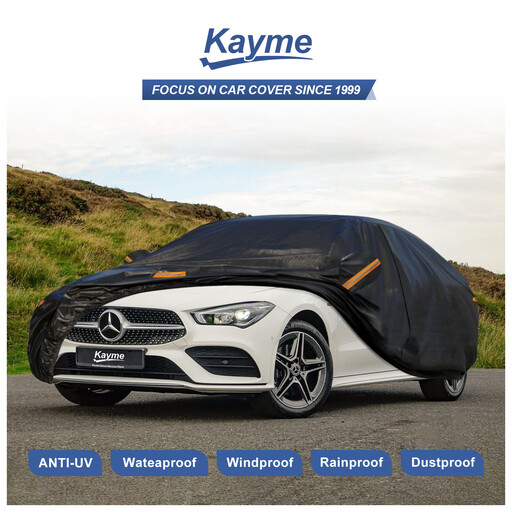
Why This Fits Their Persona: Ideal for sedan owners who park their vehicle outdoors year-round and need robust, durable protection from all weather conditions like snow, rain, and intense sun.
The 7-layer construction with a soft cotton inner lining actively protects the paint from scratches, while the outer layer is advertised as fully waterproof, not just water-resistant.
Robust 7-Layer Design: Offers protection against extreme temperatures and weather. Three Storm Straps: Ensure a secure hold even in high winds.

Why This Fits Their Persona: Specifically designed for the dimensions and height of SUVs. It provides a tailored solution for owners of models like the Nissan Qashqai or VW Tiguan who are looking for a straightforward and effective protective solution.
The vehicle-specific fit and elastic hem minimise chafing on the paint. Three storm straps (front, middle, rear) prevent the cover from lifting off in the wind.
SUV-Specific Fit: Prevents loose spots and ensures an optimal fit. Reflective Strips: Increase the visibility of the parked vehicle at night.

Why This Fits Their Persona: For car owners in regions with a high risk of hail who are looking for a specialised solution to protect against dents and paint damage. The focus here is clearly on shock absorption.
Unlike standard tarps that only protect against dirt, this model offers a genuine cushioning function thanks to a 5 mm thick EVA composite fabric. Ventilation openings also counteract the formation of condensation.
Specialised Hail Protection: The 5 mm thick padding material dampens the impact of hailstones. Extended Protection Area: Protects not only the roof but also the side and rear windows.
We've compiled a complete, up-to-date list of products that fully meet these strict selection criteria.
Yes, a car cover can cause scratches if it is not selected or used correctly. The main causes are a rough inner surface of the cover or a poor fit. If the cover is too loose, it can rub against the paint surface in the wind and leave fine scratches (so-called scuff marks). Therefore, always look for a soft, paint-friendly inner layer (e.g., made of cotton or microfleece) and a snug size with secure storm straps.
The correct size is crucial for the protective effect. Do not rely on general statements like "fits compact cars." The most precise method is:
Not necessarily. The choice depends on your intended use. While a multi-layer all-season cover offers the most comprehensive protection, it is also heavier and more cumbersome to handle. If you only want to protect your car overnight from frost on the windows or from heat in the summer, a lighter and quicker-to-install half cover may be the more practical and cost-effective solution. However, for the long-term protection of a vehicle parked outdoors, a high-quality, multi-layer full cover is usually the more sensible investment.