
Lieferung heute & morgen

Qualitätsgarantie

Willkommens-Angebote freischalten: KOSTENLOSE Lieferung | Bis zu 80 % RABATT | Kostenlose 30-Tage-JoyPlus-Testphase
App herunterladen
A car jack is part of the basic equipment for many car owners, DIY enthusiasts and workshops. Even so, buying mistakes often lead to unnecessary costs: a model does not fit beneath the vehicle, the stated lifting capacity is misinterpreted or the ease of use does not match the intended application.
Three common buying misconceptions are particularly important:
First, check the permissible gross vehicle weight in the vehicle documents. When lifting a single axle or one side of the vehicle, the full vehicle weight is not placed on the jack. Nevertheless, the stated lifting capacity should not be calculated too closely.
A 3-tonne car jack is often suitable for cars, pick-ups and many SUVs, depending on its design and the jacking point. For heavier vehicles, models with a 5-tonne car jack or more may be suitable. However, a hydraulic bottle jack with a high lifting capacity is not automatically suitable for every vehicle: its minimum height and small lifting saddle must match the chassis.
For light commercial vehicles, large pick-ups and heavy SUVs, you should also check:
The minimum height determines whether the car jack will fit beneath the vehicle at all. Lowered vehicles and sports cars often require an especially low-profile design. A trolley jack with a low entry height may be more practical here than a tall bottle jack.
For vehicles with greater ground clearance, the lifting height is what matters. On SUVs and light commercial vehicles, the jack should be able to reach the intended jacking point sufficiently. A lifting range that is too short may mean that the wheel does not clear the ground even when the jack is fully extended.
For this reason, pay attention to the complete range, such as 85 to 380 mm, 140 to 450 mm or 155 to 450 mm. The specifications should be verifiable not only on the product page, but also in the operating instructions.
The design affects the space required, ease of use and operating environment:
Regardless of the design, the following applies to maintenance work: the vehicle must not be supported solely by the car jack. After lifting, suitable axle stands should be used. Never work beneath a vehicle that is supported only by a hydraulic or electric jack.
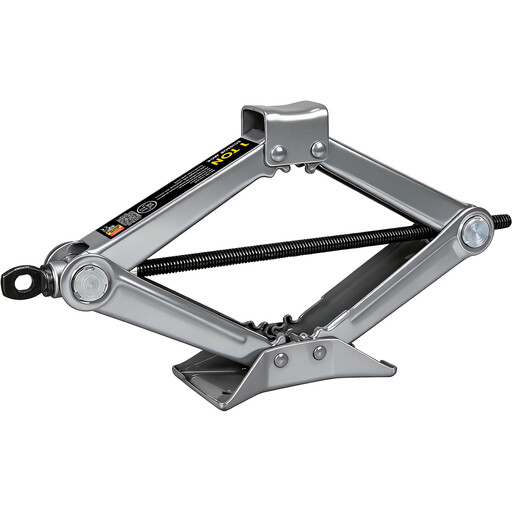
Why this product suits this profile: The folding scissor jack is designed for emergency tyre changes on saloons, city SUVs and vehicles with low ground clearance.
The minimum height of 88 mm is clearly stated. This allows you to check in advance whether the jack will fit beneath the intended jacking point.
Lifting capacity of 1,000 kg, lifting range of 88–380 mm, folding design and a widened non-slip base.
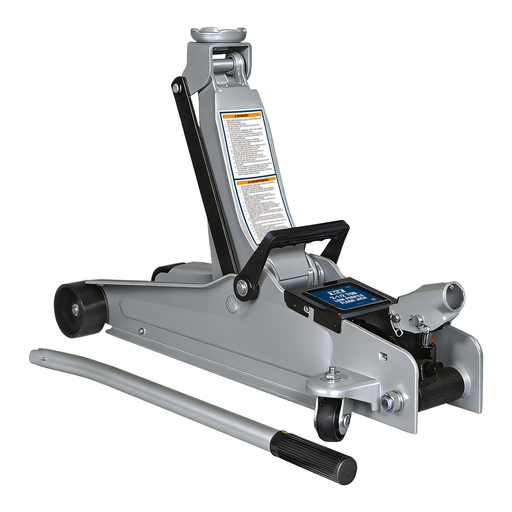
Why this product suits this profile: The low-profile hydraulic design is aimed at owners of sports cars, lowered cars, saloons, SUVs and MPVs.
The entry height of 85 mm reduces the risk of choosing a jack that is too tall for a vehicle with low ground clearance.
2.5-tonne lifting capacity, lifting range of 85–380 mm, steel construction, and stated compliance with EN 1494 and CE certification.
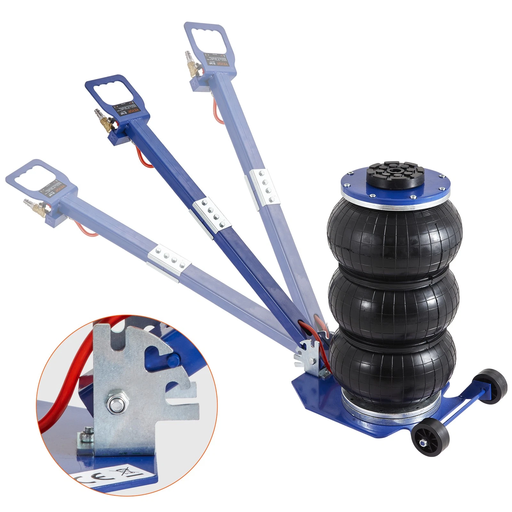
Why this product suits this profile: For workshops, breakdown services and users with a compressor, an air bag jack can be an alternative to purely mechanical systems.
The required connection to an air compressor must be taken into account. This prevents the power source from being confused with an integrated pump.
Lifting capacity of 3 tonnes and lifting height of 140–450 mm; according to the product description, it is intended for cars, pick-ups and SUVs.
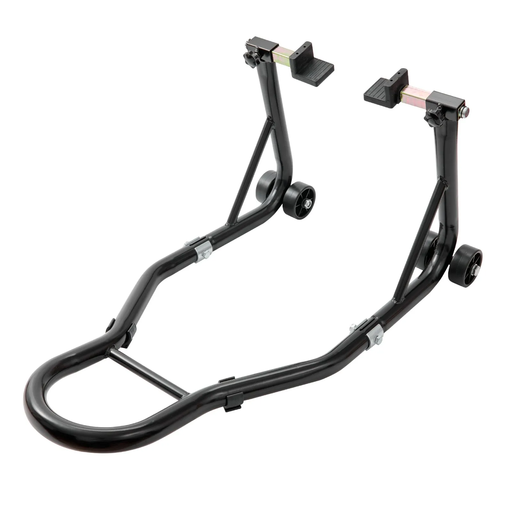
Why this product suits this profile: The rear-wheel motorcycle stand is designed for cleaning, chain care and maintenance work on motorcycles.
U- and L-fork adapters allow adjustment for different rear-wheel designs. Before buying, check the motorcycle’s swingarm and the shape of its contact points.
Stated lifting capacity of 385 kg and two adapter types; the design is intended for lifting the rear wheel.
We have compiled a complete, regularly updated list of products that fully meet these strict selection criteria and the safety regulations applicable in the EU.
Before placing your order and before every use, check the following:
The lifting capacity should exceed the actual vehicle weight or the load acting at the jacking point. For many cars and smaller SUVs, a model with a capacity of 2 to 3 tonnes may be sufficient. Heavier SUVs, pick-ups and light commercial vehicles benefit from a greater safety margin. The vehicle specifications, jacking point and manufacturer’s information remain decisive.
An electric car jack can reduce the effort required, but it needs a working power source. Models for 12-volt connections therefore depend on the vehicle battery, socket and cable length. For longer repairs in the garage, a hydraulic or electric car jack is intended to be used only together with suitable axle stands.
Service life depends on the load capacity, frequency of use, storage and maintenance. Hydraulic models should be stored in a dry, clean place and checked for oil leaks. Mechanical scissor jacks require a clean, smooth-running threaded spindle. Overloading, uneven ground and using the jack as a permanent vehicle support can significantly increase wear.