
Lieferung heute & morgen

Qualitätsgarantie

Willkommens-Angebote freischalten: KOSTENLOSE Lieferung | Bis zu 80 % RABATT | Kostenlose 30-Tage-JoyPlus-Testphase
App herunterladen
A car jack shouldn’t be chosen based solely on the lowest price or the highest lifting capacity. What really matters is whether the design, lifting height and lifting point are compatible with your vehicle. A scissor jack for a saloon has different requirements to a hydraulic jack for an SUV, or a lifting tool for a motorcycle and ATV.
Three common buying pitfalls crop up time and again:
For a jack for an SUV, van or larger estate car, the lifting capacity should have a sufficient safety margin over the actual vehicle weight. Although only part of the vehicle’s weight is lifted for a one-off tyre change, you still need to consider the lifting point, ground surface and load distribution.
The figures should be clearly stated in kilograms or tonnes. A 1-tonne scissor jack may be suitable for certain saloons and emergency use, while for larger vehicles a model with 2 or 3 tonnes could be more appropriate. Always refer to your vehicle’s handbook and the jack manufacturer’s specifications.
The lifting range consists of:
For a jack for a sports car or lowered vehicle, a low entry height is essential. The TCE 1-tonne model offers a range of 88 to 380 mm. This collapsible jack is therefore designed for a low starting height. The TCE 2-tonne scissor jack, according to the product details, works from 120 to 395 mm.
Before buying, measure the distance from the ground to the lifting point specified by your vehicle manufacturer. Don’t use the sill trim or random suspension parts.
A scissor jack is compact and can be stored in the boot. A hydraulic jack usually offers more comfortable operation and is better suited to a garage or workshop. An electric jack can save time and effort during an emergency tyre change, but it needs a suitable 12-volt power supply and should be used on a dry, stable surface.
Also look out for:
The EN 1494 and CE markings are listed in the product data for the TCE aluminium hydraulic jack. However, a marking doesn’t replace the need to check whether the lifting capacity and design are suitable for your own vehicle.
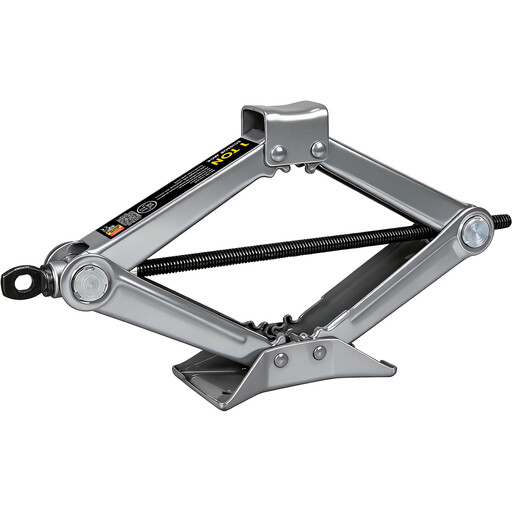
Why this product fits the profile: This compact scissor jack is intended for selected saloons, city SUVs and emergency tyre changes. Its collapsible design makes it easy to store in the boot.
The minimum lifting height of 88 mm reduces the risk that the jack can’t be positioned under vehicles with low ground clearance. The lifting capacity is stated as 1,000 kg and must be checked against your own vehicle.
Lifting range 88–380 mm; foldable design; widened non-slip base and spindle drive according to the product description.
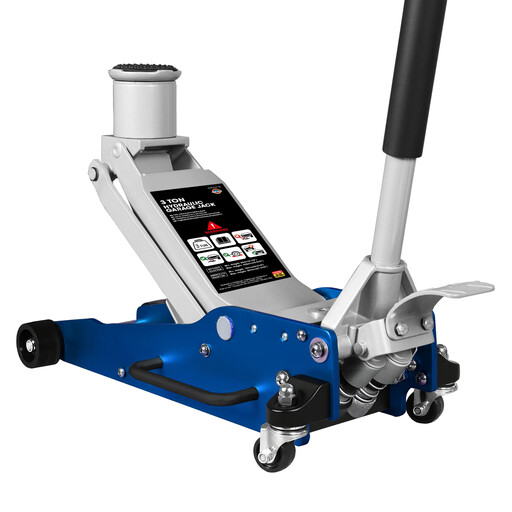
Why this product fits the profile: This hydraulic jack is aimed at users who regularly work on SUVs, MPVs, vans or vehicles with low ground clearance.
The stated entry height of 85 mm addresses the typical fitment issue with sports cars and lowered vehicles. The included height extension increases the range to up to 541 mm according to the data.
3 tonnes lifting capacity; lifting range 85–465 mm or 161–541 mm with extension; EN 1494 and CE according to the product information.
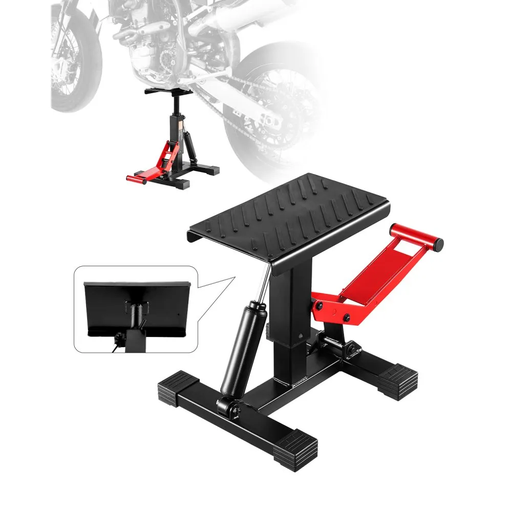
Why this product fits the profile: This motorcycle lift is designed for motorcycles and ATVs, covering a use case for which a classic car jack isn’t built.
The clearly stated target audience prevents a common misuse: using a car lifting tool for a two-wheeled vehicle. Before use, you must check the standing surface, centre of gravity and mounting of your particular vehicle.
Hydraulic design; stated lifting capacity 544 kg; lifting range 250–465 mm.
An electric jack with a 12-volt connection could appeal to drivers who want to do as little cranking as possible when changing a tyre. The VEVOR model, according to its product name, is designed for 3 tonnes or 2,993.7 kg and comes with a remote control. Before buying, check the connection, cable length, fuse and available space in your vehicle.
For occasional emergencies, a mechanical scissor jack can be easier to store. A hydraulic jack, on the other hand, is usually more practical for regular work in a garage or workshop, but it needs more storage space and a level surface.
We’ve put together a full, regularly updated list of products that fully meet these strict selection criteria and the safety regulations in force in the EU.
That depends on the vehicle’s weight, lifting point and required lifting height. For many SUVs, models from 2 tonnes upwards are suitable; however, you must check the specific lifting capacity against your vehicle manufacturer’s specifications. For a taller vehicle, a larger lifting range or a height extension may be necessary.
It’s impossible to give a general lifespan. Clean, dry storage, regular visual inspections and adherence to the permitted lifting capacity all affect how long it will last. If the mechanism is bent, there’s oil leakage, cracks appear or operation becomes stiff, the jack should no longer be used.
No. A moving dolly or wheel dolly is designed for shifting and positioning a vehicle. For changing a tyre or working on the suspension, you need a suitable jack. The two tools serve different purposes and must not be combined without the appropriate manufacturer approval.