
Lieferung heute & morgen

Qualitätsgarantie

Willkommens-Angebote freischalten: KOSTENLOSE Lieferung | Bis zu 80 % RABATT | Kostenlose 30-Tage-JoyPlus-Testphase
App herunterladen
A dead car battery or a flat tyre always happens at the worst time – usually early in the morning on the way to work or at night in a deserted location. A multifunctional car jump starter with air compressor promises a quick, independent solution. But the market is flooded with devices making grandiose promises. Many drivers invest in a supposed all-in-one device, only to find it's useless in an actual emergency.
As your Joybuy Product Recommendation Officer, I'll help you recognise the typical marketing traps and make an informed decision. We'll focus on the facts that truly matter.
Before you spend any money, you should be aware of the three most common issues that can turn a seemingly good deal into a costly mistake:
To avoid falling into these traps, you should check three core technical features. These define whether a jump starter is a reliable investment or a useless gimmick.
Ignore the pure marketing numbers for a moment. The crucial factor is the combination of peak current and its suitability for your specific engine. A rule of thumb is:
A good device will clearly state the maximum engine displacement sizes (in litres) it is designed for, for both petrol and diesel engines.
A high maximum pressure of 150 PSI is useless if the compressor has a low airflow rate (measured in litres per minute, L/min). A powerful compressor should deliver at least 35 L/min. This ensures that a standard car tyre (e.g., from 2.0 to 2.5 bar) is inflated in a few minutes, not half an hour. Also, look for an automatic shut-off function when the target pressure is reached – this prevents over-inflation and protects the device.
The capacity of the internal battery, given in milliampere-hours (mAh), determines how many start attempts are possible or how many times you can charge your smartphone. A capacity of over 10,000 mAh is a good benchmark. Modern devices act as versatile jump starter power bank and should have modern ports. A USB-C PD (Power Delivery) port is particularly valuable, as it allows for both fast charging of the jump starter itself and rapid charging of laptops or tablets.
Here are two recommendations based on objective performance data, suitable for specific user profiles.
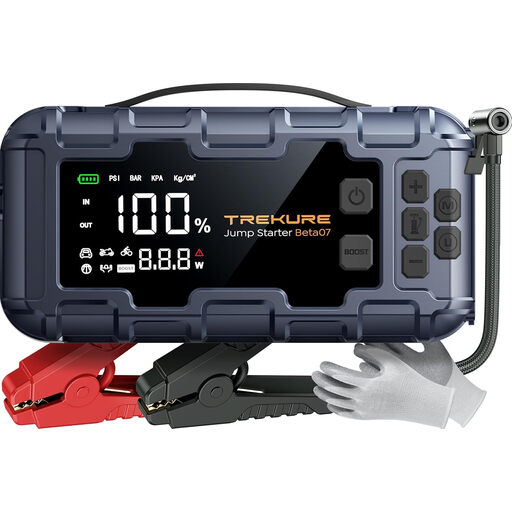
Why This Fits Their Persona: Ideal for owners of SUVs, vans, or large-displacement diesel cars. The high starting power provides the necessary reserves even in cold temperatures, while the powerful compressor quickly inflates even large tyres.
Counters the "exaggerated amp rating" trap with proven suitability for engines up to 12L displacement. The compressor bypasses the "weak pump" trap with a specified airflow rate of 45 L/min.
High Starting Power: 6000A peak current for reliable starts.
Efficient Compressor: 160 PSI and 45 L/min for fast inflation.
Fast Charging: 45W PD USB-C input and output.
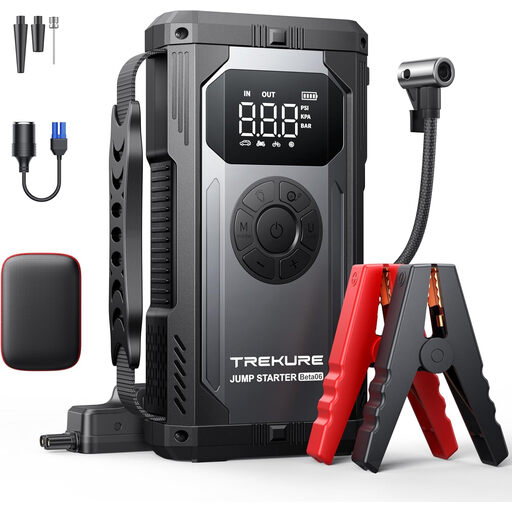
Why This Fits Their Persona: Perfect for commuters and outdoor enthusiasts looking for a versatile car emergency kit. The high power is sufficient for almost all passenger cars, while the 12V cigarette lighter output allows for operating cool boxes or other devices during camping.
Addresses the "missing safety" trap with a 10-fold protection system, including reverse polarity detection. The clear LCD display provides transparency about battery level and pressure, instead of leaving the user in the dark.
High Versatility: Additional 12V DC output for car accessories.
Comprehensive Safety: Smart chip with 10 protection functions.
Good Performance: 5500A peak current and 150 PSI compressor.
We have compiled a complete, up-to-date list of products that fully meet these strict selection criteria and UK safety regulations.
1. How often do I need to charge a jump starter with a compressor? Even when not in use, the battery slowly self-discharges. It is recommended to fully charge the device every 3 to 6 months to ensure it is ready for an emergency. Most modern devices have a charge level indicator that shows you the current status.
2. Is it safe for a novice to operate such a device? Yes, high-quality models are designed for safe use by novices. The most important feature is reverse polarity protection. It prevents damage if you accidentally connect the red and black clamps to the wrong battery terminals. In this case, the device will emit a warning signal and interrupt the current flow. Nevertheless, you should read the manual carefully before the first use.
3. Can I use the integrated compressor to inflate a completely flat tyre? Technically yes, but that is not its primary purpose. A portable jump starter with a compressor is mainly intended for correcting tyre pressure or re-inflating a slowly leaking tyre to a drivable level. Inflating a completely flat tyre can take 10-20 minutes or longer, depending on the tyre size and compressor power, and will heavily drain the device's battery.