
Lieferung heute & morgen

Qualitätsgarantie
App herunterladen
Kategorien
A dead car battery is a common and unforeseen problem for vehicle owners. Instead of waiting for roadside assistance or needing a second vehicle for a jump-start, a modern jump starter offers a self-sufficient and quick solution. These compact devices, also known as Jump Starters or Battery Boosters, are designed to give a vehicle with a discharged 12V battery the necessary boost to start. Furthermore, many models integrate other useful features such as a power bank or a compressor, making them multi-functional tools for both emergencies and everyday use.
Choosing the right device depends on specific technical parameters that should be matched to your individual needs and vehicle type.
The peak current, measured in Amperes (A), is the critical metric for the performance of a portable jump starter. It indicates the maximum current the device can deliver in a short burst to start an engine.
Check the manufacturer's specifications for compatibility with the displacement (measured in litres) of your gasoline or diesel engine to ensure adequate performance.
The battery capacity, specified in milliampere-hours (mAh), determines how many start attempts are possible and how long the device can function as a jump starter with a power bank to charge external devices like smartphones or tablets. A higher capacity offers greater energy reserves. Many devices feature USB outputs (USB-A, USB-C) with various charging speeds.
An integrated LED light is a standard feature that proves invaluable during breakdowns in the dark. Look for different light modes such as a solid beam, strobe, or SOS signal.
Some multi-functional jump starters are also equipped with an air compressor. A jump starter with a compressor can not only start a vehicle but also correct tyre pressure. This is particularly useful for long journeys, camping trips, or in the event of sudden pressure loss. Key metrics here are the maximum pressure (in PSI) and the airflow rate (in litres per minute).
Modern 12V jump starters feature intelligent protection circuits to prevent user error and to protect both the user and the vehicle's electronics. Essential safety features include:
A robust, ideally water- and dust-resistant housing increases the device's durability and reliability under adverse conditions.
Based on an analysis of technical specifications and feature sets, we present a selection of recommended devices here.
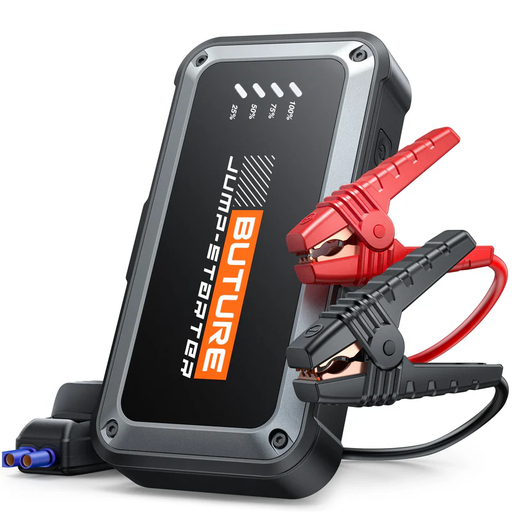
Why We Recommend This Product The BUTURE Beta08 combines a high 3000A peak current with a very compact and lightweight housing (0.370 kg). This combination makes it a powerful yet portable solution for a wide range of vehicles.
Pros
Who It's For This model is suitable for owners of vehicles with large-displacement engines, such as SUVs, pick-up trucks, or motorhomes, who are looking for a powerful yet easy-to-store device. Its multi-functionality also makes it a great choice for outdoor enthusiasts.
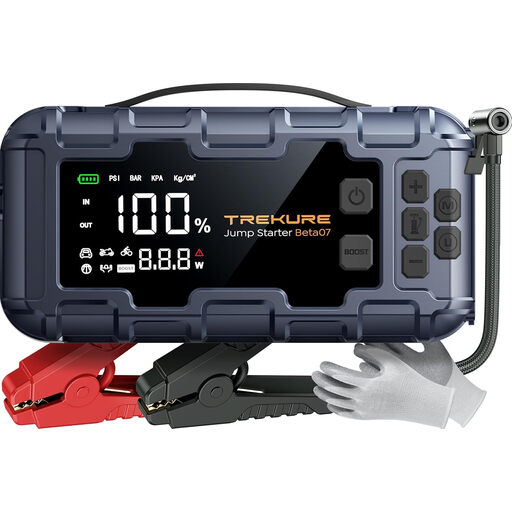
Why We Recommend This Product The TREKURE Beta07 is an all-in-one emergency tool. With an extremely high 6000A peak current and an integrated 160 PSI air compressor, it covers two of the most common breakdown causes: a dead battery and incorrect tyre pressure. The 3.3-inch display provides a clear overview of all functions.
Pros
Who It's For Ideal for drivers who prefer a comprehensive emergency kit in a single device. It is especially suited for long journeys, camping, and owners of large vehicles where both battery performance and tyre pressure need regular monitoring.
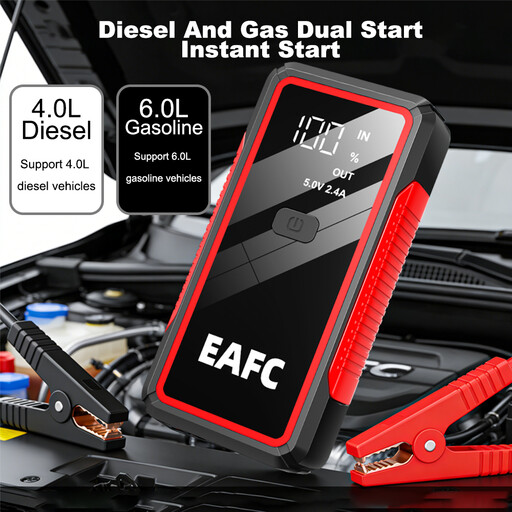
Why We Recommend This Product The EAFC model focuses on the core functionality of a jump starter, offering a solid 2000A peak current for most common cars and SUVs. Its wide operating temperature range and straightforward operation make it a reliable companion for everyday use.
Pros
Who It's For This device is a pragmatic choice for the average driver of a standard car, estate, or smaller SUV. It provides the necessary power for the most common emergency scenarios without complex additional features.
In addition to technical emergency equipment, it's also important to prepare for other eventualities on your travels. For collectors and those interested in special items of value, our range includes a selection of Banknotes.
1. How often does a jump starter need to be charged? Most manufacturers recommend fully charging the jump starter every 3 to 6 months, even if it hasn't been used. This ensures the internal battery maintains its capacity and is ready for an emergency.
2. Can a jump starter be used on any car? No, compatibility depends on the vehicle's required starting current. A Jump Starter must be able to deliver a peak current that is high enough for the engine (specifically its displacement and whether it's gasoline/diesel). Always check the jump starter's manufacturer specifications and compare them with your vehicle's requirements. The models presented here are designed for 12V electrical systems, which are standard in most cars, SUVs, and motorcycles.
3. What is the difference between peak current and cranking current? The peak current (Peak Amps) is the maximum amperage the device can discharge for a very brief moment (a few milliseconds). The cranking current (Cranking Amps) is the amperage the device can sustain over a longer period (several seconds) to turn the engine over. The peak current is often the prominently advertised figure, as it indicates the device's initial power.