
Lieferung heute & morgen

Qualitätsgarantie

Willkommens-Angebote freischalten: KOSTENLOSE Lieferung | Bis zu 80 % RABATT | Kostenlose 30-Tage-JoyPlus-Testphase
App herunterladen
A click, a stutter, then silence. A dead car battery is more than just an annoyance—it means lost time and an unexpected reliance on breakdown services, especially on cold mornings or in remote locations. A portable car jump starter offers an independent and fast solution. But the market can be confusing. This guide is designed to help you understand the technical features and make an informed decision that suits your vehicle and your needs.
As a Joybuy Product Recommendation Officer, my job is to provide you with objective information so you can find the right device for your requirements.
Before you decide on a model, there are several technical parameters to consider. These determine whether the device will function reliably in an emergency.
The peak current, measured in amperes (A), is the most crucial value for a jump starter's performance. It indicates how much energy the device can deliver in a short burst to start the engine. Larger engines, especially diesel engines, require a higher peak current than smaller petrol engines.
Always check the manufacturer's specifications for compatibility with the engine displacement (in litres) for petrol & diesel. Almost all modern devices are designed as 12V jump starters for standard cars, motorcycles, and RVs.
The battery technology used in a car battery booster affects its safety, longevity, and maintenance requirements.
Modern devices are often more than just a jump starter. Additional features can provide significant added value in a breakdown situation:
Here is a selection of devices with different specialisations, suitable for various user profiles.
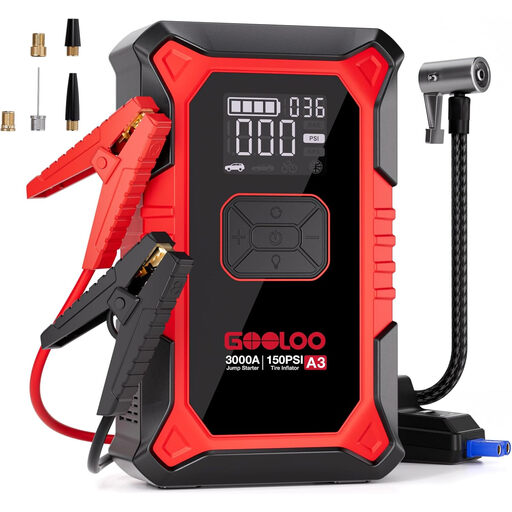
What sets it apart: The GOOLOO A3 is a multifunctional emergency tool. With a 3000 A peak current, it provides enough power for large engines (up to 9.0L petrol / 6.5L diesel). Its key feature is the integrated air compressor with a maximum pressure of 150 PSI and an airflow of 35 L/Min, controlled via a digital display with an auto-stop function.
Advantages:
Who is it for? For drivers of SUVs, larger cars, or RVs who are looking for an all-in-one solution for the most common breakdowns (dead battery, flat tyre) and who value ease of use.
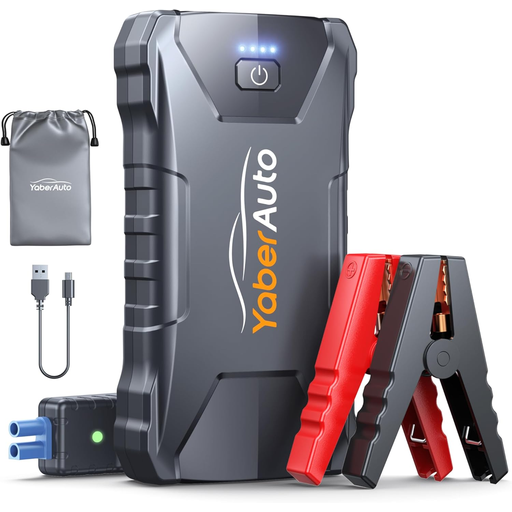
What sets it apart: The YaberAuto YA80 focuses on compactness and low weight. At just 0.340 kg and with very small dimensions, it fits easily into a glove compartment or even a motorcycle bag. Despite its size, it delivers a peak current of 2000 A, sufficient for most car engines up to 7.0L petrol or 5.5L diesel.
Advantages:
Who is it for? For commuters, motorcyclists, and car owners with limited storage space who need a reliable and discreet emergency jump starter without extra features like a compressor.
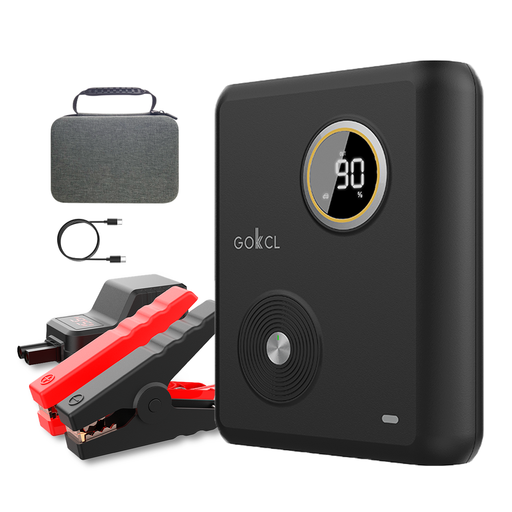
What sets it apart: The GOKKCL GK03 relies on an innovative sodium-ion battery. According to the manufacturer, this technology offers decisive advantages in terms of safety and longevity. It is stable in an extreme temperature range of -40°C to 80°C and is considered non-flammable. Particularly noteworthy is its stated standby time of up to 5 years per charge and a cycle life of over 6,000 charging cycles.
Advantages:
Who is it for? For users who place the highest priority on safety, longevity, and minimal maintenance. Ideal for people who store the device permanently in their vehicle and want to be able to rely on it even after a long time without recharging.
The models presented here cover common requirement profiles. If you haven't found the right device for your specific needs yet, there are other variants with different performance classes and feature sets.
Explore our entire selection of Instant Power Pack to find the perfect solution for your vehicle.
This largely depends on the battery technology used. Models with lithium-ion batteries should generally be fully charged every 3 to 6 months to maintain battery health. Devices with sodium-ion technology, like the GOKKCL GK03, have a significantly lower self-discharge rate and, according to the manufacturer, only need to be charged every few years. Always follow the manufacturer's specific recommendations.
Yes, many modern jump starters have a special "Boost" or "Force Start" function. This bypasses the standard safety checks and allows you to jump-start batteries with very low or no remaining voltage. The exact procedure can be found in the user manual of the respective device.
Most devices are designed for both engine types. However, the crucial factor is not the fuel type alone, but the required peak current, which depends on the engine's displacement. Due to their higher compression, diesel engines typically require a significantly higher cranking current than petrol engines of a comparable displacement. Therefore, always check the manufacturer's specifications for maximum engine displacement compatibility for petrol & diesel to ensure the device is sufficiently powerful for your vehicle.