
Lieferung heute & morgen

Qualitätsgarantie

Willkommens-Angebote freischalten: KOSTENLOSE Lieferung | Bis zu 80 % RABATT | Kostenlose 30-Tage-JoyPlus-Testphase
App herunterladen
A flat car battery or a tyre with low pressure can catch commuters, families and campers off guard. A car jump starter with compressor combines two practical functions: it can jump-start a suitable 12V vehicle battery and top up tyres on the go. Depending on the model, power bank and LED features may also be included.
However, high amp ratings or “150 PSI” alone do not automatically make for a suitable purchase. What matters is whether the device matches your engine, battery and actual usage profile.
Figures such as 1,500 A, 3,000 A or more usually refer to the maximum peak current. For selection, you also need to consider the engine size for petrol and diesel vehicles stated by the manufacturer. A device designed for petrol engines up to 4.0 litres is not automatically suitable for a larger diesel engine.
So check before you buy:
A 24V lorry or the high-voltage battery of an electric vehicle must never be connected to a standard 12V jump starter.
A 150 PSI tyre compressor may show a high maximum pressure, even though the actual airflow rate is more important for inflating a car tyre. Operating time also matters: many battery-powered car compressors can only run for a few minutes at a time and then need a cooling-off period.
Look out for:
The maximum pressure printed on the tyre sidewall is not automatically the recommended driving pressure. The figures from your vehicle manufacturer are what count – often found on the door pillar, fuel filler cap or in the owner’s manual.
A battery-powered jump starter should have a clear indicator for correct connection. Protection features against reverse polarity, short circuit, overcurrent, overheating and sparking are also useful. However, these features do not replace proper operation.
Do not use a car jump starter on a damaged, leaking or frozen battery. Check the polarity before attempting a start: Red goes to positive, black goes to negative or a suitable earth point, provided the instruction manual specifies this.
Don’t choose power based solely on the number on the packaging. For a small car, a compact car battery booster with the appropriate manufacturer approval is often sufficient. SUVs, vans, diesels or vehicles with larger engines generally need more reserve.
If you use it frequently in winter or when travelling, a model with a larger battery capacity can make sense. Capacity is given in mAh or Wh. These values cannot always be directly compared between devices, because voltage and internal cell configuration play a role.
Lithium batteries slowly lose charge even when not in use. Depending on the product specification, the car jump starter should be recharged every three to twelve months. After a jump-start attempt or using the compressor, it is advisable to recharge promptly.
USB-C and fast-charging functions shorten charging time, provided a compatible power adapter is used. Also check whether a power adapter is included in the box. For the EAFC model, for example, a USB charging cable is supplied but no wall charger.
An LCD display can show battery level, pressure unit and tyre pressure. Smart clamps on several models alert you to an incorrect connection. An LED light with constant, flashing and SOS modes is handy for breakdowns at night, but should not be considered a replacement for professional warning and securing of the scene.
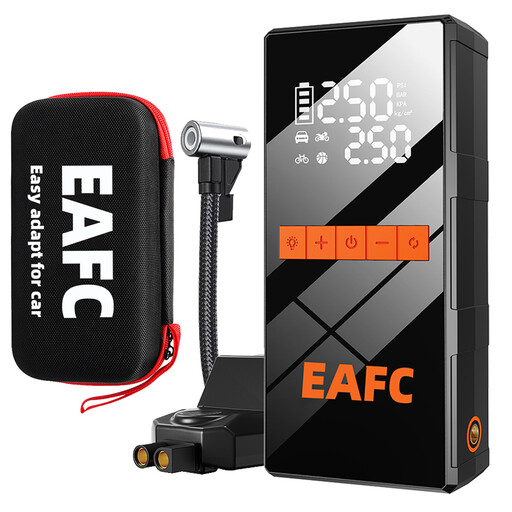
Why this product fits the profile: This compact 4-in-1 device combines jump starting, a tyre compressor, power bank and LED light. According to the product specifications, it is designed for petrol engines up to 4.0 litres and diesel engines up to 2.0 litres.
The specifications list both the peak current of 1,200 A and specific engine limits. The compressor has automatic shut-off and multiple pressure units.
8000 mAh battery capacity, 150 PSI maximum pressure and dimensions of 190 × 87 × 42 mm.
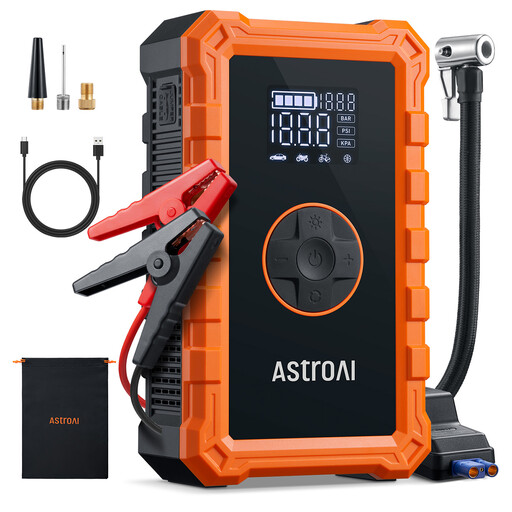
Why this product fits the profile: This model combines a 1500-A jump starter with a digital 150-PSI compressor and a 2.4-inch display. It is aimed at drivers who want to read measurements directly on the device.
The product specifications mention five preset modes, automatic shut-off and a recommended cooling-off period after compressor use.
According to the product description: 25 l/min airflow rate and inflation from 32 to 36 PSI in approximately one minute.

Why this product fits the profile: This device is interesting for users with an SUV, van, boat or frequent outdoor use. According to the product specifications, it supports petrol engines up to 9.0 litres and diesel engines up to 8.0 litres.
The manufacturer's specifications list ten protection features, five pressure modes and automatic shut-off of the compressor.
4500 A peak current, 150 PSI maximum pressure, LCD display and four supplied nozzles.
We have put together a complete, regularly updated list of products that fully meet these strict selection criteria and the safety regulations in force in the EU.
That depends on the engine type and capacity. What matters are the specific manufacturer specifications for petrol and diesel engines, not just the advertised peak current. For larger diesels, SUVs or vans, a higher power reserve makes sense.
That depends on the model. A battery-powered car compressor can top up a tyre on the road if there is a small pressure loss. However, pay attention to the airflow rate, operating time, cooling-off periods and the tyre pressure recommended by your vehicle manufacturer.
It is not possible to give a fixed lifespan in general terms. Frequent full discharging, heat and long storage without recharging all put strain on the lithium battery. Regular checks and recharging according to the manufacturer's instructions help keep your car emergency kit ready for use.