
Lieferung heute & morgen

Qualitätsgarantie

Willkommens-Angebote freischalten: KOSTENLOSE Lieferung | Bis zu 80 % RABATT | Kostenlose 30-Tage-JoyPlus-Testphase
App herunterladen
A dead car battery or a flat tire always happens at the worst possible time. A multifunctional car jump starter with a compressor promises a quick fix and independence from roadside assistance. But the market is flooded with devices boasting impressive numbers and bold claims. Many vehicle owners invest in a device that fails when they need it most. To make sure that doesn't happen to you, we'll show you what pitfalls to watch out for and which technical specifications truly matter.
Before you make a purchase, you should be aware of the common marketing tactics that often lead to a bad buy.
To find a suitable device that won't let you down, you should carefully examine three core areas.
Look for a clear statement on compatibility with gasoline and diesel engines (e.g., "for up to 8.0L gas and 6.0L diesel engines"). This information is often more practical than a simple amp rating. A 12V jump starter for a small car requires less power than one for an SUV or an RV. The peak current should serve as a guide, but suitability for your specific engine type is the deciding factor.
The battery capacity determines how many times you can jump-start your car or charge your devices. A capacity between 15,000 and 25,000 mAh is a good benchmark for most use cases. Also, check the charging features of the integrated car jump starter power bank. Modern devices offer USB-C ports with fast charging capabilities (e.g., Power Delivery, PD), allowing you to charge not only your smartphone but also laptops.
An integrated compressor, also known as a jump starter with an air pump, should be able to reach a pressure of at least 10 Bar (approx. 150 PSI) to inflate a car tire efficiently. Models with a digital pressure preset and an auto-shutoff function are particularly convenient. You set the target pressure, and the device stops automatically once it's reached. This prevents over-inflation and makes it easy to use.
Here are some recommendations tailored to different user profiles that avoid the pitfalls mentioned above.
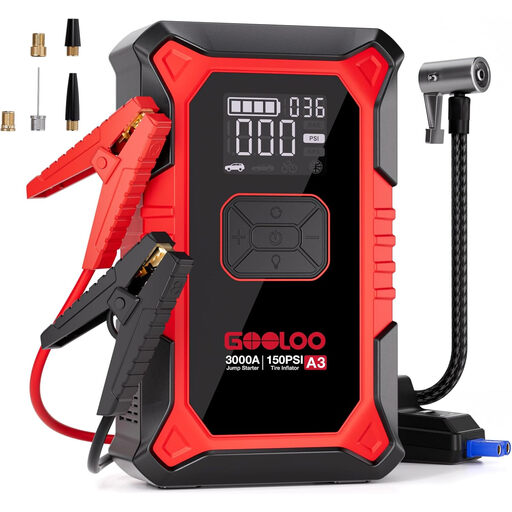
Why It's a Good Fit: Ideal for drivers of common gasoline and diesel vehicles who are looking for a reliable and easy-to-use all-in-one solution. The compressor's preset modes make inflating car and bicycle tires straightforward.
The manufacturer provides clear engine compatibilities (up to 9.0L Gas/6.5L Diesel), which are more practical than a simple peak amp rating. The 10 protection features cover all key safety aspects.
The compressor, with its 5 preset modes and auto-shutoff, offers great convenience. The "BOOST" button also allows for jump-starting very weak batteries.
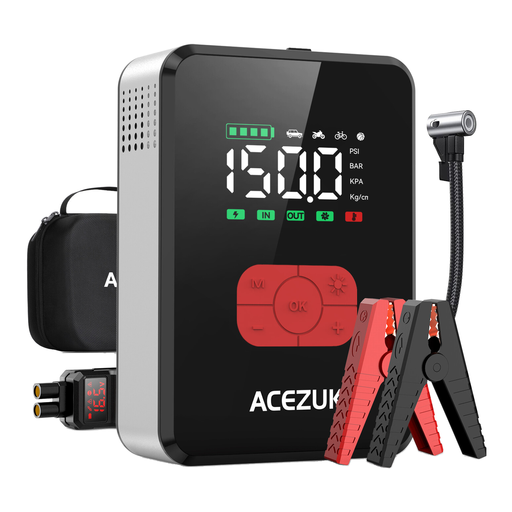
Why It's a Good Fit: Designed for owners of SUVs, vans, or vehicles with large-displacement diesel engines. Its high power and robust construction provide the necessary reserves for demanding jump-starts, even in cold weather.
This device bypasses the peak amp trap by specifying clear suitability for engines up to 12L. The smart clamps with their own display also actively prevent user errors.
The combination of 7000A peak current and 26800mAh capacity offers enormous power reserves. The patented clamp design with an integrated display ensures maximum user safety.
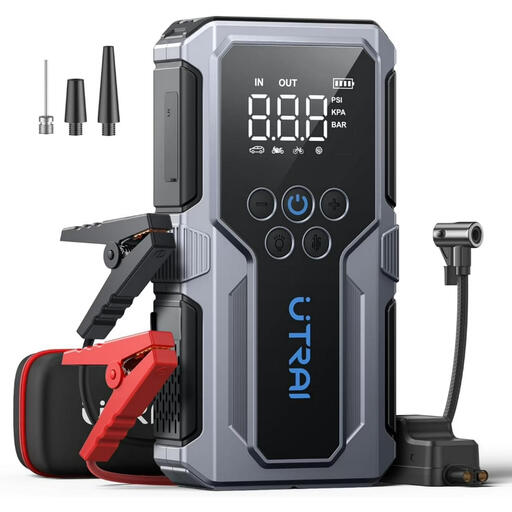
Why It's a Good Fit: Perfect for drivers of small to mid-size cars looking for a compact, lightweight device for the glove compartment. It combines all essential emergency functions without taking up much space.
Despite its compact size, the device offers comprehensive safety features and a clear LCD display that shows its status. The performance specs are realistic for its intended vehicle class (up to 8.5L Gas/6.5L Diesel).
Its low weight and compact dimensions make it extremely portable. The power bank's Quick Charge function is a practical bonus for on-the-go use.
We have compiled a complete, up-to-date list of products that fully meet these strict selection criteria and rigorous safety standards.
1. How often should I charge a jump starter? To maintain the battery's lifespan and ensure the device is ready in an emergency, it's recommended to fully charge it every 2 to 3 months, even if it hasn't been used. Most modern devices have low self-discharge, but regular maintenance is crucial for reliability.
2. Can I use a device like this to jump-start a completely dead battery? Many high-quality jump starters feature a "Boost" or "Override" function. This allows you to jump-start a battery whose voltage is so low that it's no longer automatically detected by the device's safety system. However, this function should be used with caution and exactly according to the manufacturer's instructions, as it bypasses some of the automatic protection mechanisms.
3. Is peak current the only important value for jump-starting? No. While peak current (Peak Amps) is often prominently advertised, other factors are just as important. These include the continuous starting current, the quality and capacity of the battery cells, the build quality of the jumper cables and clamps, and the reliability of the integrated protection circuits. A balanced combination of these features is crucial for an effective and safe device for jump-starting a car battery.