
Lieferung heute & morgen

Qualitätsgarantie

Willkommens-Angebote freischalten: KOSTENLOSE Lieferung | Bis zu 80 % RABATT | Kostenlose 30-Tage-JoyPlus-Testphase
App herunterladen
A flat car battery, low tyre pressure or a faulty charging cable can quickly become a practical problem when you're on the road. A car jump starter with compressor combines several functions in one portable device: car jump starter, tyre inflator, power bank for your car and an LED emergency light.
But not every specification on the packaging describes the actual value in use. If you only look at high amp ratings or the term "150 PSI", you could end up buying a device that doesn't suit your vehicle size, battery or intended use in everyday life.
Figures like 3,000 A or 4,500 A usually refer to the maximum peak current. This value alone doesn't tell you how many times a device can start your engine in succession, or which engine size it's suitable for. What also matters are:
A 12V jump starter isn't automatically suitable for every 12-volt vehicle either. You should always check the manufacturer's specifications for engine size and vehicle type against your own car, SUV, van, transporter or motorcycle.
The maximum pressure of a compressor is just a technical limit. For practical use, what also matters are airflow rate, hose length, valve connection, auto shut-off and operating duration. A compressor with 150 PSI can be suitable for car tyres, motorcycle tyres and bicycles, but may take longer with larger tyres.
The permitted operating time is also important. Several devices require a cooling break after prolonged compressor use. Your vehicle's recommended tyre pressures are in the owner's manual, on the B-pillar or inside the fuel filler flap – not on the device's casing.
A figure like 20,000 or 24,800 mAh describes the internal battery capacity under certain conditions. The actual usable energy can be lower due to voltage conversion, temperature and charging losses. For products with a power bank function, you should check:
For storage in the car, temperature guidelines are also relevant. Extreme heat, moisture and direct sunlight can affect a battery's lifespan.
For a petrol-engined car, a different performance profile is often needed depending on engine size compared to a diesel, SUV or transporter. The manufacturer's specifications should clearly state the suitable engine type and displacement. For motorcycles, a device with 12-volt support and suitable clamps makes sense; peak current shouldn't be the only selection criterion.
Look for intelligent safety features such as:
A battery booster doesn't replace repairing a faulty battery. If the battery is damaged, leaking or frozen, you should not attempt a jump start.
An integrated tyre inflator is particularly practical when the display shows the current pressure digitally and the device switches off automatically at the target value. Check whether the units PSI, bar and kPa are supported and whether adapters for bicycle valves or balls are included.
A 150 PSI compressor is sufficient for many mobile applications. For frequent inflation of several tyres, however, airflow rate, cable length and cooling times are more important than the maximum pressure.
A mobile car battery jump starter delivers short-term energy. A car battery charger, on the other hand, works from a mains socket and charges the battery in a controlled manner over a longer period. These devices are more suited to the garage, workshop or seasonal maintenance.
When choosing a charger, the battery type and capacity range must match. Models from the range support, depending on the version, AGM, GEL, EFB and conventional lead-acid batteries. The distinction between 6 V, 12 V and 24 V is also important. For continuous maintenance charging, automatic charging programmes and overcharge protection are relevant.
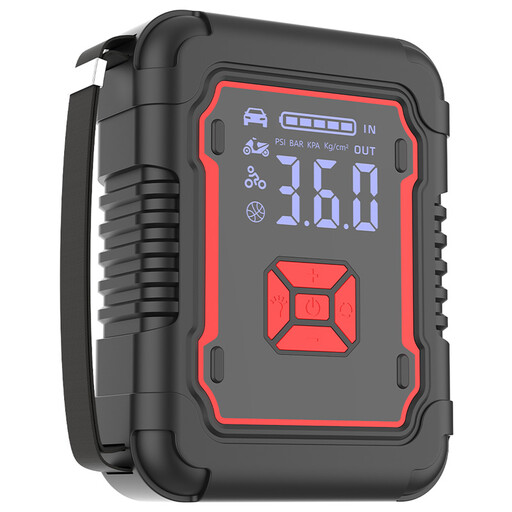
Why this product fits the profile: This device combines jump start, tyre compressor, power bank and LED light in a compact housing. It's rated at 3,000 A peak current, 20,000 mAh internal capacity and suitability for 12 V petrol and diesel vehicles.
The compressor's automatic shut-off helps maintain the preset tyre pressure. Suitability for vehicle types and engine types is clearly stated in the product data.
150 PSI maximum pressure, QC3.0 USB output and three LED modes. The weight is stated at approximately 800 g.

Why this product fits the profile: For users who prefer a clearly readable display and defined vehicle limits. According to the product specifications, this model is designed for petrol engines up to 8.0 l and diesel engines up to 6.0 l.
The engine size specifications are more concrete than an isolated peak current value. An LED display and multiple protection features support controlled operation.
3,000 A peak current, 65 W PD charging, 59.2 Wh energy rating and LED light with constant, SOS and strobe modes.
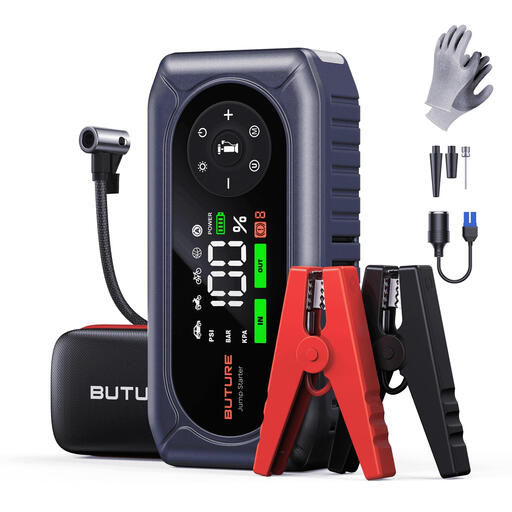
Why this product fits the profile: This model is aimed at drivers of cars, SUVs, trucks and motorcycles, as well as campers. It's rated at 4,500 A peak current and suitability up to 9.0 l petrol or 8.0 l diesel.
Five inflation modes, pressure units in PSI, bar and kPa, plus an auto shut-off make compressor use more controllable.
150 PSI, four nozzles, LCD display, 500-lumen LED and, according to the product specifications, ten protection features.
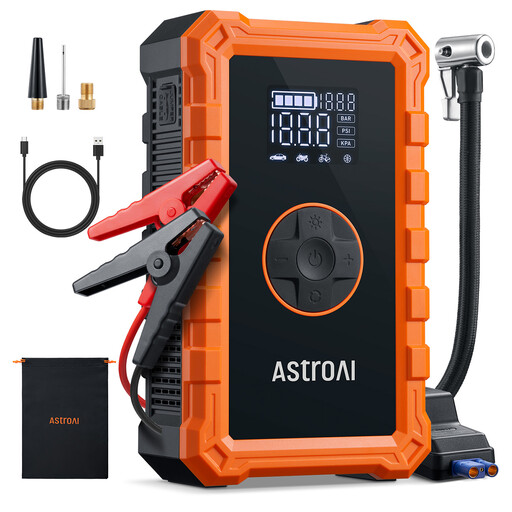
Why this product fits the profile: This device is designed for compact storage in the vehicle and, according to the product specifications, is intended for petrol engines up to 6.0 l and diesel engines up to 3.0 l.
The display shows the preset and current tyre pressure. The automatic shut-off reduces the risk of exceeding the target value when inflating.
150 PSI, five inflation modes, three pressure units and an integrated power bank function.
We've put together a complete, regularly updated list of products that fully meet these strict selection criteria and the safety regulations in force in the EU.
Switch off the vehicle and disconnect any unnecessary electrical consumers. Connect the red clamp to the positive terminal and the black clamp to the negative terminal or a suitable earthing point as per the instructions. Only then activate the start process. After a successful start, remove the clamps in the specified order. Jump starting is not permitted on damaged or frozen batteries.
The lifespan depends on the battery type, storage conditions, temperature and charging intervals. Many manufacturers recommend charging the device every three to six months and storing it in a cool, dry place. A power bank with an empty battery is not ready for jump starting. Check the charge level before longer journeys.
No. A battery booster delivers high energy briefly for the starting process. A car battery charger charges a vehicle battery in a controlled manner over a longer period and, depending on the model, is also suitable for maintenance charging. If you want to maintain your battery regularly, you should choose a suitable 12 V charger in addition to a mobile jump starter.